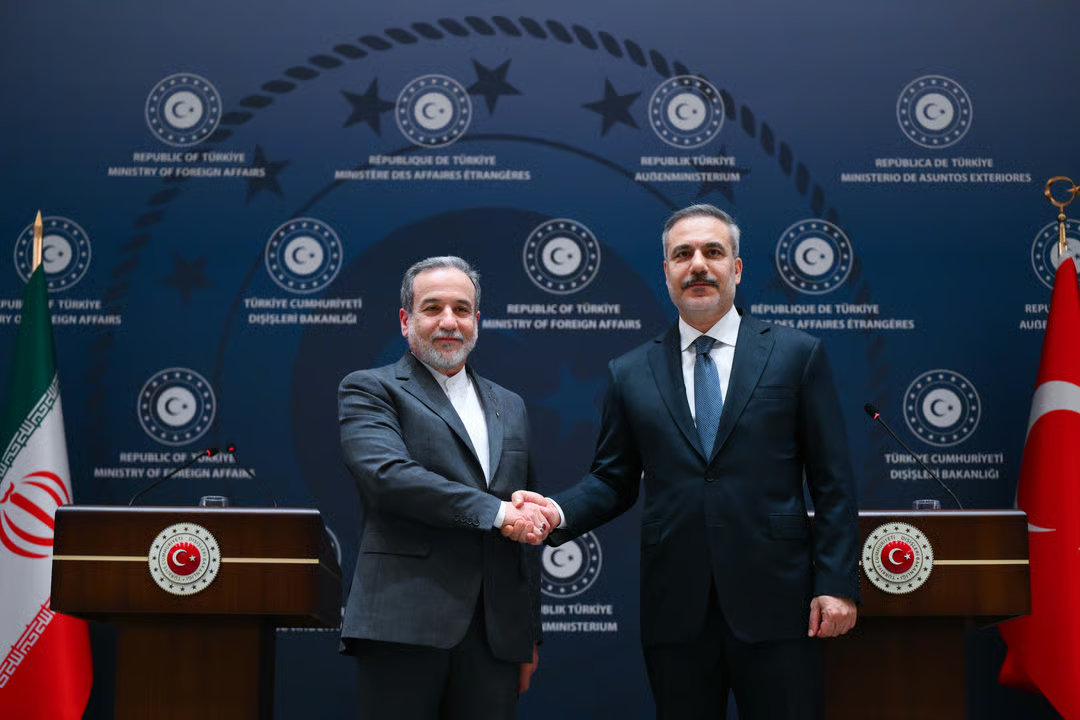
Istanbul Sets the Line: Türkiye and Iran Define the Limits of Escalation Amid Rising Regional Tensions
The meeting between the foreign ministers of Türkiye and Iran held in Istanbul on January 30 became a significant diplomatic moment against the backdrop of mounting instability across the Middle East. At a time marked by internal unrest in Iran, intensified external pressure, growing military risks, and increasingly confrontational rhetoric from several regional and global actors, Ankara and Tehran publicly articulated their positions in a notably coordinated manner, outlining both shared concerns and firm red lines.
Türkiye’s foreign minister stated that Ankara is closely monitoring developments in Iran and expressed deep sorrow over the loss of life during recent protests. He emphasized that Iran’s internal issues should be resolved peacefully by the Iranian people themselves, without any form of external interference. This message was framed not as a rhetorical gesture, but as a principled stance rooted in Türkiye’s broader regional security calculations.
A central element of Türkiye’s position was its categorical opposition to any military intervention against Iran. Ankara, according to the Turkish foreign minister, has consistently conveyed this view to all counterparts. Continued conflicts, he warned, create fertile ground for terrorism, mass migration, and widespread poverty, destabilizing not only the immediate conflict zone but the wider region as well. From Türkiye’s perspective, a military escalation involving Iran would trigger a chain reaction with direct consequences for regional security, economic stability, and social cohesion.
Particular attention was drawn to Israel’s role in the current escalation dynamic. Türkiye stated that it observes efforts aimed at persuading the United States to undertake military action against Iran, warning that such moves risk inflicting severe damage on the already fragile balance in the region. Ankara explicitly rejected all forms of regional expansionism, stressing that it does not accept Turkish, Arab, Persian, or Israeli expansionism alike. Israeli actions in Palestine, Lebanon, Syria, Iran, and Qatar were cited as evidence of a destabilizing regional posture that increases the likelihood of broader confrontation.
Iran’s foreign minister, for his part, presented Tehran’s position as firm yet formally open to diplomacy. He argued that many of the crises unfolding in the region are the result of illegitimate interventions by external powers and accused Israel of systematically seeking to weaken regional states through various schemes. According to Tehran, Israel’s intention to provoke war has never diminished and now represents a serious and growing danger to regional stability.
Reflecting on past interactions with Washington, the Iranian foreign minister stated that previous experience has demonstrated a lack of loyalty and good faith on the part of the United States. Nevertheless, he stressed that Iran remains ready to engage in diplomatic processes, provided that such engagement is legitimate, rational, fair, and respectful of Iran’s legal rights. He noted that the United States has repeatedly sought negotiations through intermediaries and continues to renew these requests. However, Iran made clear that negotiations cannot begin under threat. Any meaningful dialogue, Tehran insists, requires the abandonment of coercive pressure.
On matters of national security, Iran’s position was unequivocal. The Iranian foreign minister stated clearly that Iran’s missile program and defense systems will never be subject to negotiation. He also dismissed the effectiveness of military pressure, pointing out that previous strikes had failed to achieve their stated objectives. From Tehran’s standpoint, this demonstrates that a military approach is both ineffective and counterproductive.
The Iranian side also reaffirmed its support for Syria’s unity, territorial integrity, and stability, calling for an end to foreign occupation. Türkiye echoed the importance of stability in Syria, underlining its close attention to developments there and its support for efforts that contribute to integration and long-term stabilization.
A particularly sharp exchange concerned Europe’s stance toward Iran, especially regarding the designation of the Islamic Revolutionary Guard Corps. Iran’s foreign minister argued that without the Revolutionary Guards, the fight against terrorist organizations would not have succeeded and that Europe itself would have faced far greater security threats. He described the European Union’s policy as a grave mistake, one that Tehran believes will eventually be recognized as such. This position was reinforced by a statement from Iran’s national security leadership, which warned that, under a resolution passed by Iran’s parliament, the armed forces of countries involved in actions against the IRGC could themselves be designated as terrorist entities, with consequences borne by those states.
All of this unfolded against a wider backdrop of continued low-intensity confrontation. Reports of alleged covert operations against Iranian military assets and the controlled reopening of Gaza’s Rafah crossing illustrate the dual-track reality of the region: official calls for restraint and diplomacy coexist with ongoing clandestine and military activities that sustain tension beneath the surface.
Taken together, the Istanbul meeting did not signal a formal alliance, but rather a convergence of interests at a critical juncture. Türkiye seeks to prevent a regional collapse that would directly threaten its security and economic stability. Iran, under mounting pressure, signals readiness for diplomacy while drawing firm boundaries around sovereignty and defense. The statements made in Istanbul amount to a clear message: regional actors are attempting to impose political limits on escalation, even as external pressure and covert confrontation continue to intensify. In this sense, Istanbul emerged not merely as a venue for talks, but as a marker of where the line is being drawn between managed crisis and uncontrolled regional war.
Related Articles
Cyprus Defence Ministry Responds to Reports of Turkish Air-Defence Expansion in the North
31 January 2026
Read more
The Aegean Sea as a Zone of Managed Pressure. Turkey’s Rising Activity and Greece’s Strategic Response
24 January 2026
Read more
Northern Cyprus as a Zone of De Facto Integration
24 January 2026
Read more
Escalation in Rojava and the Hasakah Deal: What Happened in Northeastern Syria
21 January 2026
Read more