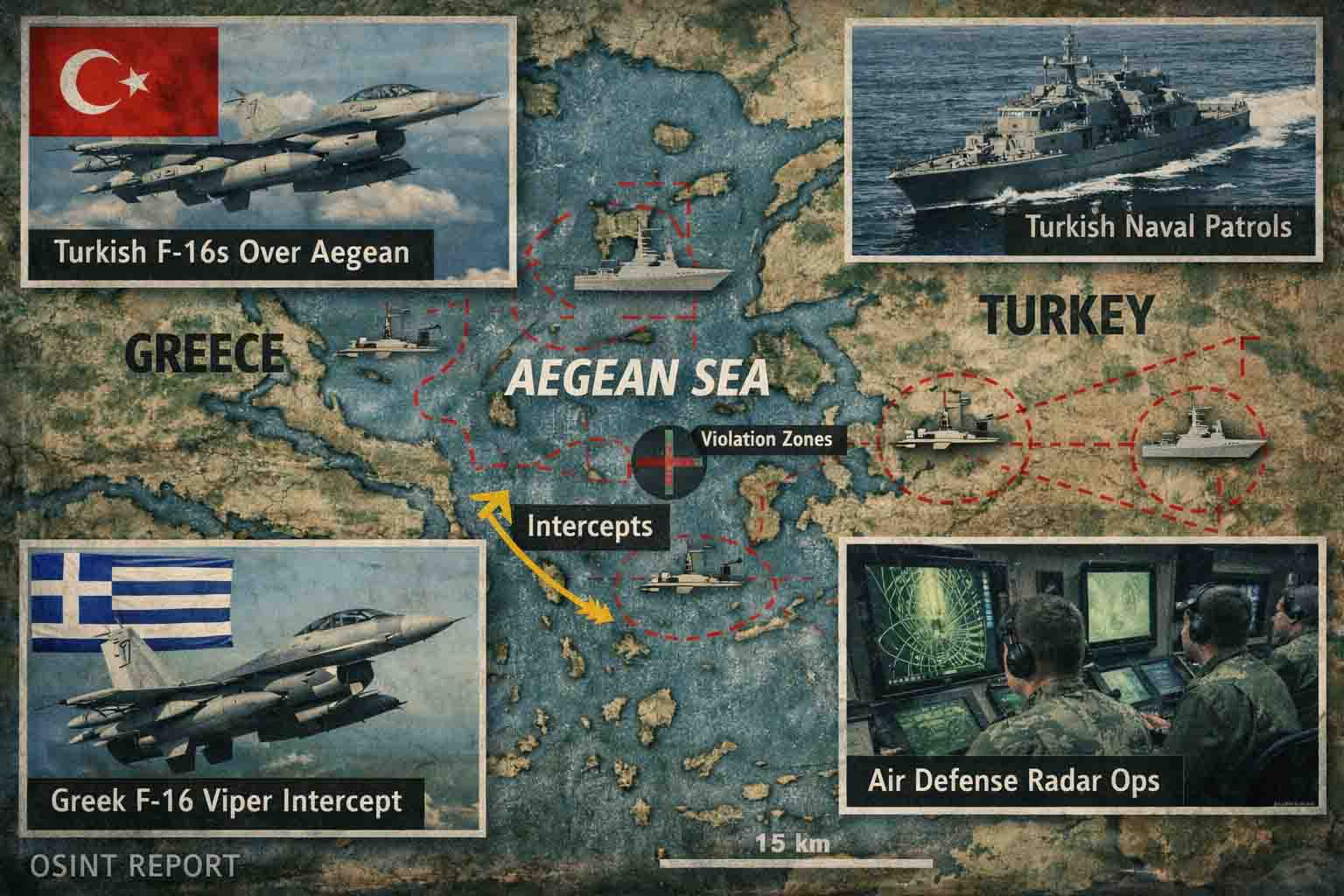
The Aegean Sea as a Zone of Managed Pressure. Turkey’s Rising Activity and Greece’s Strategic Response

In late 2025 and early 2026, the Aegean Sea once again emerged as one of the most sensitive fault lines in the Eastern Mediterranean. What is unfolding is not a sudden escalation, but a gradual and deliberate increase in Turkish military activity in the air and maritime domains, met by Greece through established and institutionalized deterrence procedures. The situation reflects a logic of managed pressure, in which both sides seek to advance their positions while formally avoiding red lines, continuously testing the limits of what is acceptable.
During December and January, multiple incidents were recorded in which Turkish military aircraft, including F-16 fighter jets, operated in areas that Athens considers part of its national airspace or the Athens FIR zone. Some of these flights were conducted without the submission of flight plans or prior notification, a practice that Greece views not merely as a technical breach but as a form of political and military pressure. In several cases, these were not isolated sorties but coordinated group entries involving escort and patrol aircraft, reinforcing the demonstrative nature of the actions.
Greece’s response has remained consistent and highly structured. In every such episode, the Hellenic Air Force scrambled fighter jets to intercept, identify, and escort the Turkish aircraft. Particular emphasis has been placed on the use of upgraded F-16s in the Viper configuration, which Athens increasingly sees as the backbone of its air deterrence posture. These intercepts are carried out in accordance with international rules, without attempts to provoke escalation, but with a clear intent to record presence and signal readiness to defend sovereignty.
For Greece, these actions are not ad hoc reactions. They are embedded in a broader strategy of military modernization and defense consolidation. The upgrading of the fighter fleet, reinforcement of air defense systems, and longer-term plans for further technological enhancement provide the strategic backdrop against which each interception becomes more than a tactical maneuver. It turns into part of a sustained policy aimed at containing Turkish assertiveness in the Aegean.
The deeper context goes well beyond individual flights or maneuvers. The Aegean Sea remains an area defined by unresolved disputes over maritime boundaries, airspace, and zones of responsibility. The dense geography of islands, the proximity of coastlines, and long-standing differences in the interpretation of international maritime and air law create a structural ambiguity that is routinely exploited as a political instrument. Turkey and Greece interpret territorial waters, airspace limits, and the status of certain areas in fundamentally different ways, turning each incident into a potential signal rather than a purely operational event.
From Ankara’s perspective, the increase in air and naval activity appears aimed at reaffirming its claims and demonstrating that Turkey does not accept a Greek-defined status quo in the Aegean. This posture also aligns with broader internal and external dynamics, including Turkey’s own military modernization efforts and its ambition to reinforce its regional role. For Turkey, sustained activity serves to keep disputed issues open and to prevent the gradual normalization of Greece’s legal and political interpretation of the Aegean framework.
Greece’s position, by contrast, is grounded in the prevention of incremental erosion of sovereign rights. Athens has consistently stated that it will not make territorial concessions and treats each violation as part of a broader pattern of systematic pressure. At the same time, Greece seeks to avoid actions that could be interpreted as deliberate provocation, limiting itself to symmetrical, legally grounded responses.
A defining feature of the current phase is that both countries are NATO members, which imposes clear constraints on the trajectory of escalation. This makes the Aegean a case study in intra-alliance rivalry, where military tools are employed in a calibrated manner under constant political oversight. The dynamic is not one of preparation for open conflict, but of competition over norms, interpretations, and physical presence.
In a wider perspective, the intensification of activity over the Aegean fits into the broader pattern of rising military and political competition in the Eastern Mediterranean. Energy routes, maritime security, and regional influence intersect in this space, turning the Aegean theater into one element of a much larger strategic mosaic. Local incidents thus carry significance beyond their immediate tactical context.
At present, the situation remains controlled but tense. The increasing frequency of incidents raises the risk of miscalculation or unintended escalation, even if neither side appears to seek such an outcome. This reality explains why firm rhetoric is paired with efforts to keep communication channels open.
In the end, the Aegean Sea continues to function as a zone of sustained pressure, where military activity serves as a language of politics. Turkey signals its readiness to challenge existing frameworks, while Greece demonstrates determination to defend them. For now, this interaction remains bounded, but its future trajectory will depend on whether both sides can maintain the delicate balance between power projection and recognition of mutual constraints.
Related Articles
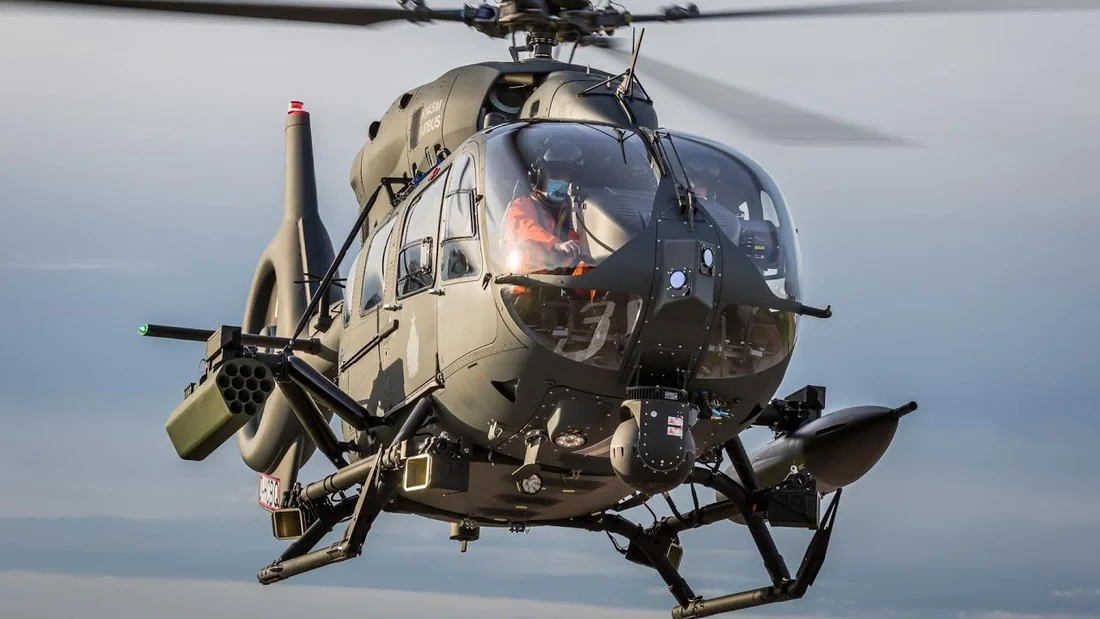
Cyprus Defence Ministry Responds to Reports of Turkish Air-Defence Expansion in the North
31 January 2026
Read more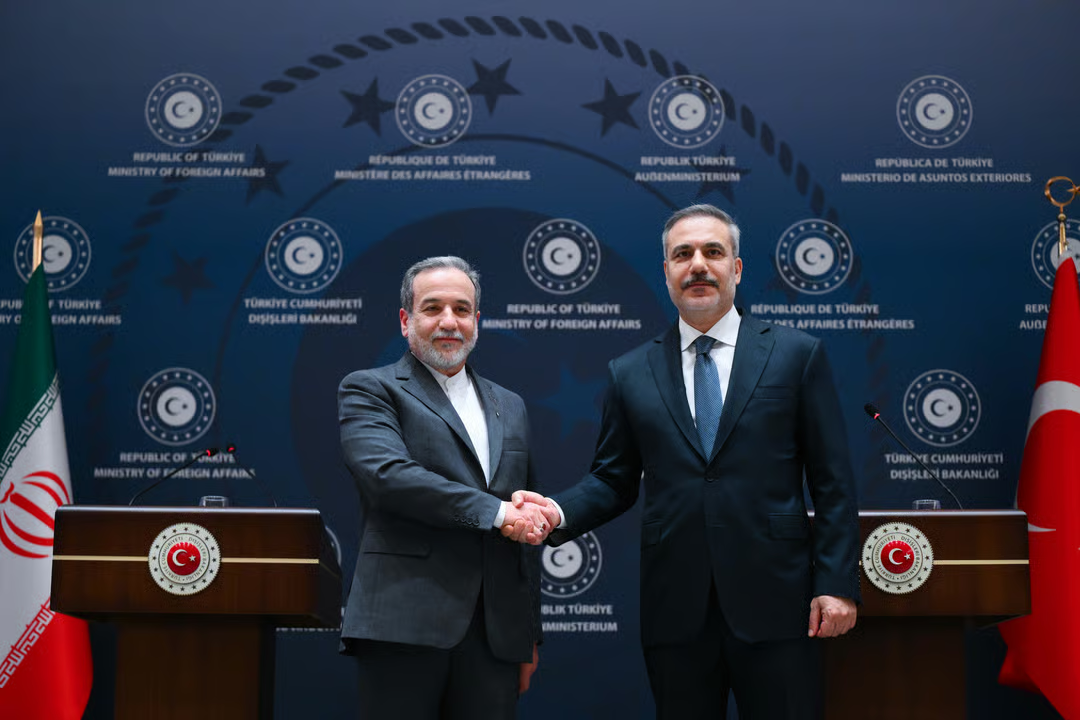
Istanbul Sets the Line: Türkiye and Iran Define the Limits of Escalation Amid Rising Regional Tensions
30 January 2026
Read more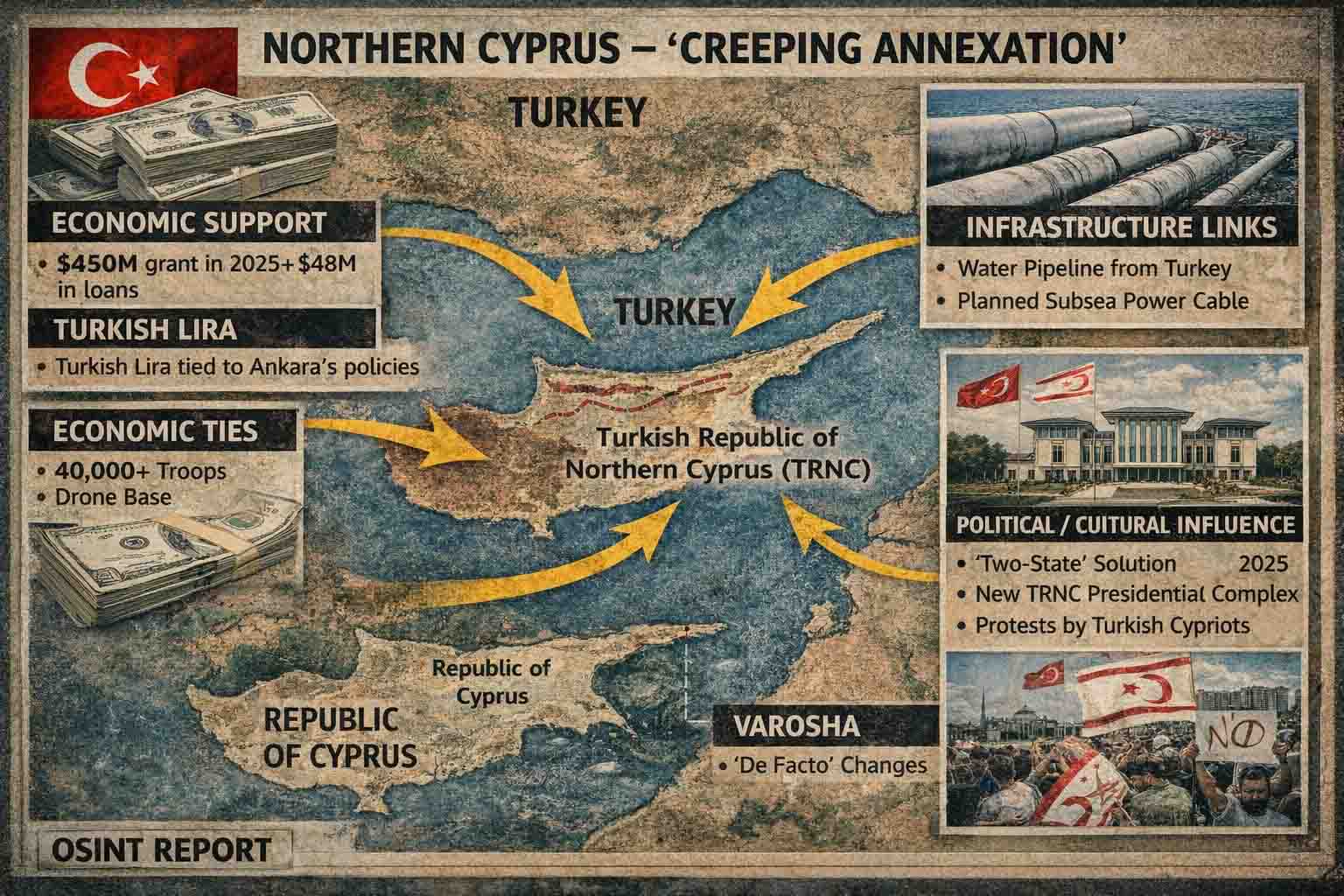
Northern Cyprus as a Zone of De Facto Integration
24 January 2026
Read more
Escalation in Rojava and the Hasakah Deal: What Happened in Northeastern Syria
21 January 2026
Read more