Russian Africa Corps Sustains Losses in Mali: Kidal as the Breaking Point of the War’s Entire Configuration

The situation in Mali is rapidly moving beyond the framework of a localized conflict and increasingly taking on the characteristics of a systemic crisis affecting not only отдельных regions but the very architecture of power in the country. What is unfolding can no longer be described as a routine escalation in the north or another cyclical surge of violence typical for the Sahel. It is a phase where multiple processes intersect simultaneously: military pressure, transformation of armed actors, erosion of external support, and a fundamental shift in the logic of control.
At the center of this transformation stands Kidal. For a long time, the city symbolized the restoration of state authority following previous operations, when Malian forces, backed by external partners, reasserted control over the north. That control was presented as a strategic achievement. Yet today, Kidal exposes the fragility of that model. What was once seen as consolidation now reveals itself as conditional and vulnerable under coordinated pressure.
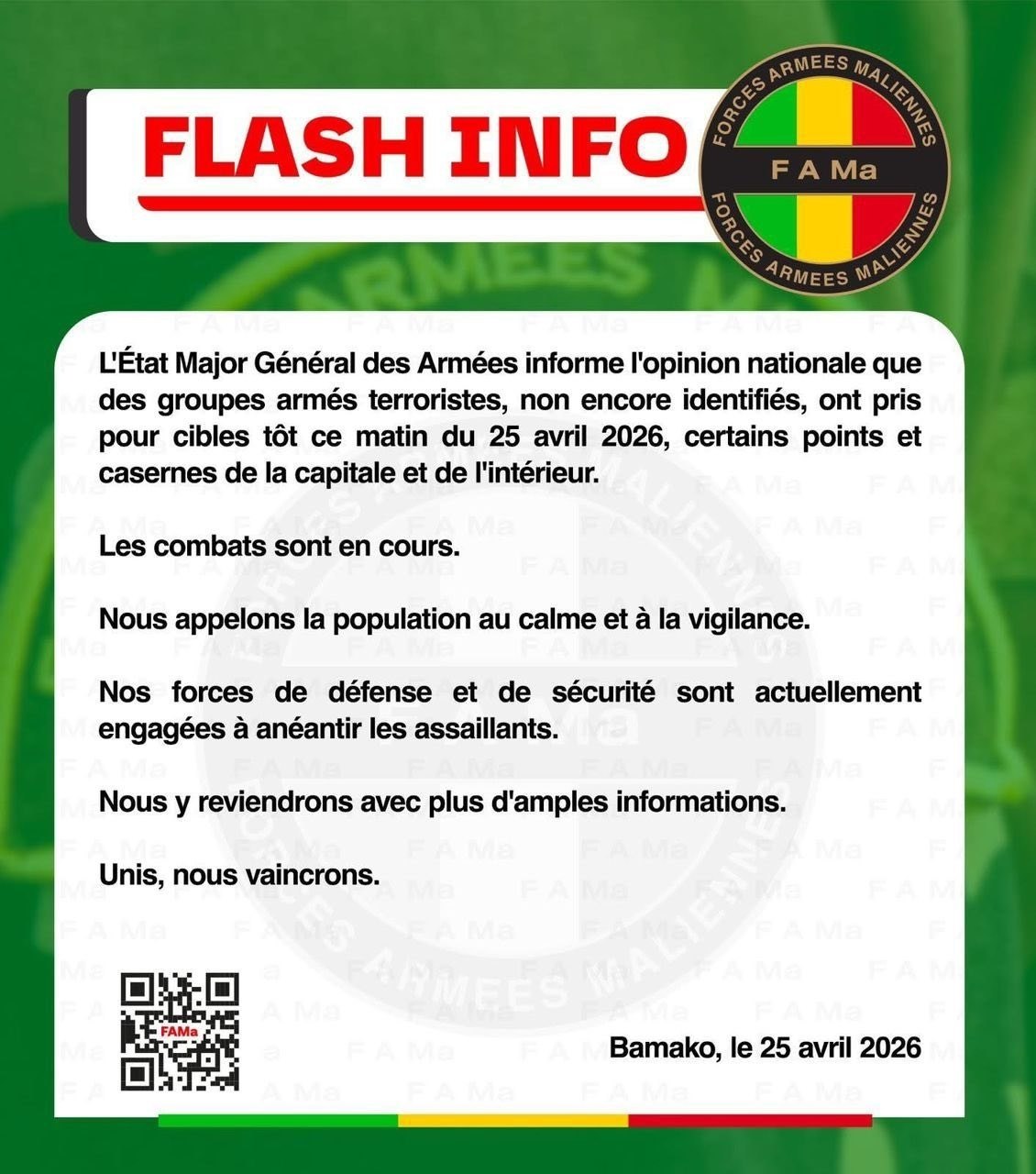
The offensive that unfolded in late April represents the largest escalation in recent years. Its significance lies not only in scale but in structure. Attacks were launched simultaneously across multiple направления — from northern strongholds to areas near the capital. This level of synchronization indicates coordination beyond the capabilities of fragmented insurgent activity. It reflects an attempt to overload the entire security system, depriving it of the ability to respond selectively.
A defining feature of this phase is the simultaneous action of FLA forces and JNIM militants. Such coordination between Tuareg formations and jihadist structures had rarely been observed at this level. Their convergence alters the nature of the conflict. What was once a set of parallel tensions is evolving into a layered confrontation in which different actors operate within a shared strategic dynamic.
Against this backdrop, the limitations of the Malian army and its external support become increasingly visible. After the withdrawal of French and other Western forces, Russia emerged as the primary external military partner of Bamako. The so-called Africa Corps functioned as a stabilizing force, compensating for structural weaknesses in the national army and helping maintain control over key positions. However, developments in Kidal suggest that this model is reaching its limits.
Available information indicates that the Kidal area came under intense pressure, with forces positioned there facing conditions resembling operational encirclement. In such circumstances, the question of holding territory transforms into the question of how to exit it. This is where a key characteristic of the current phase emerges: the boundary between combat and negotiation becomes blurred. Reports point to cycles of clashes, failed talks, localized agreements, and subsequent withdrawals.
This is not randomness but a new logic of warfare. Military pressure is used to shape the conditions of negotiation, while negotiation itself becomes a continuation of pressure by other means. In this framework, control over territory is no longer determined solely by firepower. It becomes a function of the ability to impose terms under which holding a position loses its strategic value.
Another critical indicator is the reported losses sustained by the Russian contingent. Claims regarding the downing of a helicopter—while requiring independent verification—fit into a broader pattern. Opposing forces are demonstrating the capability to strike critical components of military infrastructure. This suggests a shift from sporadic attacks to systematic efforts aimed at weakening external support structures.
Equally important is the informational dimension. The circulation of such reports, regardless of their level of confirmation, plays a significant role. In modern conflicts, perception shapes reality. Losses, even partially verified, amplify pressure, influence expectations, and alter decision-making behavior. The battlefield extends into the information space, where narratives become strategic tools.
Statements from JNIM representatives that “operations have not yet truly begun” reinforce this dynamic. They signal that current developments are not seen as an endpoint but as the initial stage of a broader campaign. This contributes to an atmosphere of escalating instability and suggests the potential for further expansion of pressure zones.
The response of Malian authorities reflects the seriousness of the situation. The imposition of a curfew in Bamako and surrounding areas indicates that the threat is no longer perceived as peripheral. The shift of pressure from the periphery toward the center is a classic indicator of a conflict entering a more advanced and dangerous phase.
In this context, Kidal cannot be viewed as an isolated episode. It is a convergence point of multiple structural shifts: increased coordination among armed groups, declining effectiveness of external military backing, intensified informational pressure, and the transition toward a hybrid model of conflict. Each of these elements reinforces the others, creating a feedback loop that accelerates systemic instability.
The losses sustained by the Russian Africa Corps should therefore not be interpreted merely as tactical setbacks. They function as indicators of a deeper transformation in the balance of power and the limitations of external intervention. Even if some losses are situational, their significance lies in the broader context in which they occur.
Kidal thus becomes a marker of systemic resilience. Where control once served as proof of strategic success, the current situation demonstrates that resilience now requires a different set of mechanisms. In an environment defined by synchronized opposition and multi-layered pressure, the mere presence of force is no longer sufficient.
More broadly, the events in Mali illustrate the transformation of modern conflict. The traditional model—based on territorial control and direct confrontation—is gradually giving way to a hybrid system in which pressure, maneuver, and perception are intertwined. In this system, the line between war and negotiation dissolves, and outcomes are determined not by individual battles but by overall strategic positioning.
What is unfolding is not the conclusion of a crisis but the beginning of a new phase. A phase in which previous approaches lose effectiveness, while new ones are still emerging. The combination of external losses and internal pressure suggests that the balance of power is undergoing a fundamental recalibration.
If current dynamics persist, further expansion of instability is likely, along with increased pressure on central regions and a gradual erosion of control. In this scenario, Kidal will remain not just a geographic location, but a symbol of transition—from one model of conflict to another, more complex, more aggressive, and significantly less predictable.
Related Articles
“Operation Self-Liquidation”: The Transformation of OSINT from Passive Monitoring to an Instrument of Digital Operational Impact
19 February 2026
Read more
Russia–Ethiopia Military-Technical Cooperation in 2024–2026
19 February 2026
Read more
United States, Russia and Ukraine in Abu Dhabi. After the First Round
26 January 2026
Read more
OSINT or a Weapon of Terror
24 January 2026
Read more