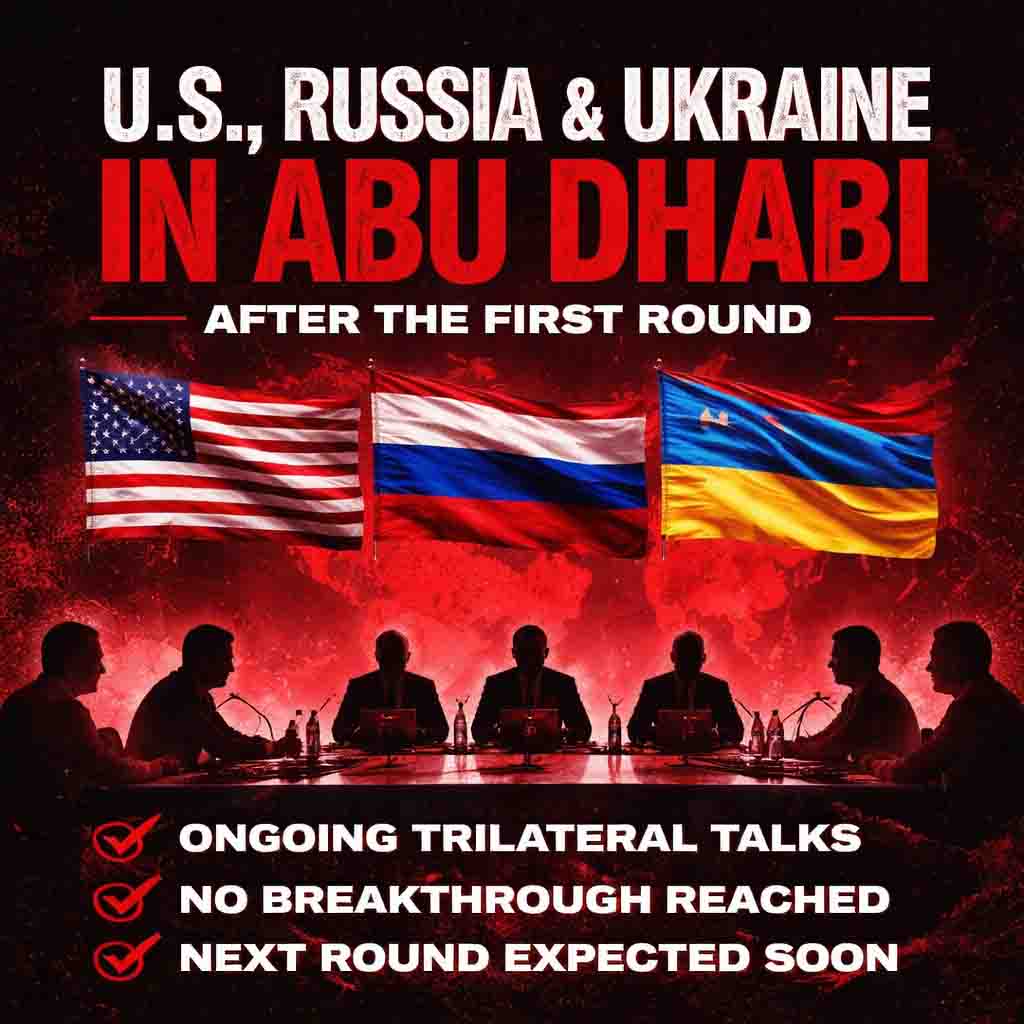
United States, Russia and Ukraine in Abu Dhabi. After the First Round

The first round of trilateral talks in Abu Dhabi concluded without signed documents and without publicly recorded agreements. However, in practical terms, it produced an outcome of a different order. The parties agreed to continue negotiations in the coming days, thereby confirming that the format is considered acceptable and useful under current conditions.
The conclusion of the first round should be understood as the establishment of a standing communication channel, albeit in a non-formalized form. None of the parties revised its core positions, yet none considered it expedient to terminate the dialogue. This indicates a shared recognition of the limitations of purely military and sanctions-based approaches in the absence of a parallel diplomatic track.
The first round was used not for bargaining, but for calibration. What was tested was not readiness for concessions, but the ability to sustain direct dialogue amid fundamental disagreement. The format passed this test. The talks were not disrupted, working discipline was maintained, and the continuation of contacts was agreed upon. This, in itself, alters the configuration of conflict management.
The transition to the second round changes the internal purpose of the process. Previously, the question was whether the format itself was viable. The second round will determine whether the format can produce practical effects. Not political settlements, but manageability. Not compromise, but predictability.
Several trajectories are plausible in the second round, each carrying distinct strategic implications.
The first trajectory involves consolidating the talks as a stable channel of interaction.
In this case, the focus would be on procedural elements: the regularity of meetings, levels of representation, mechanisms for information exchange, and a defined list of topics that can be discussed without preconditions. This approach does not imply political convergence or a cessation of hostilities. Its function is to reduce uncertainty, limit misinterpretation of actions, and create a predictable diplomatic background. For all parties, this scenario is attractive because it does not require concessions while providing a mechanism for escalation control.
The second trajectory involves limited functional progress in narrowly defined areas.
This would entail identifying issues where interests partially overlap or at least do not directly collide. Such areas can serve as testing grounds for the functionality of the format without touching core disputes. Progress here would be strictly practical and used to justify the continuation of the dialogue. It would not amount to political settlement and would not alter the broader strategic balance.
The third trajectory involves a shift toward managing disagreement rather than resolving it.
Under this scenario, the parties acknowledge that convergence on fundamental issues is unattainable and instead focus on mitigating the practical consequences of persistent disagreement. The dialogue shifts from normative positions to risk management. This is characteristic of protracted conflicts and reflects a more pragmatic, less ideologically driven phase. It does not lead to peace but reduces the likelihood of abrupt, uncontrolled escalation.
The fourth trajectory involves the gradual winding down of the process without a formal rupture.
If, during the second round, one party concludes that the talks are being used against its interests—militarily, politically, or domestically—the process may be de facto suspended. Publicly, the format would not be declared terminated, but meetings would lose regularity and substance. This outcome remains possible, though it appears less likely now than prior to the initiation of the talks.
At this stage, the Abu Dhabi negotiations should be viewed as an instrument of observation and calibration rather than influence. The parties are assessing behavior more than statements, particularly in closed settings. The second round will test whether this mode can be sustained and whether the dialogue will evolve into a mechanism of managed interaction or remain a limited episode.
In the short term, substantive political decisions are unlikely. However, the fact that disengagement from talks is increasingly perceived as a cost rather than a default option indicates a shift in the logic of conflict management. It is within this context that the second round assumes particular importance.
Related Articles

Artificial Intelligence Enters a New Era
27 July 2026
Read more
Саммит G7 во Франции: мировые лидеры перед лицом новой эпохи глобальных вызовов
17 June 2026
Read more
Russian Africa Corps Sustains Losses in Mali: Kidal as the Breaking Point of the War’s Entire Configuration
26 April 2026
Read more
The AI Tsunami: What Dario Amodei Warned About — And Why the Numbers Matter
26 February 2026
Read more