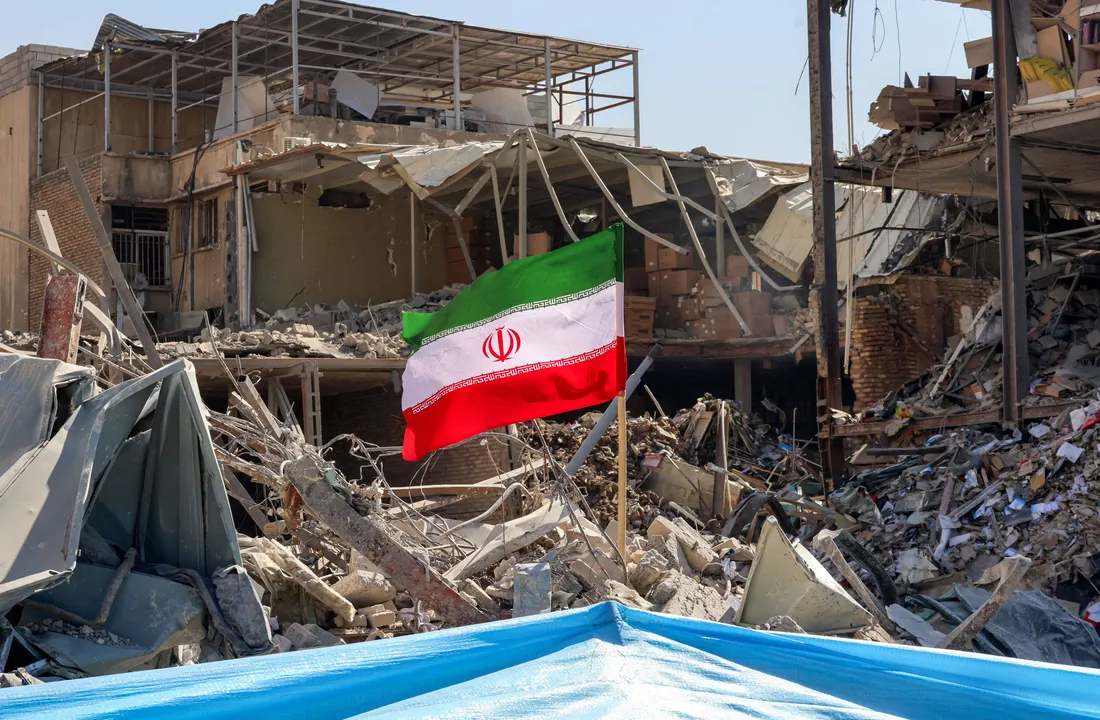
Risk of a Frozen Conflict: A Post-War Scenario for Iran
.png "Department of Strategic Monitoring")
The war against Iran, which began on February 28, is likely to end with each side declaring some form of military success. Yet battlefield gains alone are unlikely to translate into immediate political transformation. Even after the reported killing of Supreme Leader Ali Khamenei on the first day of hostilities and sustained strikes on critical infrastructure, the Iranian system quickly reorganised its leadership and continued retaliatory operations against Israel and more exposed Gulf Arab states. Tehran has shown that its deliberately decentralised military architecture allows for continued resistance even when central command structures are disrupted. For the authorities, the conflict appears to be framed above all as an existential struggle.
Washington’s aims have appeared fluid. At various points, US officials have described the campaign as an effort to dismantle Iran’s nuclear capacity, degrade its armed forces and regional networks, or create conditions for domestic political change. These objectives point toward very different end states. In the absence of a clearly articulated strategy, and as the costs of war mount, a more familiar outcome is taking shape: Iran could resemble Iraq in the aftermath of the 1990–91 Gulf war — militarily weakened and economically strained, yet still governed by a reconstituted version of the existing order.
The Iraqi precedent is instructive because decisive military outcomes did not bring about the political shift many policymakers had anticipated. Coalition forces expelled Iraqi troops from Kuwait and severely damaged Baghdad’s military capabilities but stopped short of removing Saddam Hussein from power. Encouraged by public signals from Washington, uprisings erupted in 1991 among Shia communities in the south and Kurdish forces in the north. For a brief moment, the regime’s grip seemed to waver. However, loyal elite units regrouped and crushed the rebellions with overwhelming force.
What followed was not regime collapse but a prolonged strategy of containment. Throughout the 1990s, Iraq endured sanctions, intrusive weapons inspections, no-fly zones and periodic military strikes. The country remained trapped in a strategic grey zone: its armed forces degraded, infrastructure battered and economy hollowed out by international restrictions. Western powers controlled large parts of Iraqi airspace, limiting Baghdad’s reach. Although Saddam’s regional influence diminished, he maintained coercive authority at home. The humanitarian toll was severe. Economic isolation eroded state capacity, poverty surged and public services deteriorated. Ordinary citizens bore the brunt of the pressure, while the leadership adapted by consolidating control over scarce resources and securing the loyalty of security institutions.
Iran could face a comparable trajectory. Recent intelligence assessments in Washington suggest that military pressure alone is unlikely to generate immediate political change in Tehran. Systems built around powerful security establishments have historically demonstrated resilience even after suffering setbacks. Saddam remained in power largely because his elite forces stayed loyal. In Iran, a similar function is performed by the Islamic Revolutionary Guard Corps, which combines military influence, economic leverage and ideological commitment to regime continuity.
The conflict may therefore conclude with an Islamic republic that is weakened yet enduring — confronting damaged defence capabilities, a worsening economic crisis and deeper international isolation, while its political leadership remains intact. Tehran could see its regional reach reduced and its ability to finance partners such as the Houthis and Hizbollah constrained, even as domestic repression intensifies.
For Iran’s population, the consequences may be profound. Wartime destruction layered on top of sanctions could accelerate economic decline, potentially triggering a sharper currency slide and inflationary pressures. Social discontent might rise as living standards deteriorate. Although some observers speculate that economic hardship could revive protest movements, authorities have signalled that dissent may be treated as collaboration with external adversaries. In such an environment, demonstrations would likely face harsher crackdowns.
The humanitarian effects could also spill across borders. Economic contraction and instability may drive new migration flows toward neighbouring countries — Turkey, Iraq, Gulf states — and further toward Europe. For the wider region, this would echo the strategic patterns of the 1990s.
After the Gulf war, the United States and its allies chose to contain rather than immediately remove Saddam from power. While this approach limited Iraq’s capacity to threaten its neighbours, it also produced a prolonged period of tension and uncertainty. For more than a decade, Iraq remained locked in a low-intensity confrontation with western powers, a dynamic that ultimately culminated in the US-led invasion of 2003.
That experience offers a cautionary lesson for the aftermath of the current conflict with Iran. Leaving a defeated but contained regime in place without a clear political settlement may provide temporary stability, yet it rarely resolves underlying disputes. Frozen conflicts have a tendency to drift back toward escalation. Over time, unresolved grievances resurface, fuelling recurring crises, episodic military flare-ups and growing pressure in Washington and Tel Aviv to pursue a more decisive outcome.
If the war ends with Iran weakened but still governed by its existing system, the greater danger may lie in a renewed cycle of containment, confrontation and instability — one that could gradually build momentum toward a broader and more destructive conflict in the years ahead.
Related Articles

Artificial Intelligence Enters a New Era
27 July 2026
Read more
Agentic AI: Why It Is Poised to Become the Defining Technology of the Coming Years
22 July 2026
Read more
Саммит G7 во Франции: мировые лидеры перед лицом новой эпохи глобальных вызовов
17 June 2026
Read more
China Against the System: How Beijing Is Preparing for an Era of Great Global Confrontation
23 May 2026
Read more