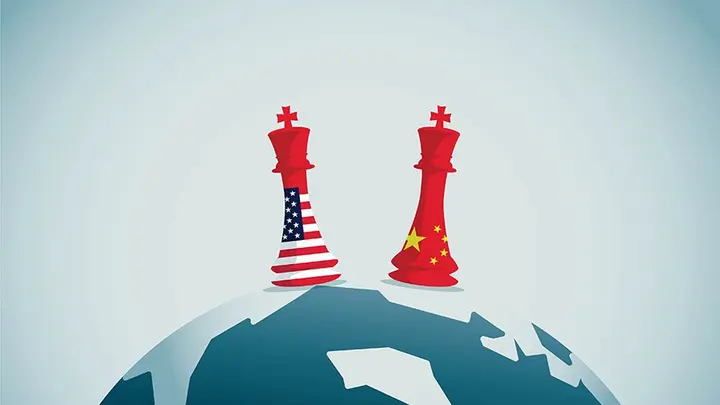
China Against the System: How Beijing Is Preparing for an Era of Great Global Confrontation
Global politics is gradually entering an entirely new phase in which the primary source of strategic tension is no longer the Middle East or even the war in Ukraine, but the long-term confrontation between China and the United States. It is around Beijing that a new architecture of global rivalry is now beginning to form — one capable of defining the structure of the international system for decades to come.
On the surface, the situation still appears relatively stable. China continues to demonstrate economic growth, expand its international influence, invest heavily in technology and strengthen its military capabilities. Yet beneath this appearance of stability lies an extraordinarily deep process of geopolitical transformation in which Beijing has effectively ceased to be viewed in Washington as merely a major economic competitor.
Today, China is increasingly perceived by the American strategic establishment as the only country in the world possessing the potential to challenge U.S. global dominance simultaneously in economics, technology, manufacturing, finance and military power.
This is precisely why the current confrontation between Washington and Beijing differs fundamentally from previous American rivalries with other states.
This is no longer simply a regional geopolitical dispute.
It is a struggle over the future structure of the global order itself.
Over the past several decades, China has methodically constructed a unique state model combining centralized political control, industrial gigantism and advanced technological development. Unlike many other countries, Beijing did not attempt to integrate into the Western system as a dependent participant. On the contrary, Chinese leadership gradually used globalization itself as an instrument for strengthening the Chinese state.
In many ways, China became the first major power in decades capable of using the global economic system not to dissolve into the Western-led order, but to build an autonomous center of power within it.
This is exactly what now generates the greatest anxiety in Washington.
For many years, a large part of the American elite assumed that economic integration would eventually push China toward political and ideological transformation along Western lines. Instead, the exact opposite occurred.
China not only preserved its political system, but dramatically strengthened state control over strategic sectors of the economy, technology and information infrastructure.
Moreover, Beijing has now begun openly competing for technological supremacy.
Technology has become the central nerve of the U.S.-China confrontation.
Semiconductors, artificial intelligence, quantum computing, robotics, military technologies, satellite infrastructure and autonomous supply chains are no longer merely economic sectors. They represent the foundation of the future global system.
Taiwan occupies a uniquely sensitive place within this confrontation.
To an outside observer, the Taiwan issue may appear to be a conventional territorial dispute. In reality, Taiwan has become one of the most critical nodes of the global technological system. The island hosts production facilities responsible for some of the world’s most advanced microchips — components essential to the functioning of the modern digital economy.
Taiwan has effectively become the strategic nerve center of the global technological order.
This is precisely why tensions surrounding the island have become so dangerous.
For China, Taiwan remains a question of historical sovereignty and national legitimacy. Within the Chinese political system, the permanent separation of the island is viewed not merely as a geopolitical issue, but as a direct challenge to the authority and legitimacy of the state itself.
For the United States, Taiwan has evolved into both a cornerstone of China containment strategy and one of the world’s most important technological assets.
This is where one of the most dangerous zones of global risk begins to emerge.
Any major escalation around Taiwan could trigger a massive international chain reaction.
Not only regional security, but the entire global economy would immediately come under pressure.
The modern international system has become deeply dependent on Asian manufacturing and logistical networks. Any serious destabilization in the Taiwan Strait would instantly impact global markets, semiconductor production, financial systems and international trade flows.
At the same time, China fully understands its own vulnerabilities.
Despite extraordinary economic expansion, Beijing faces severe internal challenges. China’s property sector remains under pressure, regional debt burdens continue to grow, demographic growth is slowing and many Western corporations are attempting to reduce their dependence on Chinese manufacturing.
Yet this is precisely where one of the most important features of Chinese strategy becomes visible.
Beijing operates according to far longer historical cycles than most Western political systems.
The Chinese state model is not structured around short electoral timelines, but around decades and generations. This allows Beijing to pursue projects designed for long-term transformation of the global balance of power.
This increasingly alarms Washington.
The United States is gradually coming to the conclusion that China can no longer be contained through sanctions or trade restrictions alone. In many respects, American pressure has only accelerated Beijing’s drive toward technological and industrial self-sufficiency.
In effect, the world is slowly beginning to divide into two parallel systems:
an American system and a Chinese system.
This process extends far beyond geopolitics or economics.
Two technological ecosystems are gradually emerging. Two models of digital governance. Two financial infrastructures. Two competing visions of global order.
At the same time, both sides continue attempting to avoid direct military confrontation.
Neither Washington nor Beijing has any genuine interest in a full-scale war. The cost of such a conflict would be catastrophic not only for both powers, but for the entire global system. This is precisely why the current confrontation has become so extraordinarily complex.
On one side, the United States seeks to slow China’s rise through sanctions, technological restrictions, military alliances and control over critical supply chains.
On the other side, China is rapidly preparing for an era of prolonged strategic pressure by attempting to construct a максимально autonomous economic and technological system capable of surviving long-term geopolitical competition.
This is why the current global crisis appears so historically unusual.
For the first time in decades, the international system is confronting not simply a regional conflict, but the emergence of a fully developed alternative center of global power.
And the central question today is no longer whether China can eventually rival the United States.
The real question is whether the world itself can survive such a massive redistribution of power without descending into a profoundly destabilizing global crisis.
Related Articles

Artificial Intelligence Enters a New Era
27 July 2026
Read more
Agentic AI: Why It Is Poised to Become the Defining Technology of the Coming Years
22 July 2026
Read more
Саммит G7 во Франции: мировые лидеры перед лицом новой эпохи глобальных вызовов
17 June 2026
Read more
Washington, Tel Aviv and Tehran: How the Iranian Crisis Is Beginning to Reshape the Entire Middle East
23 May 2026
Read more