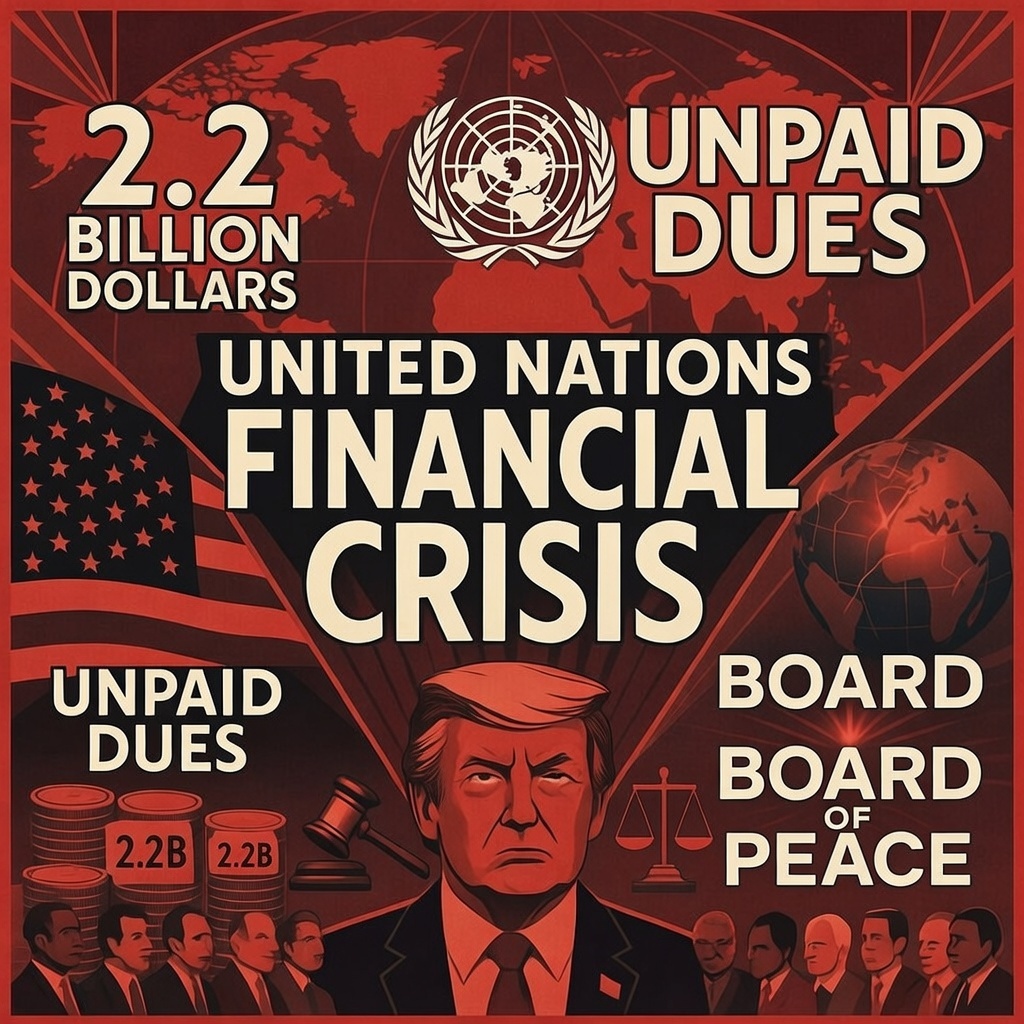
UN on the Brink of Financial Collapse: How Unpaid Dues and U.S. Policy Are Undermining the Global System
The United Nations is facing one of the most severe financial crises in its history. In a confidential letter circulated this week to all 193 permanent representatives, UN Secretary-General António Guterres warned that the organization is approaching an “imminent financial collapse.” This was not diplomatic exaggeration. It was a blunt assessment of a system running out of cash.
At the center of the crisis is a simple but destabilizing reality: member states are not paying their mandatory contributions. Unlike previous budgetary shortfalls, the current situation has reached a scale at which traditional stop-gap measures no longer work.
The United States as the primary driver of the deficit
The largest arrears belong to the United States. According to UN officials, Washington owes nearly 2.2 billion dollars in overdue and current assessments for the regular UN operating budget, with additional hundreds of millions tied to other assessed and pledged programs. Much of this debt dates back to the end of 2024 and remains unresolved.
Under the UN’s assessment formula, based on gross national income, population, and debt levels, the United States is responsible for 22 percent of the organization’s regular budget. For 2026, that budget stands at 3.45 billion dollars. China follows closely with a 20 percent share and, unlike the United States, had paid its dues through the beginning of this year.
While delayed or partial payments are not unprecedented, the current U.S. approach marks a departure from established practice. Previous Republican administrations often used funding delays as leverage, but a near-total halt in payments without formal notification represents a qualitatively different strategy. Compounding the issue, the Biden administration left office with the second half of its 2024 assessment unpaid.
A broader shift away from multilateralism
The financial crisis cannot be separated from the wider transformation of U.S. foreign policy under President Donald Trump’s second term. Trump has repeatedly described the UN as ineffective, wasteful, and hostile to American interests. Early this year, he signed an executive order withdrawing the United States from 66 international organizations, agencies, and commissions, nearly half of them connected to the UN system.
Participation in voluntary UN bodies has also been scaled back. The United States withdrew from the World Health Organization and sharply reduced contributions to humanitarian programs, pledging 2 billion dollars for refugee and disaster relief — a fraction of previous levels.
For UN officials, the message is clear: Washington is no longer treating multilateral institutions as pillars of global governance, but as optional tools subject to transactional calculation.
An attempt to bypass the UN framework
Tensions have intensified further with Trump’s launch of a new initiative known as the Board of Peace. Originally conceived as an oversight mechanism for his Gaza peace proposal, the body has evolved into a broader platform intended to address global conflicts through a “new approach.”
Trump appointed himself chair, granting personal veto power over membership and decisions. Of the 60 countries invited to join, only 25 have formally signed on, none of them major U.S. allies. Within the UN, the initiative is widely interpreted as an attempt to create a parallel architecture for international security, sidestepping established legal frameworks.
Asked whether the board could replace or compete with the UN, Guterres responded that responsibility for international peace and security rests with the United Nations and its Security Council, and that no alternative body can legally compel universal compliance.
A structural paradox in UN finances
Beyond unpaid dues, the UN faces an internal financial contradiction. Under existing rules, any budgeted funds left unspent at the end of the year must be returned to member states, regardless of whether those states have actually paid their contributions.
Guterres described this situation as a “Kafkaesque cycle.” The organization is required to refund money it never received, while simultaneously struggling with liquidity shortages caused by nonpayment. If unchanged, this mechanism will increasingly erode each successive budget cycle.
Financial officials warn that, under current conditions, the UN could run out of cash as early as July.
Cost-cutting without cash flow
In response to the growing alarm, UN leadership last year proposed aggressive austerity measures: staff reductions, asset sales, administrative streamlining, and relocation of offices from high-cost cities such as Geneva to less expensive regions. The General Assembly ultimately approved a 7.6 percent reduction in the regular budget for 2026.
While significant, these cuts do not address the core problem. A leaner organization still cannot function without actual revenue.
U.S. Ambassador to the UN Mike Waltz has claimed credit for forcing the UN to accept what he called “real cuts for the first time in its modern history,” while simultaneously acknowledging the organization’s diplomatic value. He argued that there must be at least one place where all states can talk — and that the United States wants that place to be on its own terms.
A crisis beyond accounting
The UN’s financial emergency is more than a budgetary issue. It is a manifestation of a deeper crisis in the post-war multilateral order. As major powers increasingly prioritize unilateral leverage over collective responsibility, global institutions lose both resources and authority.
The United Nations remains the only body with a universal legal mandate in matters of international peace and security. Yet without predictable financing, that mandate risks becoming symbolic rather than operational.
The question is no longer whether the UN can absorb another cash-flow shock. It is whether the principle of shared global governance can survive in an era defined by fragmentation, distrust, and strategic disengagement.
Related Articles

Artificial Intelligence Enters a New Era
27 July 2026
Read more
Agentic AI: Why It Is Poised to Become the Defining Technology of the Coming Years
22 July 2026
Read more
Саммит G7 во Франции: мировые лидеры перед лицом новой эпохи глобальных вызовов
17 June 2026
Read more
China Against the System: How Beijing Is Preparing for an Era of Great Global Confrontation
23 May 2026
Read more