U.S. Ground Troop Deployment in Iran: Scenarios Under Consideration and Escalation Risks

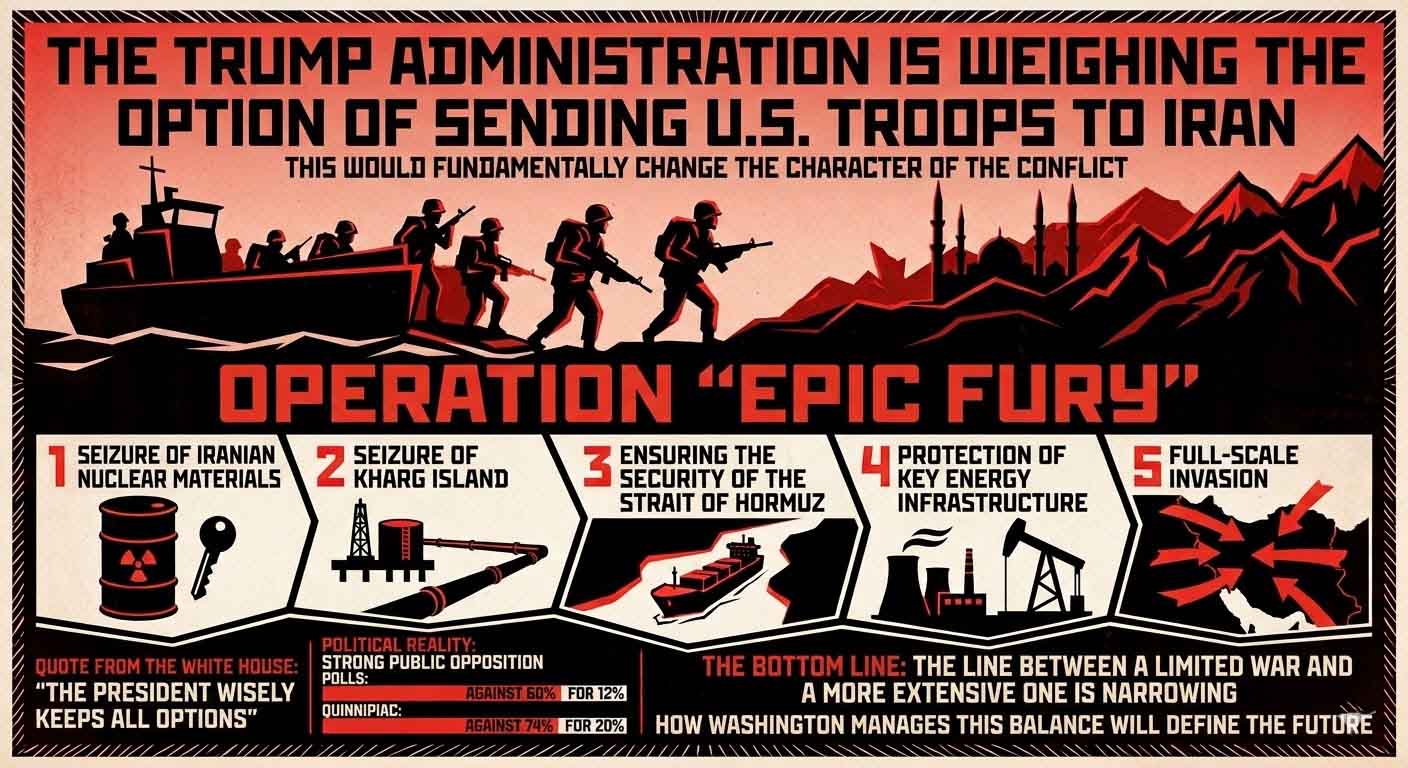
The Trump administration is weighing the option of deploying U.S. ground troops to fight in the war against Iran. Such a move would have been unthinkable just a few weeks ago and would fundamentally change both the character and the severity of the conflict.
According to Reuters, officials are discussing the possible deployment of “thousands of U.S. troops” to the region in order to broaden military flexibility as the campaign evolves. No final decision has been made, but the discussions signal a potential shift away from an operation dominated by air and naval power toward limited, targeted ground missions.
The stated objectives of “Operation Epic Fury” are sweeping: dismantling Iran’s missile capabilities, weakening its navy, and ensuring that it cannot develop a nuclear weapon.
Five potential scenarios are being considered for what the deployment of ground troops in Iran could look like. The most sensitive involves securing Iran’s stockpiles of highly enriched uranium — an operation officials privately describe as extraordinarily complex and dangerous.
Another option would be the seizure of Kharg Island, the terminal that handles roughly 90 percent of Iran’s oil exports. However, U.S. officials warn that such a move would expose American forces to Iranian missile and drone attacks.
A third scenario focuses on the Strait of Hormuz, with troops potentially deployed along Iran’s coastline to help guarantee the safe passage of oil tankers.
A fourth would involve U.S. forces protecting critical energy infrastructure, such as the South Pars gas field, echoing missions carried out during the Iraq war.
The fifth and most extreme option is a full-scale Iraq-style invasion, which officials broadly view as highly unlikely.
An unnamed White House official told Reuters:
“There has been no decision to send ground troops at this time, but President Trump wisely keeps all options at his disposal. The president is focused on achieving all of the defined objectives of Operation Epic Fury: destroying Iran’s ballistic missile capacity, annihilating its navy, ensuring its terrorist proxies cannot destabilize the region, and guaranteeing that Iran can never possess a nuclear weapon.”
None of the five options is believed to be imminent. Still, the fact that they are being discussed highlights how quickly the conflict could deepen — and how narrow the gap has become between a limited war and a far more expansive one.
1. Securing Iran’s Nuclear Materials
One of the most strategically significant options under discussion is sending U.S. forces to seize Iran’s highly enriched uranium stockpiles. This would be an exceptionally complex mission with no guarantee of success. Iran’s nuclear infrastructure is dispersed across multiple hardened sites, many deeply buried and protected by layered air defenses. Even a limited special forces operation would likely require broader military support, including air cover and sustained ground logistics.
Beyond battlefield risks, such an attempt could be interpreted by Tehran as an existential threat to the regime, potentially triggering rapid escalation and drawing in regional actors.
2. Seizing Kharg Island
Another option involves a ground operation to take control of Kharg Island. The strategic logic is clear: holding the island would sharply restrict Iran’s oil exports and give Washington leverage over global energy flows.
However, the risks are substantial. The island could be targeted by Iranian missiles and drones, potentially leading to significant U.S. casualties. Its small size and exposed location in the Gulf would make it a vulnerable and difficult-to-defend outpost.
3. Securing the Strait of Hormuz
The Strait of Hormuz remains the most immediate flashpoint in the conflict, given its importance to global oil supplies. While U.S. operations have so far relied on air and naval power, ensuring safe tanker transit could require deploying troops along Iran’s coastline.
Even if framed as a defensive mission, such a move would represent a major escalation. A limited presence on Iranian territory could provoke retaliation, including attacks on U.S. forces and regional assets.
4. Protecting Key Energy Infrastructure
A more limited option under consideration is deploying U.S. forces to secure critical energy assets such as the South Pars gas field. This approach would resemble past U.S. missions in Iraq, where troops safeguarded vital oil infrastructure during periods of instability.
Yet such operations often expand over time. Protecting large, high-value facilities typically requires a sustained ground presence, exposing troops to missile, drone, or insurgent-style attacks.
5. Full-Scale Invasion
The most extreme scenario — a full invasion and occupation of Iran — remains highly unlikely. The scale, cost, and military challenge would far exceed those of Iraq or Afghanistan, both of which evolved into prolonged and expensive conflicts with no clear long-term political resolution. Iran’s larger population, difficult terrain, and stronger state institutions would make any occupation even more complex.
Political Reality: Strong Public Opposition
While military options are expanding, public support is not. Polling cited by CNN shows strong opposition to deploying ground troops. A CNN survey found Americans opposed the idea by 60 percent to 12 percent. A Quinnipiac poll showed an even wider gap, 74 percent to 20 percent.
Opposition cuts across party lines. Even among Republicans, support remains limited — just 27 percent in the CNN poll and 37 percent in the Quinnipiac survey. This creates a clear political constraint for Trump, who has repeatedly pledged to avoid new prolonged Middle East wars and is mindful of the approaching midterm elections.
The Bottom Line
The mere consideration of sending U.S. boots on the ground in Iran shows how rapidly the conflict could shift from a campaign of strikes to a far more dangerous phase. Even limited deployments carry significant military, political, and economic risks, and history suggests such missions are difficult to contain once they begin.
For now, the administration appears to be preserving strategic flexibility rather than committing to escalation. But the line between current operations and a ground deployment is narrowing. How Washington manages this balance in the coming weeks could shape not only the trajectory of the war but also its broader global impact.
Related Articles

Artificial Intelligence Enters a New Era
27 July 2026
Read more
Agentic AI: Why It Is Poised to Become the Defining Technology of the Coming Years
22 July 2026
Read more
Саммит G7 во Франции: мировые лидеры перед лицом новой эпохи глобальных вызовов
17 June 2026
Read more
China Against the System: How Beijing Is Preparing for an Era of Great Global Confrontation
23 May 2026
Read more