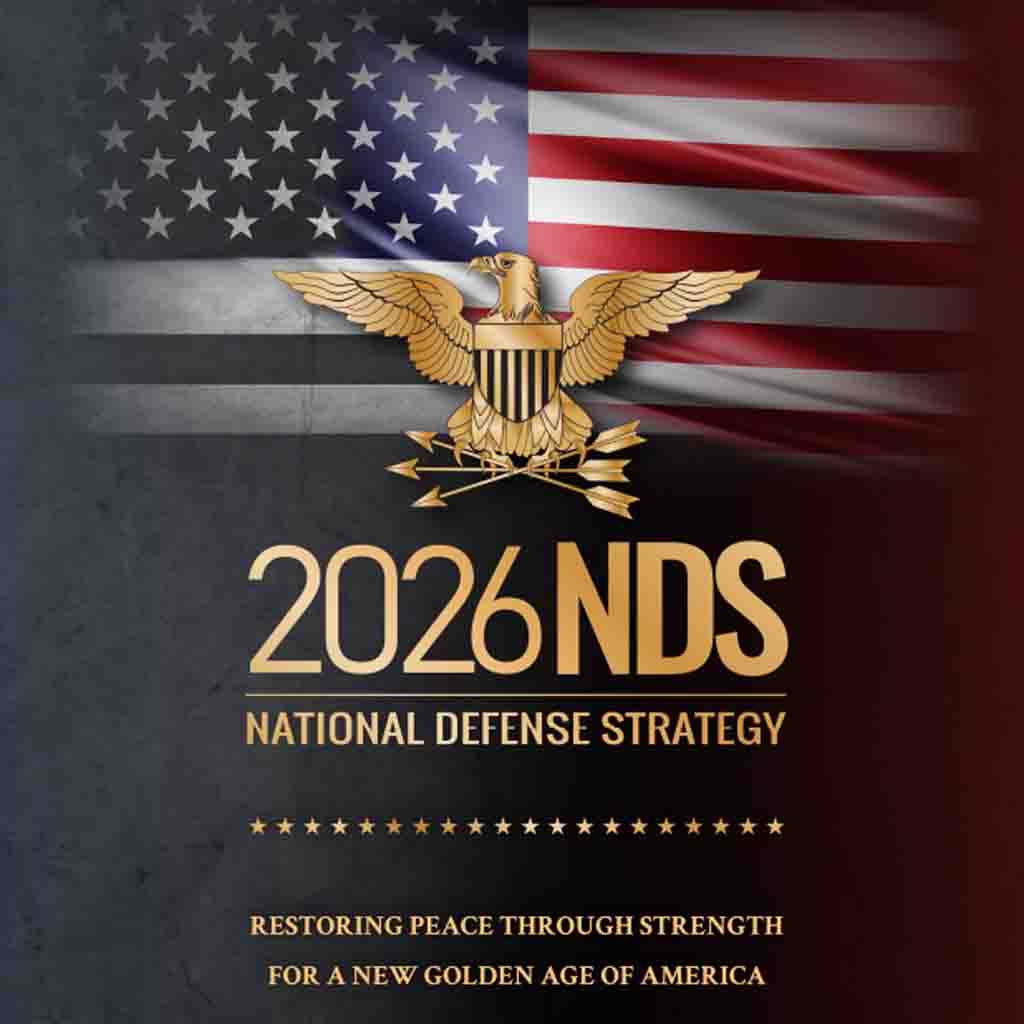
The United States National Defense Strategy for 2026. The report has been published

President Trump, during his first term and again after returning to office in January 2025, restored the United States Armed Forces and ensured that they remained the best in the world—the most formidable fighting force. It is important to emphasize the scale of what was accomplished. In January 2025, the President assumed leadership in one of the most dangerous security environments in the nation’s history. Domestically, the U.S. border was overwhelmed by illegal flows, drug cartels and their affiliated networks were strengthening across the Western Hemisphere, and U.S. access to key geostrategic points such as the Panama Canal and Greenland was becoming increasingly uncertain.
In Europe, where President Trump had previously compelled NATO allies to take defense seriously, the prior administration effectively encouraged their passivity and reliance on the United States, leaving the Alliance unprepared either to deter or to respond effectively to Russia’s invasion of Ukraine. In the Middle East, Israel demonstrated that it was capable of and willing to defend itself after the barbaric attacks of October 7, thereby proving itself a model ally; yet instead of strengthening Israel, the previous administration constrained its capabilities. At the same time, China and its armed forces were expanding their power and influence.
The preceding years were marked by a weakening of defense capacity: erosion of readiness, delays in modernization, degradation of the industrial base, and the offshoring of production, including defense manufacturing. U.S. service members were repeatedly sent into wars without a clear political objective or a clearly defined outcome, undermining readiness, wearing down equipment, and damaging morale. Against this background, the nation came to require a strategy grounded in realism and clearly defined national interests, rather than endless projects of remaking the world.
This National Defense Strategy establishes the framework for the Department of Defense and the U.S. Armed Forces to protect the country and its citizens, deter adversaries, prevail in war when necessary, and do so in a manner that allows American power to create space for diplomacy. The core principle of this approach is captured in a simple formula: peace is achieved through strength. Strength is not an end in itself; it exists to ensure that adversaries are dissuaded from aggression and that the President possesses real leverage for negotiations from a position of advantage.
The Strategy is based on the premise that the United States must correct the imbalance between commitments and resources. Allies and partners must make a more substantial contribution to collective security. The United States will support coalitions, but it will not indefinitely compensate for the lack of will, resources, or responsibility of other countries. At the same time, the United States will retain global leadership, grounded in the priority of protecting the American people, U.S. territory, and sovereign interests.
The document emphasizes that U.S. defense is impossible without a strong defense industrial base, resilient supply chains, and a workforce and production capacity capable of rapidly scaling the output of weapons and munitions. The United States intends to strengthen its defense-industrial base, accelerate production, expand capacity, and increase quality and tempo in order to be prepared for prolonged, high-intensity conflicts, while also supporting allies when doing so serves U.S. interests.
The Strategy also underscores the need to restore the warrior ethos, discipline, a culture of victory, and higher levels of readiness. The Armed Forces must be prepared for intense great power competition, emerging technologies, space and cyber threats, precision weapons, and the large-scale employment of unmanned systems. The United States will foster innovation and accelerate the adoption of new solutions without sacrificing baseline readiness or the ability to wage war.
Security Environment
The strategic environment is described as a period of direct great power competition. The United States views this reality as the central factor shaping planning, resource allocation, and priorities.
China is characterized as the primary long-term challenge. It possesses an economy and industrial base large enough to sustain prolonged competition and is actively converting that potential into military power. China seeks to alter the balance of power, expand its presence and influence, enhance power projection capabilities, and develop missiles, naval and air forces, space and cyber capabilities, and nuclear forces. The Strategy stresses that the Indo-Pacific region is the central theater of long-term competition and that the U.S. objective is to maintain military advantage and prevent the coercion of allies and partners by China. The United States will strengthen deterrence and remain prepared to defend its interests, ensuring freedom of action and the security of its allies.
Russia is identified as an immediate and acute military threat in Europe. The document calls for restoring NATO’s ability to conduct credible deterrence and defense and for eliminating the practice whereby some allies rely on the United States without providing their own meaningful contribution to defense. It emphasizes that Russia’s war against Ukraine exposed critical weaknesses in European security and demonstrated the need to develop weapons and ammunition production at a scale sufficient for prolonged confrontation. The United States intends to maintain resolve in Europe while expecting European states to do far more themselves.
Iran and its network of regional partners are described as sources of instability in the Middle East, threats to U.S. interests and allies, and factors capable of drawing the region into major crises. The Strategy affirms U.S. support for Israel as an ally willing and able to defend itself and commits to ensuring conditions under which adversaries cannot expand their aggression.
North Korea is assessed as a persistent military challenge possessing missile and nuclear capabilities and capable of provoking crises. The United States will maintain deterrence on the Korean Peninsula in cooperation with allies and strengthen defenses against missile threats.
Transnational threats are highlighted separately: terrorism, drug cartels, and associated networks that fuel instability in the Western Hemisphere, undermine the security of U.S. citizens, and place pressure on the border. The Strategy stresses that domestic security and external security are interconnected, as geographic proximity, criminal networks, and illegal flows create real vulnerabilities.
The Strategy notes that future conflicts will be characterized by high speed, widespread use of unmanned systems, the proliferation of precision weapons, active competition in cyberspace and space, and attempts by adversaries to paralyze logistics and command-and-control systems. Accordingly, the United States will enhance the resilience of communications, command systems, infrastructure, and supply chains.
Strategic Approach and Priorities
The document sets out an overarching approach: the United States will act based on realism, direct national interests, and the priority of protecting the American people. Military power will be developed as an instrument of deterrence and as a foundation for diplomacy. When necessary, the Armed Forces must be ready to win wars.
The Strategy establishes priorities: defense of U.S. territory and citizens; maintenance of credible nuclear deterrence; superiority in space and cyberspace; preservation of military advantage in the Indo-Pacific region; and strengthening deterrence in Europe, the Middle East, and other regions. Deterrence must be credible—adversaries must see U.S. readiness, speed of response, and capacity for sustained competition.
A central focus is placed on the defense-industrial base. The Strategy calls for increasing production rates, expanding capacity, ensuring supply resilience, reducing dependence on external sources for critical materials and components, accelerating procurement, removing bureaucratic obstacles, engaging industry more actively, strengthening stockpiles, and creating conditions for expanded production of munitions and key systems. Industry must be capable not only of meeting U.S. requirements but, when necessary, of supporting allies when it aligns with U.S. interests.
The Strategy also underscores the task of enhancing readiness through the restoration of discipline, training, a culture of victory, and morale. The emphasis is placed on activities that directly improve the ability to prevail, rather than missions that dilute the core purpose of the Armed Forces.
Lines of Effort (Primary Directions of Action)
The document outlines practical lines of effort through which the Strategy will be implemented.
The first line of effort focuses on strengthening homeland defense and domestic resilience: border security, infrastructure protection, defense against missile threats, resilient logistics and command systems, and countering networks that undermine security in the Western Hemisphere.
The second line of effort centers on deterrence and competition with great powers, particularly China, as well as countering Russia. It emphasizes maintaining advantage in the Indo-Pacific region, developing forces capable of rapid long-range operations, ensuring allied security, strengthening naval and air capabilities, and sustaining credible nuclear deterrence.
The third line of effort addresses the redistribution of responsibility: allies and partners must contribute more, increase defense spending, strengthen their armed forces and industrial bases. The United States will support allies but expects tangible actions rather than declarations. The logic is straightforward: collective security requires collective investment and effort.
The fourth line of effort concerns modernization and innovation: accelerating the adoption of new technologies, expanding unmanned systems, improving command efficiency, leveraging data, advancing cyber defense and space capabilities, and shortening the cycle from concept to mass production.
The fifth line of effort focuses on process reform: reducing bureaucracy, increasing the speed of procurement and maintenance, strengthening execution discipline, managing resources with an outcome-oriented approach, and eliminating practices that undermine readiness.
Conclusion
The Strategy concludes by affirming that the United States will remain the sword and shield of the nation, acting in the interests of the American people, securing peace through strength, reinforcing deterrence, supporting allies where it serves U.S. interests, and creating conditions under which adversaries cannot succeed through aggression or coercion. The United States intends to be prepared for sustained and demanding competition, as well as for high-intensity wars should deterrence fail.
Related Articles

Artificial Intelligence Enters a New Era
27 July 2026
Read more
Agentic AI: Why It Is Poised to Become the Defining Technology of the Coming Years
22 July 2026
Read more
Саммит G7 во Франции: мировые лидеры перед лицом новой эпохи глобальных вызовов
17 June 2026
Read more
China Against the System: How Beijing Is Preparing for an Era of Great Global Confrontation
23 May 2026
Read more