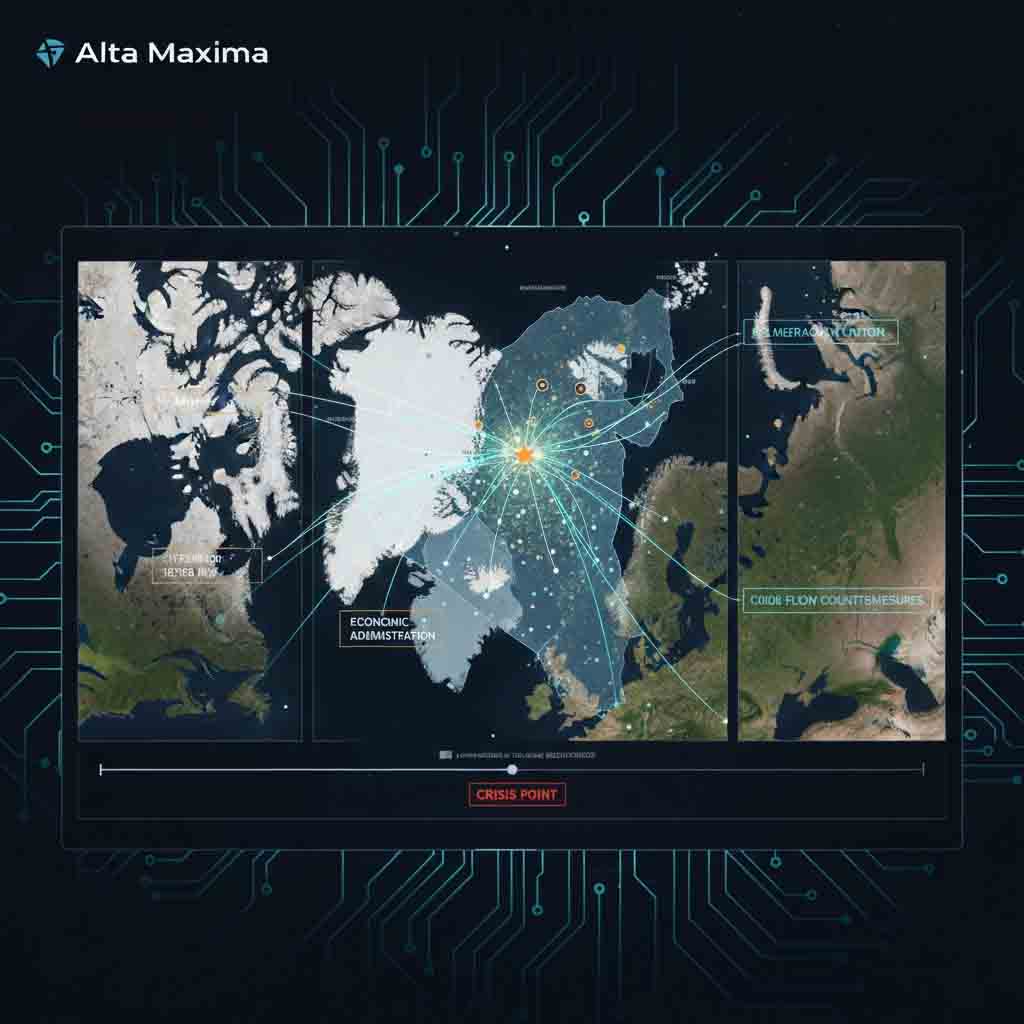
The EU Prepares Retaliatory Measures Over Trump’s Greenland Threats
The European Union is approaching one of the most serious crises in transatlantic relations in decades, triggered by threats from U.S. President Donald Trump to impose punitive tariffs on NATO allies opposing his ambitions regarding Greenland. In response, Brussels is weighing a package of countermeasures worth up to €93 billion, alongside possible restrictions on U.S. companies’ access to the EU market.
European officials describe the situation as a turning point. For years, EU capitals pursued a cautious and conciliatory approach toward Washington, prioritizing the preservation of the transatlantic partnership even at the cost of political and economic concessions. The latest escalation, however, has convinced many that this strategy has reached its limits.
The End of Appeasement
Since Trump’s return to power, European governments have sought compromise. They accepted higher defense spending, tolerated trade imbalances, adjusted regulations to accommodate U.S. demands, and often ignored harsh rhetoric directed at Europe. The underlying calculation was that maintaining U.S. commitment to NATO and securing continued support for Ukraine outweighed the costs of accommodation.
That calculation is now being openly questioned. Trump’s threat to target the United Kingdom, France, Germany, and several other allies with tariffs over their stance on Greenland is widely viewed in Europe as crossing a fundamental line. Senior EU officials acknowledge that efforts to “manage” the relationship through restraint and flexibility have failed to prevent escalation.
In private discussions, European diplomats emphasize that the issue is no longer limited to trade. It touches on sovereignty, international law, and the basic premise of trust among allies.
Economic Pressure as a Tool of Coercion
The countermeasures under discussion in Brussels are not improvised. A list of potential tariffs on U.S. goods was prepared last year but suspended to avoid a full-scale trade war. That list is now being reconsidered, along with the possible activation of the EU’s anti-coercion instrument adopted in 2023.
This mechanism would allow the EU to respond to economic pressure by restricting investment and market access, potentially affecting U.S. service providers and large technology firms operating in Europe. France and Germany have been particularly vocal in calling for a firm response, arguing that failure to act would invite further pressure.
At the same time, other member states urge caution, stressing the need to keep channels of dialogue open. The prevailing view in Brussels is that Europe must demonstrate readiness to defend its interests while leaving space for de-escalation.
Greenland as a Strategic Flashpoint
European leaders insist that Greenland is not a marginal or isolated issue. For them, it represents a test case for the principles of sovereignty and territorial integrity. The perception that economic threats are being used to force political concessions has resonated strongly across the continent, from Scandinavia to the Baltic states.
Several European NATO members have deployed troops to Greenland, citing the need to respond to security concerns raised by Washington itself. The subsequent use of these deployments as justification for tariff threats has deepened frustration within the EU and reinforced the sense that traditional alliance norms are being undermined.
Security Risks and Strategic Dilemmas
Despite the increasingly tough rhetoric, European policymakers remain acutely aware of their dependence on the United States for security. American military presence, intelligence capabilities, weapons supplies, and nuclear deterrence have underpinned Europe’s defense for decades.
Any prolonged confrontation risks spillover into the security domain, potentially affecting troop deployments, arms transfers, and support for Ukraine. Analysts warn that Europe lacks the capacity to rapidly replace these assets, particularly in areas such as strategic airlift, long-range strike capabilities, and intelligence gathering.
This reality explains the caution evident in Brussels. Yet many officials argue that failing to respond would be even more damaging, signaling that economic coercion can be applied without consequence.
Strategic Autonomy Gains Momentum
The crisis has accelerated a debate that has been simmering within the EU for years: strategic autonomy. Once regarded as an abstract or long-term aspiration, the concept is now gaining urgency.
Even in Eastern European states traditionally reliant on U.S. protection, there is growing recognition that Europe must be capable of standing on its own. Building such capacity will take time, investment, and political resolve, and few believe it can be achieved quickly. Nonetheless, the current confrontation has made the discussion unavoidable.
A Defining Moment for Europe
Many European diplomats describe the present moment as a point of no return. The combination of tariff threats, territorial demands, and confrontational rhetoric is seen as incompatible with the foundations of an alliance built on mutual trust and shared principles.
In the coming days, EU leaders are expected to meet at an emergency level to coordinate their response and prepare for talks with Washington. Officials emphasize that Europe does not seek confrontation, but they also stress that core interests and principles cannot be traded away.
In this sense, Greenland has become more than a dispute over an Arctic territory. It has exposed a deeper fracture in transatlantic relations and forced Europe to confront a harder reality, one in which economic power, security, and sovereignty are increasingly intertwined, and in which reliance on goodwill alone is no longer a viable strategy.
Related Articles

Artificial Intelligence Enters a New Era
27 July 2026
Read more
Agentic AI: Why It Is Poised to Become the Defining Technology of the Coming Years
22 July 2026
Read more
Саммит G7 во Франции: мировые лидеры перед лицом новой эпохи глобальных вызовов
17 June 2026
Read more
China Against the System: How Beijing Is Preparing for an Era of Great Global Confrontation
23 May 2026
Read more