Trump’s Davos
Trump’s Davos. Not a Speech, but a Demonstration of a World Model
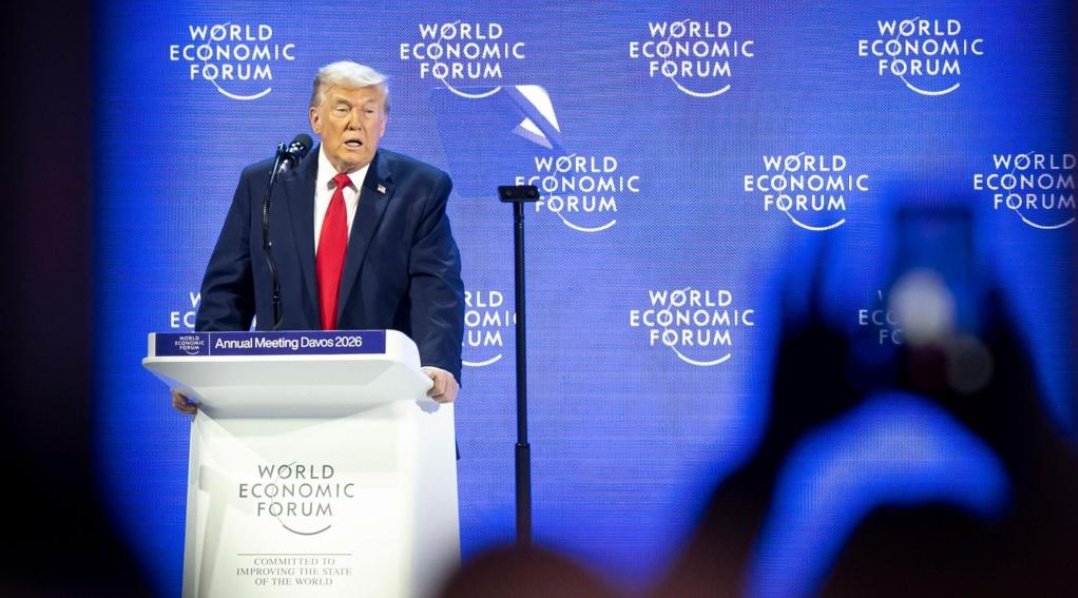
On January 21, Donald Trump delivered a speech at the World Economic Forum in Davos that was less a diplomatic address than a structured declaration of an alternative global order. It was neither an attempt to ingratiate himself with global elites nor a gesture of consensus-building. For Trump, Davos became a stage for a direct confrontation between two worldviews — the globalist model and a sovereignty-first approach.
The speech lasted more than an hour and was followed by a discussion with WEF leadership and representatives of global finance. It was filled with improvisation, provocations, and characteristic detours, yet beneath this surface lay a coherent strategic line.
America as the System’s Center, Not Its Sponsor
Trump opened by emphasizing the symbolism of the date — the anniversary of his inauguration — and immediately set the core message. The United States, he said, is undergoing “the fastest and most dramatic economic turnaround in history.” This was not presented as a technical economic report, but as a political argument.
He spoke of GDP growth, inflation being “defeated,” rising investment and incomes, framing the situation as an “economic miracle.” The stock market, in his words, is on the verge of a new surge, while recent volatility was dismissed as temporary and externally driven.
The point was not numerical accuracy, but logic. Trump portrayed the U.S. as the only economy capable of sustaining the global system — and from this followed his recurring theme: America will no longer underwrite global stability at its own expense.
Tariffs and Trade as Instruments of Pressure
Tariffs occupied a central place in the speech. Trump spoke of them not as emergency measures, but as a permanent lever of state power. He argued that tariff policy had already sharply reduced the trade deficit and made clear that he sees no reason to abandon this approach.
Europe, Canada, and Switzerland were effectively put on notice. Trade privileges, in his framing, are no longer automatic. In Trump’s logic, tariffs are not threats but a negotiating mechanism — economic pressure replacing diplomatic courtesy.
Energy, Industry, and the Rejection of the “Green Consensus”
Trump sharply criticized European energy policy. He attacked wind power, pointing to Europe’s dependence on Chinese-manufactured equipment and highlighting what he described as a contradiction: China exporting green technologies while relying on fossil fuels domestically.
Against this, he promoted U.S. reindustrialization — steel production, energy expansion, and a strong emphasis on nuclear power. This was a deliberate counter-narrative to Davos’ climate discourse. Trump replaced moral language with the vocabulary of capacity, cost, and control.
Cryptocurrency and Technological Sovereignty
Trump also addressed cryptocurrency, declaring his intention to make the United States the global capital of the crypto industry. In his framing, this was not ideological libertarianism, but geopolitics. Regulation was presented as a tool to prevent China from gaining an edge and to lock in U.S. leadership in emerging financial systems.
Greenland as a Concentrated Expression of His Worldview
The most controversial segment concerned Greenland. Trump openly stated that the United States wants to obtain control over the island, emphasizing its importance for North American security. He explicitly ruled out the use of force.
What mattered was not the object itself, but the reasoning. Trump spoke in terms of geography, resources, and strategic control, bypassing conventional diplomatic language. His formula — “you can say yes, or you can say no, and we will remember” — was perceived as a threat, but in fact reflected his transactional approach to international relations.
Historical references, including disputed claims about World War II and U.S. actions afterward, served not as lessons in history but as instruments of political pressure on Europe.
Europe, NATO, and Fatigue with Allies
Trump’s tone toward Europe was simultaneously harsh and dismissive. He said he “loves Europe,” then accused it of strategic decline — driven by migration policy, deindustrialization, and ideological cultural conflicts.
NATO, in his narrative, appeared as an asymmetric structure in which the U.S. bears the burden without proportional returns. His remarks about World War II — including the line that without the U.S. Europe would be “speaking German” — triggered criticism and ridicule, but fit squarely into his broader message: alliances are accounts to be settled, not values in themselves.
Ukraine, China, and War as a Product of Weakness
On Ukraine, Trump repeated his central claim that the war would not have begun under his presidency. He asserted that both Moscow and Kyiv want a deal and stressed the need to stop the bloodshed.
China appeared as the primary long-term competitor, particularly in artificial intelligence and industrial capacity. His assertions of U.S. superiority in AI and calls for accelerated weapons production reinforced the larger picture — the world is entering an era of hard power competition, where rules matter less than capabilities.
The Signal Sent to Davos
This was not an attempt to persuade Davos. It was a message delivered from the outside — a warning that the era of moral leadership and global redistribution is ending.
Trump spoke from the Davos stage in a language foreign to the forum itself: the language of power, deals, and resources. He offered no compromise, only conditions. The reaction — from applause by supporters to sharp criticism and fact-checking — merely confirmed that his worldview stands in direct conflict with the foundations on which Davos is built.
This was not a speech at Davos.
It was a speech against Davos — delivered from its own stage.
Related Articles

Artificial Intelligence Enters a New Era
27 July 2026
Read more
Agentic AI: Why It Is Poised to Become the Defining Technology of the Coming Years
22 July 2026
Read more
Саммит G7 во Франции: мировые лидеры перед лицом новой эпохи глобальных вызовов
17 June 2026
Read more
China Against the System: How Beijing Is Preparing for an Era of Great Global Confrontation
23 May 2026
Read more