Greece Breaks Ahead
Davos marked the moment when the world finally stopped living on the inertia of the old order. Talk of universal rules, shared values, and automatic guarantees gave way to a far tougher logic of power, infrastructure, and usefulness. In this new reality, unexpectedly for many, Greece is not losing ground but gaining it. The reason is both simple and fundamental. In a fragmented world, geography matters again, and Greece’s geography is now working in its favor more effectively than at any point in recent decades.
What was long perceived as peripheral status is turning into a strategic advantage. The Eastern Mediterranean is returning to the center of global politics, not as a space of historical symbolism, but as a hub of security, logistics, energy, and digital routes. Europe, having shed illusions about its own automatic resilience, is searching for real anchors. The United States is acting directly and transactionally, China prefers to wait and observe, the Middle East remains an area of unstable balances. Against this background, Greece appears as a rare combination of three qualities that Davos valued most this year: institutional predictability, strategic location, and the ability to exercise control over space without loud rhetoric.
The forum made it clear that security is no longer an abstract concept. It is no longer understood as a declaration or a moral obligation among allies. It has become a concrete system of ports, straits, energy terminals, cables, bases, procedures, and political decisions. This is precisely where Greece breaks ahead. It offers not a slogan, but an infrastructural reality. Maritime routes through the Aegean and Ionian seas, control over access to the Eastern Mediterranean, the link between the Balkans and the Middle East, proximity to key energy directions — all of this has ceased to be background context and has become an object of strategic calculation.
Davos showed that Europe can no longer afford the luxury of relying solely on normative power. It needs points where rules are backed by the capacity to enforce and protect them. Greece increasingly looks not like a problematic member, but like a load-bearing element of the European structure. Its role is shifting from an object of solidarity to a subject of resilience. This is a subtle but decisive change. Investors, strategists, diplomats, and security planners are looking at Athens less through the lens of past crises and more as a platform for long-term presence and stability.
Equally important is the way Greece has adapted to the new global logic without unnecessary confrontation. Davos favored those who could be firm in substance and calm in form. Athens does not seek to present itself as the center of the world. Instead, it steadily increases its weight through regional formats, strengthened partnerships, and a reputation for manageability. In an era when many states act impulsively, this composure is increasingly perceived as a strategic asset. Predictability has returned as a form of power.
Energy and digital routes have gained particular importance. Davos made it clear that the struggle for the future is not only about oil and gas, but about data, cables, logistics, and cyber resilience. The Eastern Mediterranean is becoming a competitive space where European, Middle Eastern, and global interests intersect. Greece stands out here as a natural European anchor. Not a voiceless transit zone, but an actor capable of shaping standards and ensuring their implementation.
It is telling that amid the general atmosphere of anxiety and the absence of a positive vision of the future, countries like Greece benefit from the changing era. As universal projects and grand utopias fade, tangible realities gain value. A port, a strait, a base, a route, a stable administration, a clear position. Davos confirmed this quietly, without resolutions or manifestos. And in that silence, Greece spoke louder than many.
For Europe itself, the Greek factor offers a chance to restore part of its lost agency. Not through global ambition, but through regional architecture. The Eastern Mediterranean gives the European Union a space to act as a strategist rather than merely a regulator. Within this framework, Greece looks not like an appendix, but like a pillar. It is a rare case where national interest and European necessity align.
As a result, Davos 2026 can be seen as the point where it became clear that the era of excuses for Greece is over. It is no longer viewed as a country that needs to be rescued or supported. It is increasingly seen as a country through which solutions are delivered. In a world of deals, fragmentation, and hard calculations, that is what it truly means to break ahead.
Related Articles

Artificial Intelligence Enters a New Era
27 July 2026
Read more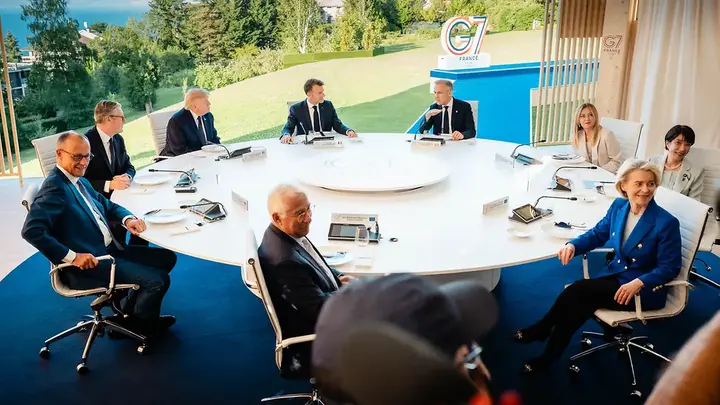
Саммит G7 во Франции: мировые лидеры перед лицом новой эпохи глобальных вызовов
17 June 2026
Read more
The AI Tsunami: What Dario Amodei Warned About — And Why the Numbers Matter
26 February 2026
Read more
Iceland Reopens the EU Question: National Referendum on Restarting Accession Talks Scheduled for 2026
26 February 2026
Read more