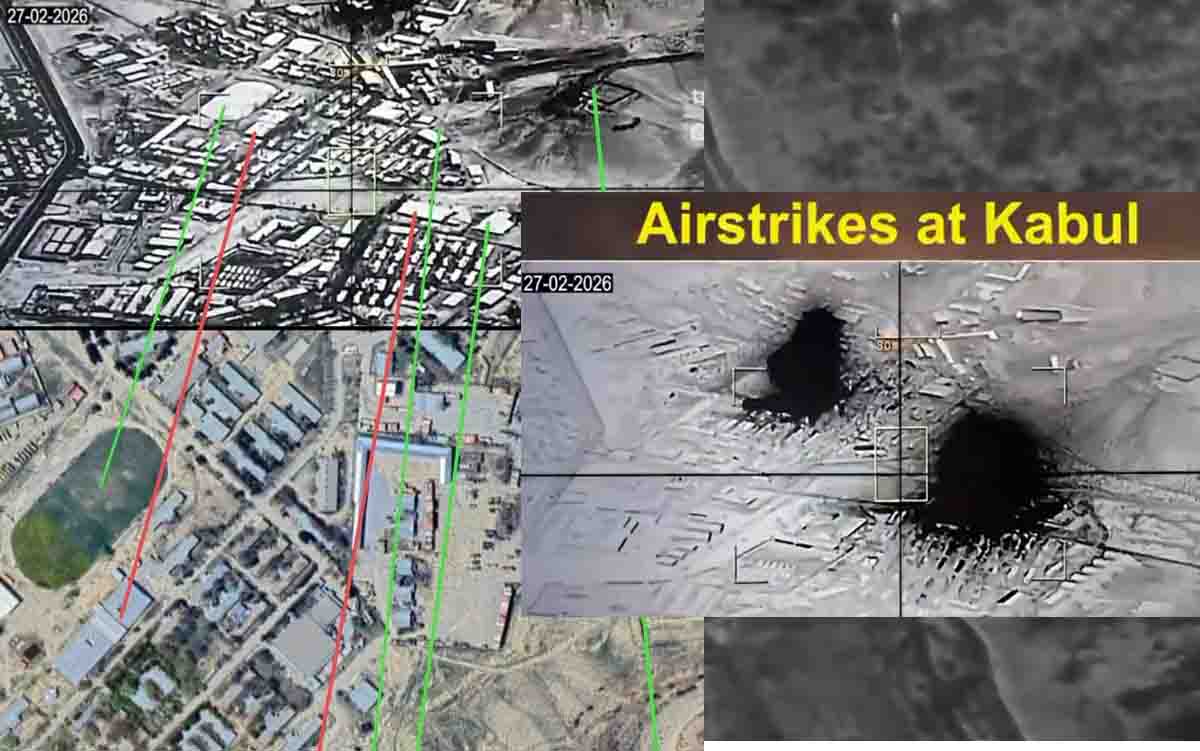
The February 2026 Afghan–Pakistani Escalation: From Border Crisis to Limited Interstate War
.png "Department of Strategic Monitoring")
In late February 2026, tensions between Afghanistan and Pakistan entered a qualitatively new phase. Within forty-eight hours, what had long been a pattern of cross-border skirmishes and reciprocal accusations along the Durand Line evolved into exchanges of strikes beyond the immediate frontier zone, including reports of targets hit in the vicinity of Kabul. Public rhetoric on both sides approached the language of open war, and the pace of events underscored how fragile the security equilibrium between the two states remains.
On the night of February 26–27, Pakistan carried out airstrikes against targets on Afghan territory. According to official statements from Islamabad, the operation was a response to cross-border militant activity allegedly originating from Afghan soil. Pakistani officials reported strikes in Kabul as well as in Kandahar and Paktia, framing the actions as a form of coercive signaling aimed at restoring deterrence. They emphasized that diplomatic channels had been used previously but had failed to produce meaningful change.
Afghan authorities responded by announcing the launch of a retaliatory operation along the Durand Line. Statements from Kabul referenced strikes on Pakistani military facilities, including locations in Jamrud, Nowshera, and Abbottabad. Afghan sources also cited the use of unmanned aerial systems and claimed the capture of certain border posts. Pakistani officials disputed several of these assertions, maintaining that their air defenses had intercepted incoming threats and that claims of territorial gains were exaggerated. Discrepancies in reported casualties and damage remain significant, and independent verification is limited.
Simultaneously, intense clashes unfolded in multiple border sectors. Fighting was reported in Kurram, Bajaur, and Khyber on the Pakistani side, and in the Afghan provinces of Khost, Nangarhar, Paktika, and Nuristan. The engagements involved artillery fire, heavy weapons, anti-armor systems, sniper units, and drone technology. Both governments claimed to have inflicted substantial losses on the other, yet confirmed figures are unavailable, and the information environment is saturated with competing narratives.
The escalation has structural roots that extend beyond the immediate trigger. The Durand Line continues to carry political and historical sensitivities, and its legitimacy is perceived differently across the border. The frontier region is characterized by dense tribal, social, and economic ties that predate the modern state boundary, complicating enforcement and control. Pakistan has long argued that militant networks exploit Afghan territory to conduct attacks, while Afghan authorities interpret Pakistani strikes as violations of sovereignty. As a result, the confrontation is framed through two incompatible logics: enforcement of security versus defense of territorial integrity.
From a military standpoint, the current phase appears limited rather than indicative of preparations for large-scale territorial invasion. There are no confirmed signs of extensive mechanized deployments aimed at deep incursions. Nonetheless, the widening geographic scope of strikes and the use of airpower increase the risk of civilian casualties and miscalculation. In an environment marked by low trust and rapid escalation cycles, even calibrated actions can be interpreted as precursors to broader operations.
The information dimension further complicates assessment. Claims regarding the destruction of headquarters, ammunition depots, and dozens of military positions have circulated widely, often accompanied by video footage whose authenticity and geolocation require scrutiny. Competing narratives seek to shape domestic and international perceptions, making it difficult to separate operational reality from strategic messaging.
The regional context amplifies the stakes. Afghanistan and Pakistan occupy a pivotal position in South and Central Asia, intersecting with major trade routes, migration corridors, and security networks. Sustained instability along their border could disrupt economic flows, intensify displacement, and create opportunities for non-state armed actors to expand their influence. External actors may attempt mediation, but the effectiveness of such efforts will depend on the willingness of both sides to recalibrate their objectives.
The central question is whether this episode remains a contained demonstration of force or evolves into a more enduring cycle of confrontation. Previous crises between Kabul and Islamabad have de-escalated after limited exchanges, yet each escalation raises the threshold of acceptable violence. The events of February 2026 have already shifted that threshold, signaling a readiness to carry conflict beyond traditional frontier skirmishes. Whether this moment proves transient or marks the onset of a more sustained phase of Afghan–Pakistani rivalry will become clearer in the weeks ahead.
Related Articles
India and the United States Conclude a Final Trade Agreement Reshaping the Global Economic Balance
3 February 2026
Read more
The EU and India in Search of Strategic Autonomy
27 January 2026
Read more
India on High Alert Ahead of Republic Day
21 January 2026
Read more
Tests in the Bay of Bengal
22 December 2025
Read more