India and the United States Conclude a Final Trade Agreement Reshaping the Global Economic Balance

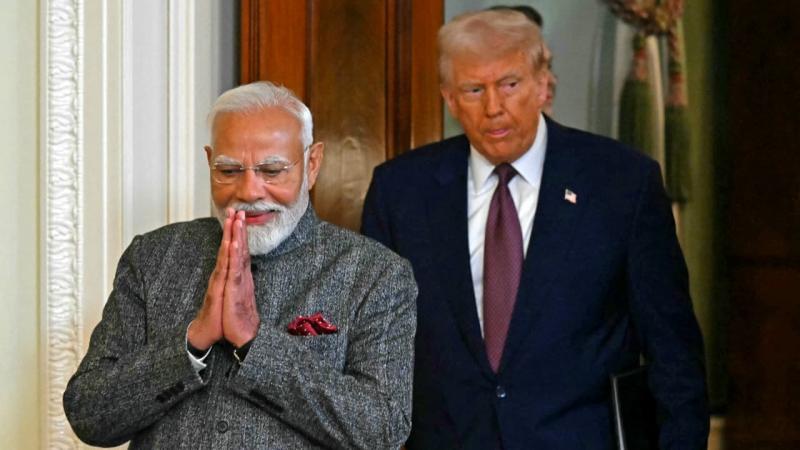
India’s Prime Minister Narendra Modi and the administration of the United States have announced the conclusion of a new trade agreement between the world’s two largest democracies, an accord that fundamentally alters the framework of bilateral trade and economic relations and reflects a broader shift in the global economic architecture. The agreement effectively eases tensions that had accumulated after a series of reciprocal tariff measures in 2025 and lays the groundwork for a significant expansion of trade turnover and cooperation in strategically important sectors of the economy.
The central economic element of the agreement is a reduction of tariffs on Indian exports to the United States from roughly 50 percent to around 18 percent. Previously, this level consisted of a base tariff combined with an additional punitive levy introduced in response to New Delhi’s foreign-policy and energy decisions. The removal of the extra tariff and the overall cut in duties substantially improve the competitiveness of Indian goods on the U.S. market, where comparable rates for other Asian suppliers stand at approximately 19–20 percent.
The agreement also sets out India’s commitments to reduce and, over time, discontinue purchases of Russian crude oil, which in recent years has played a major role in India’s energy balance. In exchange, the United States offers a package of economic incentives, among them tariff relief, broader access for Indian goods to the American market, and an expected increase in U.S. exports to India. These exports are expected to cover oil and liquefied natural gas, defense equipment, aircraft, telecommunications systems, pharmaceuticals, and agricultural products. According to international estimates, India’s purchases of U.S. goods could reach as much as 500 billion dollars in the coming years.
Even before the deal, bilateral trade volumes were substantial. In 2024, trade between India and the United States was estimated at about 212.3 billion dollars. Indian exports to the U.S. amounted to roughly 87.3 billion dollars and spanned a wide range of products, from electronics and pharmaceuticals to jewelry and textiles. In return, India imported large volumes of U.S. energy resources, industrial equipment, and advanced technologies.
Financial markets reacted swiftly to the announcement. The Indian rupee strengthened by more than 1 percent, marking its sharpest single-day gain in seven years. The benchmark Nifty 50 equity index rose by approximately 2.6–3 percent, while shares of export-oriented companies, particularly in the textile and industrial sectors, recorded gains of up to 20 percent. These movements reflect investor expectations of stronger economic growth in India and more favorable external trade conditions.
In practical terms, the agreement provides Indian companies with more predictable and stable access to the world’s largest consumer market, while giving American businesses expanded opportunities in one of Asia’s fastest-growing economies. This is particularly important for industries with long investment cycles, such as aviation, defense, and telecommunications, where demand in India continues to grow steadily.
At the same time, the deal does not eliminate all restrictions. For a number of sensitive categories, including steel, aluminum, and certain automotive components, tariffs may remain elevated due to U.S. legislation related to national security considerations. Analysts note that the current agreement should be viewed as an initial phase of a broader trade and economic framework that will require further negotiations and clarification of implementation mechanisms.
In recent years, India had been among the countries facing the highest overall tariff burden on the U.S. market. The new agreement significantly alters this position, lowering barriers and moving toward a more balanced model of bilateral trade. This shift takes place against the backdrop of a wider reconfiguration of global production and trade chains, as major economies seek to reduce risks and diversify external economic ties.
Overall, the India–U.S. trade agreement reflects a broader transformation of the global economy, in which leading states are focusing not only on increasing trade volumes but also on deeper strategic integration, growing interdependence, and a redistribution of roles within global value chains. Despite remaining limitations and political conditions, the deal has the potential to exert a noticeable influence on global markets and the international economic landscape in the medium term.
Related Articles

Artificial Intelligence Enters a New Era
27 July 2026
Read more
Agentic AI: Why It Is Poised to Become the Defining Technology of the Coming Years
22 July 2026
Read more
Саммит G7 во Франции: мировые лидеры перед лицом новой эпохи глобальных вызовов
17 June 2026
Read more
China Against the System: How Beijing Is Preparing for an Era of Great Global Confrontation
23 May 2026
Read more