Tests in the Bay of Bengal
.png "Department of Strategic Monitoring")
Tests in the Bay of Bengal: Indian NOTAMs, the Maritime Leg of Deterrence, and Strategic Intelligence Competition with China
А signal, not merely a notice
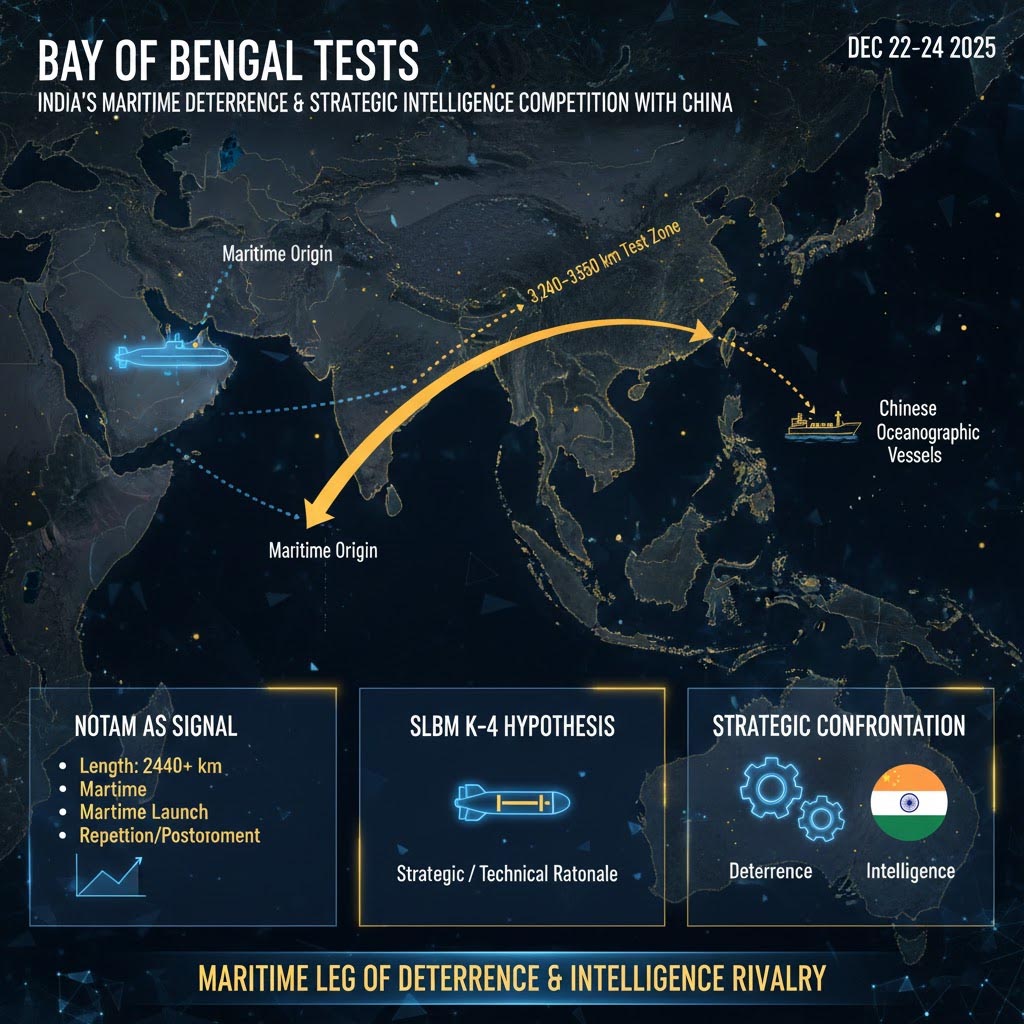
The series of NOTAMs issued by India over the Bay of Bengal for the period 22–24 December 2025 goes well beyond routine navigational safety measures. The geometry of the restricted zone, its length — estimated at approximately 3,240 to 3,550 km — as well as repeated adjustments to timing and configuration, point to preparations for a strategic long-range missile test of maritime origin. Against the backdrop of parallel activity by Chinese oceanographic vessels, the episode takes on the character of a strategic-intelligence confrontation, rather than an isolated technical event.
NOTAMs as an instrument of strategic signaling
In Indian practice, NOTAMs related to missile tests traditionally serve not only as formal notifications to civilian aviation and maritime traffic, but also as public indicators of readiness. In this case, three parameters are decisive:
- The length of the corridor, exceeding what is typical for cruise missiles or short-range ballistic systems.
- The maritime configuration, which rules out land-based test ranges and points to a sea-launched system or a maritime phase of flight.
- Repetition and postponements, creating an unstable temporal profile atypical for purely technical preparation.
Taken together, these elements suggest that the NOTAMs functioned not as a one-off warning, but as a dynamic component of a broader operation, in which the notification itself becomes part of interaction with external observers.
The SLBM K-4 hypothesis: technical and strategic rationale
The leading analytical hypothesis concerns a possible test of the K-4 submarine-launched ballistic missile (SLBM) developed by India’s Defence Research and Development Organisation (DRDO). This assessment rests on a convergence of factors rather than on a single indicator:
- The reported range of the K-4 (around 3,500 km) closely matches the upper limit of the declared NOTAM corridor.
- Previous tests in 2024, according to industry and Indian media sources, were conducted from India’s second nuclear-powered ballistic missile submarine of the Arihant class, INS Arighaat, indicating a phase of system refinement and operational validation.
- The absence of official attribution by Indian authorities is consistent with sensitive stages of strategic weapons programs.
It is important to note that the lack of official confirmation neither disproves the K-4 hypothesis nor excludes alternative scenarios, such as the testing of another long-range system or elements of maritime launch infrastructure.
The Chinese factor: “research vessels” as intelligence platforms
A significant element of the December episode was the presence in the region of several Chinese research and survey vessels, among them Lan Hai 101, Shi Yan 6, Shen Hai Yi Hao, and Lan Hai 201. While officially engaged in scientific missions, such platforms are widely viewed in Indian and Western analytical circles as dual-use assets.
In the context of missile testing, their potential value lies in the ability to:
- conduct acoustic monitoring of undersea activity,
- collect indirect data on launch events and flight profiles,
- identify impact zones of missile stages,
- observe patterns of naval escort and recovery operations.
Even without direct access to telemetry, such data accumulate over time and enhance the accuracy of adversarial capability assessments.
The logic of uncertainty: why India keeps shifting the window
The repeated postponement and reissuance of NOTAMs in December has led to interpretations of a deliberate strategy of managed uncertainty. Within this framework, notifications serve multiple purposes:
- Testing the reactions of external observers, particularly the movement and positioning of Chinese vessels.
- Reducing the intelligence value of collected data by forcing observers to reposition or lose optimal observation windows.
- Concealing the true launch moment, which remains known only to a narrow circle of decision-makers.
Such practices are characteristic of states strengthening the maritime leg of their strategic deterrent and seeking to limit information leakage during critical development and validation phases.
Broader strategic context
The Bay of Bengal episode fits into a wider regional pattern:
- India is accelerating the development of its maritime nuclear deterrent to improve survivability and autonomy.
- China continues to expand its presence in the Indian Ocean through “grey-zone” instruments such as research vessels, logistical access points, and port visits.
- The region increasingly represents an intersection of nuclear-armed powers’ interests, with limited transparency and weak confidence-building mechanisms.
In such an environment, even a technical test inevitably acquires political and military significance.
Confirmed facts and analytical assumptions
Confirmed facts:
- India issued large-scale NOTAMs over the Bay of Bengal for 22–24 December 2025.
- The parameters of the restricted zone correspond to profiles associated with long-range missile testing.
- Chinese research vessels were present in the region during this period.
Analytical assumptions:
- A direct link between the specified window and a K-4 SLBM test.
- The deliberate use of a “cat-and-mouse” strategy as a strategic tool rather than coincidence.
- The scope and quality of intelligence collected by Chinese platforms.
Conclusion
The December NOTAMs over the Bay of Bengal should be viewed not as an isolated technical event, but as a fragment of strategic interaction, in which testing, intelligence collection, and capability signaling are tightly interwoven. Regardless of whether a launch occurred within the declared window, the scenario itself reflects intensifying competition in the Indian Ocean and a shift toward more sophisticated forms of signaling and counter-intelligence among regional powers.
Sources
Chatham House
India Today
South China Morning Post
Mathrubhumi
The Tribune India
Naval Technology
The Economic Times
Related Articles

Artificial Intelligence Enters a New Era
27 July 2026
Read more
China Against the System: How Beijing Is Preparing for an Era of Great Global Confrontation
23 May 2026
Read more
The Race for AGI: How Artificial Intelligence Is Reshaping the Global Balance of Power
14 May 2026
Read more
China and Global OSINT: How Analysts Are Tracking the New Superpower of the 21st Century
14 May 2026
Read more