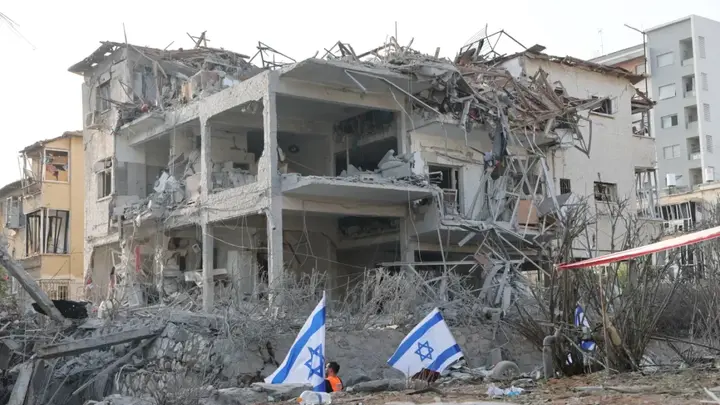
Washington, Tel Aviv and Tehran: How the Iranian Crisis Is Beginning to Reshape the Entire Middle East
The continuing tensions surrounding Iran are gradually evolving far beyond the framework of a conventional Middle Eastern crisis. American and Israeli media outlets are increasingly discussing possible disagreements between Donald Trump and Benjamin Netanyahu over the future strategy toward Tehran. Formally, the debate revolves around negotiations, sanctions, possible strikes and diplomatic pressure. In reality, however, the situation is far deeper. What is now emerging is a collision between two fundamentally different strategic visions regarding the nature of the Iranian threat itself.
For Israel, the Iranian issue has long been viewed as a matter of strategic survival. Israeli political and military elites have spent decades operating under the belief that Tehran cannot be treated as an ordinary regional adversary. Within Israel’s security doctrine, Iran is perceived as a long-term project aimed at gradually surrounding Israel through a network of allied structures, military formations and political influence across the Middle East.
This is precisely why any attempt to prolong the timeline surrounding Iran’s nuclear program is viewed with extreme suspicion in Tel Aviv. The Israeli strategic mindset is built around the assumption that every additional week of negotiations, every delay and every pause objectively strengthens Iran itself. Within this framework, diplomacy is often perceived not as a solution, but rather as a mechanism allowing Tehran to gain strategic time.
History demonstrates that this logic has long been embedded within Israeli military doctrine. In 1981, Israel struck Iraq’s Osirak nuclear reactor. In 2007, Israeli forces targeted a Syrian facility in Deir ez-Zor. Over recent years, Israeli aviation has repeatedly conducted strikes against Iran-linked infrastructure in Syria. For Israel’s security establishment, preventive action has consistently been viewed as a legitimate instrument for preventing a far more dangerous scenario in the future.
Yet the current situation differs from previous crises in almost every possible way.
Iran in 2026 is no longer the isolated regional power of the early 2000s. Over the past two decades, Tehran has managed to construct one of the most sophisticated regional influence architectures in the Middle East. This extends far beyond the development of missile capabilities or the strengthening of the Islamic Revolutionary Guard Corps. It involves the creation of an entire distributed pressure system spanning multiple regions simultaneously.
According to various estimates, Iran possesses thousands of ballistic and cruise missiles of different ranges. Massive resources have been invested in underground infrastructure, fortified facilities and dispersed production networks. In addition, Tehran has significantly expanded its drone capabilities, a factor that became particularly visible with the global spread of Iranian unmanned technologies across multiple conflict zones.
However, the most important transformation is not purely military. The real strategic shift lies in the creation of a vast regional network of allied structures and proxy mechanisms. Lebanon, Syria, Iraq and Yemen have effectively become interconnected parts of a highly complex geopolitical system in which Iran functions as one of the central nodes.
This is precisely why Washington evaluates the prospect of direct conflict far more cautiously.
For the American system, the current situation is significantly more complicated than the environment surrounding the Iraq invasion in 2003. At that time, the United States occupied a completely different position both domestically and globally. Today, America faces several simultaneous large-scale crises — the war in Ukraine, escalating competition with China, instability in the Red Sea and growing internal political polarization.
Under these conditions, a full-scale war with Iran becomes an extremely risky scenario for Washington.
The economic factor remains especially sensitive. A substantial portion of global oil supplies passes through the Strait of Hormuz. Any serious destabilization of the region would immediately threaten dramatic increases in energy prices. For a global economy already struggling with inflationary pressures, debt burdens and fragile logistics chains, such a scenario could become extraordinarily painful.
For Donald Trump, this dimension carries particular significance. Despite his aggressive rhetoric and reputation as a politician inclined toward hard pressure tactics, Trump has consistently demonstrated caution toward prolonged military campaigns. During his first presidency, he pursued a policy of maximum pressure against Iran, withdrew from the JCPOA nuclear agreement, imposed sweeping sanctions and authorized the killing of General Qassem Soleimani. Yet even after these moves, he avoided crossing the threshold into full-scale war.
It is precisely here that a potential strategic divergence between Washington and Tel Aviv begins to emerge.
The Israeli logic is built around the assumption that delay is more dangerous than escalation. A significant portion of the Israeli establishment believes that if Iran eventually approaches full nuclear weapons capability, the price of any future confrontation will become exponentially higher.
The American logic is increasingly more restrained. Washington fully understands that a strike against Iran can no longer be viewed as a localized military operation with limited consequences. Any major conflict would automatically affect the entire regional security infrastructure. American bases in Iraq and Syria, maritime routes in the Persian Gulf, allied energy infrastructure and global supply chains would all immediately come under threat.
Moreover, Iran has spent years preparing specifically for an asymmetric confrontation model. Tehran understands the limitations of direct military confrontation with the United States. As a result, it has focused on building a distributed pressure system in which conflict rapidly spreads across multiple fronts simultaneously.
This is why many American analysts today fear not merely the strike itself, but the consequences that would follow. The central problem is that under current conditions, nobody can realistically guarantee that escalation would remain controllable.
At the same time, another important factor is becoming increasingly visible.
For Benjamin Netanyahu, the Iranian issue is deeply connected not only to foreign policy, but also to Israel’s internal political environment. Following years of severe domestic crises, polarization surrounding judicial reform and enormous pressure related to Gaza, the theme of external threat once again serves as a powerful mechanism for political consolidation inside Israel.
For Trump, however, the primary focus remains domestic American politics, economic stability and electoral considerations within the United States itself. It is here that the divergence of motivations begins to acquire increasingly visible strategic importance.
This explains why the current information environment appears so contradictory. Media reports constantly alternate between discussions of possible strikes, signals regarding negotiations and new leaks about military preparations and hardline scenarios. In reality, an extraordinarily complex strategic game is now unfolding, in which each side simultaneously attempts to preserve room for maneuver while increasing pressure on its opponents.
Iran seeks to demonstrate that the price of conflict would become unbearably high for all participants.
Israel seeks to convince the American system that further delay only strengthens the threat.
Washington attempts to balance the need to project strength with the desire to avoid another massive Middle Eastern war.
This is precisely why the current crisis appears so unstable and psychologically tense. The Middle East has effectively entered a prolonged state of strategic anticipation in which all actors continue raising the stakes while simultaneously fearing the moment when the entire process could slip beyond anyone’s control.
Related Articles

Artificial Intelligence Enters a New Era
27 July 2026
Read more
Agentic AI: Why It Is Poised to Become the Defining Technology of the Coming Years
22 July 2026
Read more
Саммит G7 во Франции: мировые лидеры перед лицом новой эпохи глобальных вызовов
17 June 2026
Read more
China Against the System: How Beijing Is Preparing for an Era of Great Global Confrontation
23 May 2026
Read more