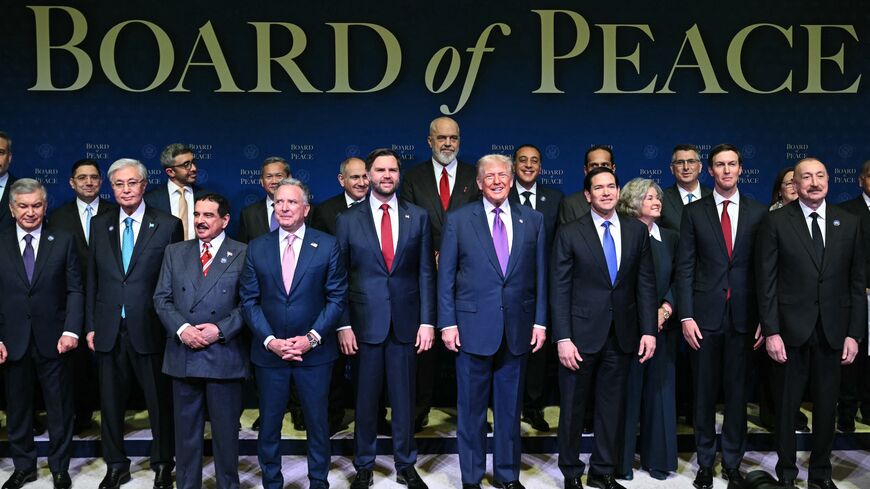
The “Board of Peace” in Washington: A New Geopolitical Platform Between Gaza’s Reconstruction and the Prospect of War with Iran
The inaugural meeting of the “Board of Peace” in Washington marks far more than the launch of another international forum. Conceived and led by U.S. President Donald Trump, the initiative presents itself as a new operational architecture for managing conflict — one that merges reconstruction, security stabilization, financial coordination, and high-level political leadership into a single platform.
From the outset, the tone was deliberately ambitious. President Trump described the Board as one of the most consequential undertakings of his career, calling it the most prestigious council ever assembled. The message was clear: this is not a consultative gathering but an action-oriented mechanism designed to implement peace rather than merely discuss it.
At the center of the initiative lies Gaza.
A newly established National Committee for the Administration of Gaza outlined a structured transition plan built around four primary pillars: restoring security, reviving economic activity, ensuring sustainable emergency relief, and rebuilding basic services such as electricity, water, healthcare, and education. A new civilian police force under a single authority is being formed, with plans to recruit and train 5,000 officers within 60 days. Thousands reportedly applied within hours of the recruitment announcement.
Parallel to this internal restructuring, an International Stabilization Force (ISF) is being established. Indonesia, Morocco, Kazakhstan, Kosovo, and Albania have agreed to deploy troops. Indonesia signaled readiness to contribute up to 8,000 personnel and assume a deputy command role. Egypt and Jordan have committed to training Palestinian police forces. The territory will be divided into five sectors, each overseen by one ISF brigade, with Rafah prioritized in the initial phase.
The model being proposed can be described as “peace through managed reconstruction.” Security will be enforced through a unified civilian authority backed by international forces. Economic revival will be supported by regional integration and external investment. Governance will transition gradually toward structured self-administration.
The U.S. administration presented a ten-year transformation framework for Gaza. By year three, Rafah is expected to be fully rebuilt, unemployment significantly reduced, and Gaza integrated into what was termed an “Abrahamic Gateway” — a corridor linking Egypt, Israel, Jordan, Gulf states, and extending toward India and Europe. By year ten, Gaza is envisioned as self-governed, economically viable, and regionally connected.
Financial commitments were central to the presentation. The United States pledged $10 billion to the initiative. Kazakhstan, Azerbaijan, the UAE, Morocco, Bahrain, Qatar, Saudi Arabia, Uzbekistan, and Kuwait collectively committed more than $7 billion. A resolution establishing principles of financial integrity and transparency was signed during the session.
Speeches from participating leaders reflected varying interpretations of the initiative’s strategic meaning. Kazakhstan’s President described the project as unprecedented and innovative in its approach to “peace through construction.” Argentina’s President emphasized the need for institutional mechanisms capable of enforcing order rather than relying solely on consensus. Hungary expressed support for the format as a pragmatic alternative to diplomatic stagnation. Turkey signaled readiness to contributeрtribut to stabilization efforts while reaffirming that a two-state solution remains the foundation of long-term peace.
Israel’s Foreign Minister highlighted prior cooperation with the U.S. and framed the initiative within broader regional security considerations. Pakistan’s Prime Minister praised President Trump’s mediation efforts in South Asia, describing him as instrumental in preventing escalation between India and Pakistan.
The Board of Peace was also framed in relation to the United Nations. President Trump stated that the U.S. intends to “bring the UN back” and strengthen it operationally, while suggesting that the Board could serve as a corrective oversight structure ensuring effectiveness. Albanian leadership emphasized that the initiative is not meant to replace the UN but could catalyze institutional revitalization.
However, the broader geopolitical context complicates the picture.
The meeting unfolded amid escalating tensions with Iran. U.S. forces have increased their regional presence, and discussions of a potential limited strike within days or weeks are ongoing. President Trump publicly gave Tehran a 10–15 day window to reach a nuclear agreement, warning of consequences if no deal is achieved. Israeli officials have indicated readiness for any scenario. Iranian representatives have warned that any aggression would trigger proportional retaliation against regional assets.
In this context, the Board of Peace functions on two parallel tracks: a reconstruction and stabilization initiative for Gaza, and a demonstration of coalition alignment ahead of potential regional escalation.
President Trump also extended invitations to China and Russia to join the Board, signaling an aspiration for broader global inclusion. Whether such participation materializes remains uncertain.
Strategically, the Board of Peace represents a hybrid structure: a funding mechanism, a stabilization mission, a political coalition of leaders, and a prototype for crisis management under centralized coordination. If the Gaza model succeeds, it may serve as a template for other conflict zones. If regional tensions erupt into broader confrontation, the initiative risks being overshadowed by military developments.
At this stage, the Board of Peace stands as an institutional experiment — an attempt to merge power projection, reconstruction, and political leadership into a unified framework designed to reshape how conflicts are managed in the twenty-first century.
Related Articles

Artificial Intelligence Enters a New Era
27 July 2026
Read more
Agentic AI: Why It Is Poised to Become the Defining Technology of the Coming Years
22 July 2026
Read more
Саммит G7 во Франции: мировые лидеры перед лицом новой эпохи глобальных вызовов
17 June 2026
Read more
China Against the System: How Beijing Is Preparing for an Era of Great Global Confrontation
23 May 2026
Read more