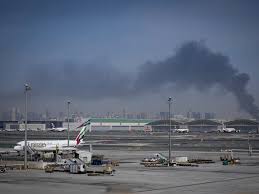
Empty Flights and Silent Panic: War Anxiety Reshapes Air Travel in Dubai

As tensions linked to the war around Iran continue to ripple across the Gulf region, an unusual aviation pattern has begun to attract attention from analysts, travelers, and financial observers alike. Long-haul passenger aircraft are reportedly arriving in Dubai with extremely low occupancy levels, while tens of thousands of people simultaneously seek ways to leave the broader conflict zone. What at first glance appears to be a logistical anomaly is increasingly viewed as an indicator of deeper psychological and economic pressure building across one of the world’s most strategically important hubs.
According to reports circulating in regional media and aviation circles, some incoming flights to Dubai have been operating at barely a fraction of their normal capacity. Wide-body aircraft capable of carrying several hundred passengers are said to be landing with only a few dozen travelers on board. Airlines continue to maintain flight schedules in part to preserve route continuity, regulatory obligations, and cargo connectivity, yet passenger demand has weakened sharply as concerns over regional security intensify.
This trend reflects a broader shift in travel behavior rather than a simple fluctuation in tourism. The Gulf has long been perceived as a zone of stability even during wider Middle Eastern crises. The current conflict environment, however, has introduced new uncertainties related to missile threats, drone activity, temporary airspace restrictions, and the possibility of rapid escalation. Such factors have altered risk calculations not only for individual travelers but also for corporations, insurers, and logistics planners.
Paradoxically, while some flights into Dubai are reportedly near empty, outbound demand appears to be rising. Residents, expatriate workers, and business travelers are increasingly exploring exit options amid fears that transport links could become more constrained if the security situation deteriorates further. This asymmetry between inbound and outbound flows has created an unusual operational dynamic in which aircraft depart with relatively high passenger loads but return with minimal occupancy. In complex aviation networks, such imbalances can strain airline economics, disrupt crew scheduling, and accelerate route adjustments.
Beyond the immediate transport implications, the phenomenon is beginning to feed into wider economic narratives. Dubai and the United Arab Emirates have built global reputations as resilient commercial centers capable of weathering geopolitical turbulence. Nonetheless, the perception of risk alone can affect hotel bookings, investment decisions, conference planning, and real estate sentiment. Some forecasts circulating in financial commentary suggest that sustained instability could push the UAE economy toward contraction levels reminiscent of pandemic-era disruptions, although such projections remain speculative and highly dependent on the duration and geographic scope of the conflict.
The information environment surrounding the aviation situation is also evolving rapidly. Social media posts, anecdotal traveler accounts, and selectively framed statistics are shaping public impressions of an unfolding “exodus,” even as official data remains limited. Analysts caution that in modern crises, mobility patterns often become symbolic markers of fear or confidence, sometimes amplifying narratives faster than verifiable indicators can be compiled. Without comprehensive traffic data and independent verification, it is difficult to determine whether the current pattern represents a structural shift or a temporary reaction to heightened headlines.
At the same time, aviation professionals note that airlines frequently continue operating flights at reduced passenger loads during periods of uncertainty for strategic reasons. Maintaining market presence, supporting cargo flows, and ensuring rapid recovery capacity once conditions stabilize can justify short-term losses. In this sense, near-empty arrivals may reflect calculated operational resilience rather than systemic collapse. Yet the optics of sparsely filled aircraft landing in one of the world’s busiest hubs carry undeniable psychological weight.
From a geopolitical perspective, the situation underscores how modern conflicts extend far beyond battlefields. Air travel disruptions, insurance premiums, shipping delays, and perception-driven capital movements form part of an interconnected ecosystem of pressure points. Even without direct strikes on major cities, the anticipation of risk can alter behavior across continents, reshaping flows of people and goods in ways that gradually influence strategic calculations.
For now, the most accurate assessment remains cautious. Reports of low passenger loads on inbound flights to Dubai and growing outbound demand illustrate a climate of uncertainty rather than a confirmed mass evacuation. The long-term economic and logistical consequences will depend on whether regional tensions subside or intensify. Nonetheless, the emerging aviation patterns provide a revealing snapshot of how quickly global mobility — often taken as a symbol of normalcy — can become a barometer of geopolitical anxiety.
Related Articles

Artificial Intelligence Enters a New Era
27 July 2026
Read more
Agentic AI: Why It Is Poised to Become the Defining Technology of the Coming Years
22 July 2026
Read more
Саммит G7 во Франции: мировые лидеры перед лицом новой эпохи глобальных вызовов
17 June 2026
Read more
China Against the System: How Beijing Is Preparing for an Era of Great Global Confrontation
23 May 2026
Read more