Greenland Shockwave: Europe’s Retaliation Plan and the Alliance Test
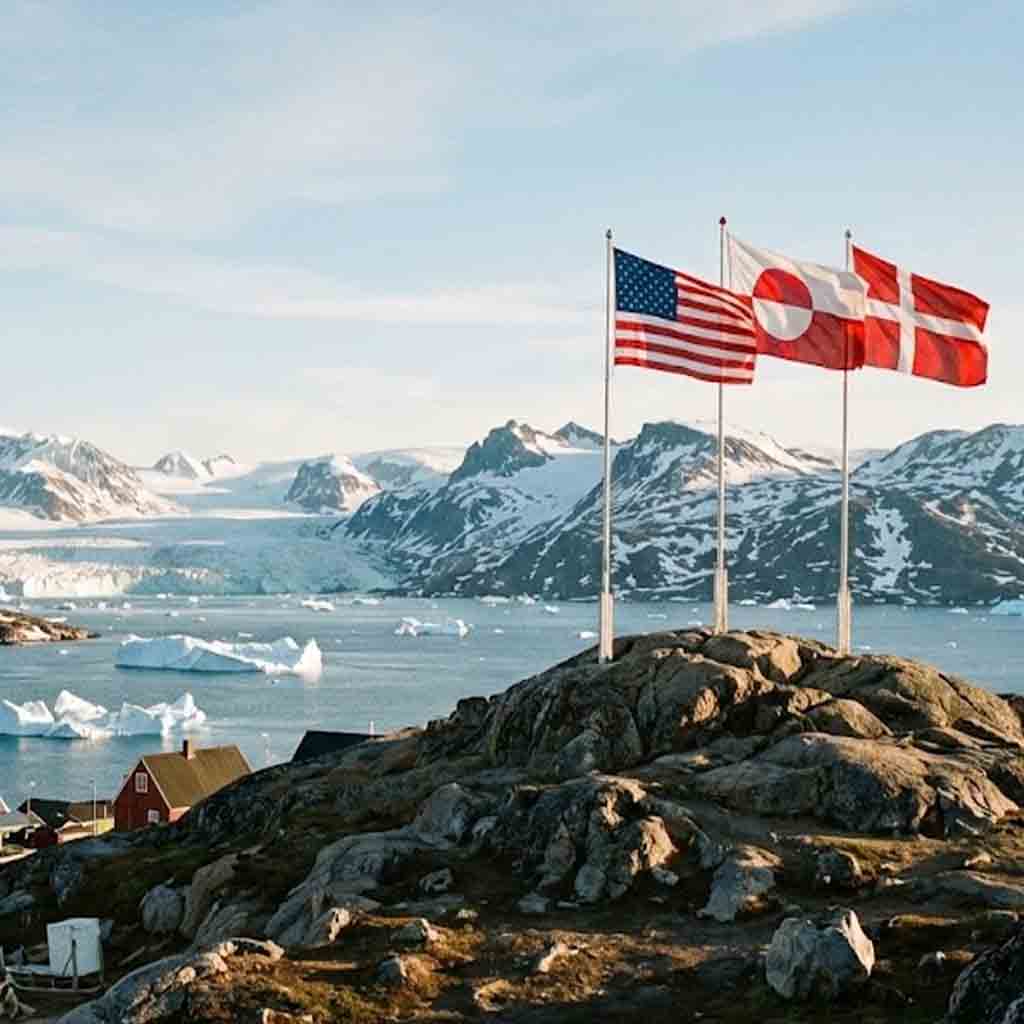
Over the past 24 hours, Greenland has stopped being a distant Arctic headline and turned into a stress test for the entire Western system of power, rules, and alliance discipline. What European capitals are reacting to is not a routine trade quarrel, and not even a sharp diplomatic spat. In their reading, this is an attempt to force political concessions on a sovereignty question through tariff threats. That single linkage, tariffs as punishment for a stance on territory, has pushed Europe from cautious management into crisis posture and triggered the rapid preparation of instruments that Brussels has long kept in reserve.
The catalyst was U.S. President Donald Trump’s public threat to impose punitive import tariffs on a group of European countries, explicitly tying the move to their position on Greenland. In European terms, the argument is not about the percentage rate, the customs code, or the list of goods. The argument is about the method. A trade weapon is being framed as leverage to change political behavior on a territorial issue. That moves the confrontation out of the familiar world of bargaining and into the realm of international law, territorial integrity, and the basic question of whether allies can still assume predictable good faith from each other.
For Europe, Greenland became a breaking point for two structural reasons. The first is the direct coupling of trade punishment with a territorial demand. EU institutions and multiple national governments have made the same public point in different words: sovereignty and territorial integrity are not tradable commodities, and they cannot be negotiated under tariff pressure. The second reason is the NATO setting. The threatened penalties are directed at allies for actions those countries present as part of collective security planning and Arctic defense attention. Once you punish allies for what they describe as alliance-relevant posture, the argument becomes existential: if economic coercion is acceptable inside the alliance, then the alliance’s political foundation is weakened, and every future crisis is harder to manage.
This is why the tone changed so rapidly. Language that European officials usually avoid in public—blackmail, coercion, unacceptable methods—has moved closer to the center of the conversation. There is also a notable admission, often made privately but increasingly reflected in public framing, that the previous approach of restraint and accommodation is failing. European leaders spent months trying to preserve two priorities they considered non-negotiable: keeping the U.S. anchored in NATO and maintaining a coherent Western position on Ukraine. But once tariff threats are used to pressure allies on a sovereignty file, the calculus shifts. The concern becomes that restraint does not buy stability, it buys escalation, because it teaches the stronger side that pressure works.
In practical terms, Europe’s response has formed into two parallel tracks, designed to reinforce each other. The first track is the classic trade counterpunch. Brussels is preparing to reactivate a pre-drafted list of retaliatory tariffs, reported in European discussions as covering up to €93 billion in U.S. exports. The list existed earlier but was politically frozen to avoid a full trade war. Now it is returning to the table as a ready lever. Its purpose is not only economic damage. Its purpose is political pricing. Europe wants Washington to understand that coercion will trigger a measurable cost and that negotiations cannot be reduced to one side issuing demands while the other side absorbs them.
The second track is more sensitive and more political: the debate over using the EU’s anti-coercion instrument, adopted in 2023 and never yet deployed. The significance of that tool is that it goes beyond tariffs on goods. It can, in principle, target market access, investment conditions, and parts of the services economy—precisely where the United States holds major advantages in Europe. That is why the instrument has become a central point of gravity in the discussion. If the dispute remains within the world of goods tariffs, the conflict is painful but familiar. If the anti-coercion instrument is activated, the confrontation moves into a different class, because it touches services and corporate positioning inside the EU’s internal market. France and some partners argue that this is exactly the kind of textbook coercion the instrument was built to counter. Others caution that once such measures are used against the United States, the political aftershock will be long and the path back to predictability will be harder.
This produces the new European tactical formula: calm on the surface, preparation underneath. Publicly, Europe signals a preference for de-escalation and dialogue. Privately and institutionally, it prepares concrete tools for fast activation. Diplomats describe the logic as deterrence combined with an off-ramp—pressure strong enough to change behavior, but structured in a way that still allows the other side to step back without a theatrical loss of face. In crises among major actors, off-ramps matter, because a cornered opponent tends to double down rather than retreat.
Behind the public unity, Europe’s internal arithmetic is complicated. The differences are less about ideology than about exposure. Export-heavy economies fear immediate turbulence and supply-chain disruption. Countries that rely heavily on U.S. military guarantees worry that a trade confrontation could spill into defense cooperation. Others see the crisis as a forcing mechanism to accelerate European autonomy and reduce strategic dependence on Washington. Yet the overarching political instinct is to maintain a single front, because trade policy is negotiated by the EU as a bloc, and many Europeans view Washington’s move as designed to pressure individual states and fracture that unity. If member states start chasing bilateral exceptions, the EU’s leverage collapses and coercion becomes easier next time.
The United Kingdom has emerged as a visible diplomatic node in this moment. London has engaged in rapid consultations with Denmark, EU leadership, and NATO’s secretary-general, and has also spoken directly with Trump. The British line, as framed in recent statements and briefings, emphasizes that Arctic security is a shared responsibility and that punishing allies through tariffs in that context is counterproductive. The political function of these contacts is important. They aim to keep the dispute inside collective formats rather than letting it devolve into a set of bilateral bargains where Washington can pick off states one by one.
Denmark, placed at the center by definition because Greenland sits within the Kingdom of Denmark, has tried to hold a careful balance: firm on principle, measured in tone. Copenhagen’s message has two pillars. First, Europe is not seeking conflict and prefers cooperation. Second, sovereignty is not up for trade and cannot be reshaped under economic threat. This posture is strategic. It preserves diplomatic space while making it impossible to convert tariffs into territorial concessions. Denmark’s core objective is to ensure the issue is treated as European and alliance-wide, not as a solitary Danish problem, because the more collective the response, the harder coercion becomes.
The stakes rose further when senior U.S. messaging argued that Europe is too weak to guarantee Greenland’s security and that enhanced security is not possible without Greenland being under U.S. control. From Europe’s perspective, this is not merely abrasive rhetoric. It functions as an attempted strategic justification, shifting the dispute from tactical bargaining into a narrative that implies control must change hands for security reasons. That makes compromise harder, because it suggests the demand is not a negotiating position but an ideological or geopolitical claim. It also increases Europe’s incentive to prepare materially costly countermeasures, because European leaders conclude that polite diplomacy alone may not blunt an agenda framed in those terms.
This is where Davos becomes the immediate stage, though not the endpoint. With top leaders converging for the World Economic Forum, European officials are trying to use the week to clarify Washington’s real intent and prevent automatic escalation into a tariff-for-tariff spiral. The logic is straightforward: if talks are unavoidable, Europe must enter them with credible leverage, not just statements. That is why tariff lists are being readied and why the anti-coercion instrument is being openly discussed. The message is that Europe prefers a negotiated exit, but it will not accept a new normal where economic threats become the tool for rewriting sovereignty.
Europe’s strategic anxiety is that the trade conflict could spill into the security domain. U.S. military presence, intelligence capabilities, certain categories of weapons supply, and nuclear deterrence remain central to Europe’s defense posture. European leaders are frank that they cannot replace those assets overnight. That reality is one reason some capitals argue for caution. Yet a competing logic is now equally prominent: if Europe absorbs coercion without response, the damage to alliance predictability may be even worse. In that scenario, security risk becomes structural, because every future dispute will carry the precedent that tariffs can be used to pressure allies on political issues.
The next phase therefore runs along a clear fork. One path is de-escalation. The United States moderates the threat, delays implementation, or reframes the issue, and Europe freezes retaliation while keeping tools ready as insurance. The conversation returns to Arctic security in institutional formats, without territorial demands. The other path is normalization of coercion. If punitive tariffs activate on schedule, Europe will almost certainly retaliate, first with goods tariffs and then potentially with broader instruments that touch services and market access. Once that threshold is crossed, every subsequent dispute will escalate faster, because the precedent has been set and both sides will have domestic political incentives to prove resolve.
What the past day’s reporting shows, above all, is that the Greenland file is no longer “about Greenland.” It is about whether the Western alliance operates by shared rules or by raw leverage, and whether trade instruments will become an accepted method of forcing political outcomes inside the alliance itself. Europe is moving to draw a hard boundary. It is preparing retaliation not primarily because of commerce, but because, in its view, surrendering the principle would invite repetition. The argument now driving Brussels is simple: if sovereignty can be traded away under tariff pressure once, it can be demanded again, and then the alliance stops being an alliance and becomes a hierarchy.
Related Articles

Artificial Intelligence Enters a New Era
27 July 2026
Read more
Agentic AI: Why It Is Poised to Become the Defining Technology of the Coming Years
22 July 2026
Read more
Саммит G7 во Франции: мировые лидеры перед лицом новой эпохи глобальных вызовов
17 June 2026
Read more
China Against the System: How Beijing Is Preparing for an Era of Great Global Confrontation
23 May 2026
Read more