The Great U.S. Middle East "Assembly" According to Open-Source Data
.png "Department of Strategic Monitoring")
The Great U.S. Middle East "Assembly" According to Open-Source Data: What OSINT Is Capturing and Why the Current Buildup Looks Like Preparation for a Long-Term Scenario Around Iran and the Red Sea
Today’s OSINT agenda is not dominated by a single "flashy" episode or a localized plot, but by a theme that directly impacts global security, energy markets, and maritime logistics: the rapid buildup of American naval and air capabilities within the CENTCOM area of responsibility. This buildup is synchronized with the diplomatic deadlock over the Iranian nuclear program and rising risks around the Strait of Hormuz and the Red Sea. The importance of this development lies in the fact that it doesn't require "taking someone's word for it." It can be verified through open sources: public statements, professional deployment trackers, commercial satellite imagery, the structure of aircraft transfers, and reports from authoritative media relying on official representatives and a confirmed picture of forces. Essentially, OSINT here functions not as a decorative "we saw something in the sky" genre, but as a system that allows for the reconstruction of intent through indicators. If the number of escort ships is growing, if a second aircraft carrier appears, if the density of tankers and reconnaissance/command aircraft increases, and if satellite images show a new concentration of aviation and air defense elements at bases—this is no longer just talk, but a physical configuration that is difficult to explain as a "routine rotation." This is why the topic is critical right now: it reflects the preparation of infrastructure for a potentially prolonged campaign, rather than a one-off gesture.
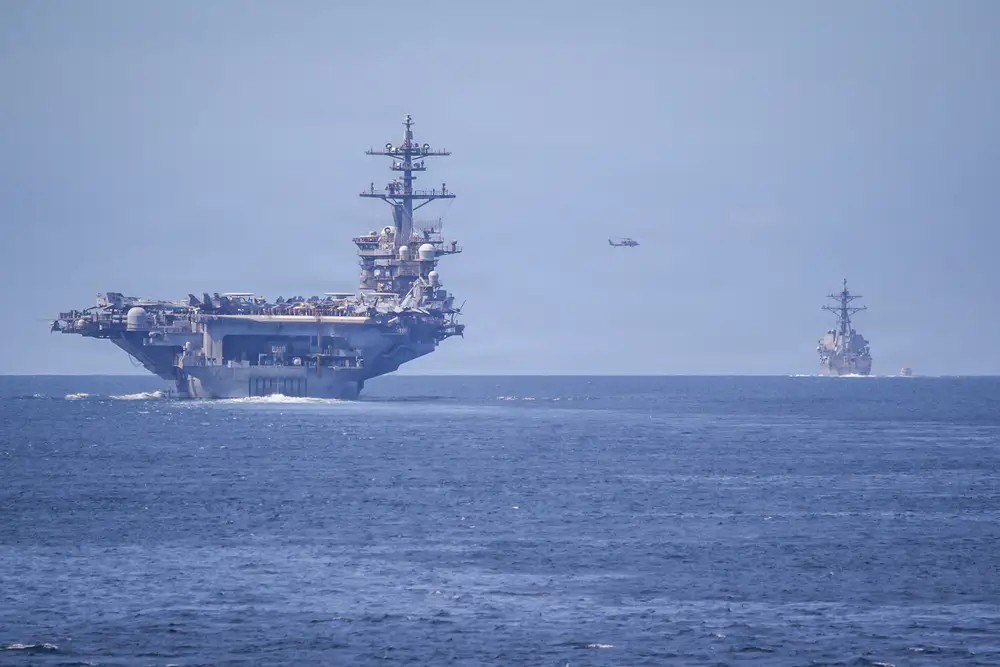
The first layer of facts is naval. The central marker is the deployment of the strike group led by the USS Abraham Lincoln already in the region and the dispatch of a second aircraft carrier, the USS Gerald R. Ford, toward the area. This expansion of surface forces in the CENTCOM zone is part of a strategy to ramp up pressure on Iran. The political context links this to the U.S. administration's "tremendous power" policy in the region and the option of a military scenario should negotiations fail. The decision regarding the Ford was made amid discussions within the Navy concerning maintenance and deployment duration, meaning this is not a light "media cruise" but a deliberate strain on the fleet. Extending and reassigning the Ford could break recent records for deployment length—a key metric for assessing the seriousness of intent.
The second layer is aerial. The U.S. is assembling the largest concentration of air power in the region since 2003, and the composition and structure are characteristic of preparation for a possible sustained air campaign rather than a "symbolic strike." In OSINT terms, this means that when not only fighters but also command, reconnaissance, electronic warfare aircraft, tankers, and search-and-rescue elements are deployed, it signals that planning accounts for duration, sustainability, and combat cycles. These "non-heroic" components are the true indicators of scale.
The third layer is verifiability through commercial satellite imagery and public reconstructions. Satellite images (including Planet Labs) describe a growth in aviation presence at Al Udeid Air Base (Qatar) within specific time windows and emphasize that changes are noticeable when comparing images just weeks or even days apart. This is significant not because "someone saw planes," but because the satellite captures dynamics: if more support vehicles and aircraft appear on the tarmacs, and dispersal and parking configurations change, it indicates a shift to an enhanced basing mode. The list of aircraft types and numerical observations at the base (including tankers and transporters), tied to specific dates of satellite capture, serves as another layer of the signal.
The fourth layer is the official diplomatic-military framework and signs that this is not isolated from negotiations but embedded within them. Following talks in Geneva, a written proposal from Iran is expected, but the American side is operating under a scenario where forces must be "in place" by a certain deadline, with the carrier movement being part of a readiness directive. In other words, the buildup is a tool of pressure within the diplomatic architecture—a demonstration of readiness intended to raise the cost of refusal and accelerate decision-making. In OSINT logic, this is read as follows: when the political track is described as "progress made, but fundamental disagreements remain" while the military track accelerates, it usually signifies an attempt to change the negotiation math through force configuration rather than words.
The fifth layer is the reaction and mirror steps. Against the backdrop of U.S. pressure, reports are emerging of joint naval drills between Iran and Russia (including China in some variations) in the Bandar Abbas region, the Gulf of Oman, and the northern Indian Ocean. This is a classic "buildup—demonstration—counter-demonstration" loop. For OSINT, this is important because such steps increase the density of military units in the area and raise the probability of incidents that could trigger escalation chains.
The sixth layer is the geography of risk: Hormuz and the Red Sea. Hormuz is the global chokepoint for energy and trade, and any increase in forces and maritime warnings reflects on market and insurance risks. Recommendations for American vessels to stay clear of Iranian waters amid negotiations fall into the category of "maritime risk management"—another indicator that scenarios are being treated as potentially dangerous.
The seventh layer is what OSINT specifically sees and why it looks like preparation for a longer scenario. Sending an aircraft carrier on its own might be interpreted as a political gesture. However, when it is accompanied by: (a) an increase in the number of destroyers and escort ships; (b) an increased logistical tempo; (c) a surge in the refueling component; (d) a rise in reconnaissance and command airframes; (e) satellite-confirmed concentrations of aviation and defense assets at bases—this is an architecture designed for resilience and duration. The growth in the number of ships in the region and the diversion of resources from other directions is a decision that impacts fleet readiness, the scale of the air component, and the nature of the preparation.
The eighth layer is Iran as an object of counter-engineering and fortification. Satellite imagery shows the restoration and fortification of several sensitive sites—from military complexes to elements related to nuclear infrastructure—with an emphasis on protecting and camouflaging tunnel entrances and new protective structures (including concrete shields and soil coverings). When one side "brings in" the means for attack and campaign sustainability, and the other increases the physical protection of its assets, the result is not a "diplomatic storm" but engineering preparation for a possible kinetic exchange. This, too, is verifiable through open means by comparing satellite series over time.
The ninth layer is why this topic is more important than any other OSINT news "today." It simultaneously meets three criteria of importance: scale, consistency, and consequences. Scale—because carrier groups, significant air packages, and basing infrastructure are involved. Consistency—because it involves the movement of forces over weeks, altering the global distribution of the fleet and aviation, rather than a single event. Consequences—because the risk of escalation in the Hormuz and Red Sea region affects not only war and diplomacy, but also oil, shipping insurance, prices, supply chains, and the political calculations of dozens of countries.
The tenth layer—what follows from this, stated plainly. Currently, OSINT is capturing not noise, but a construction of pressure. Based on open indicators, the U.S. is assembling a set of forces in the region that provides options: from a demonstration of readiness to potential strikes on specific targets, with the capability to continue operations for weeks. Iran, in response, is fortifying infrastructure and simultaneously participating in demonstrative naval steps with Russia (and China), increasing the density of military activity in a sensitive zone. Diplomacy continues, but in the logic of the parties, "negotiations" have ceased to be an alternative to "preparation" and have become its accompaniment. It is important to define the boundaries of responsibility to avoid substituting analysis with speculation: OSINT does not prove "there will be a strike" and should not trade in prophecies. It does something else—it shows that the material conditions for certain scenarios are being created. And right now, these conditions are being created on a scale that is difficult to explain as routine rotation and is integrated into the political track of pressure on Iran.
Sources:
- The Wall Street Journal: U.S. Gathers the Most Air Power in the Mideast Since the 2003 Iraq Invasion
- Business Insider: US Navy gathering warships Middle East buildup
- Reuters: Satellite images show Iran repairing and fortifying sites amid US tensions
- ABC News: Tracking the US military build-up ahead of possible Iran attack
- The Moscow Times: Iran and Russia to Hold Joint Navy Drills as U.S. Pressures Tehran
- Al Jazeera: US renews threat of military action as Iran, Russia announce naval drills
- The New York Times: As Trump Weighs Possible Iran Strikes, U.S. Military Moves Into Place
- CNN: US military prepared to strike Iran as early as this weekend
- USNI News and other specialized naval and aviation publications
- Wikipedia summary of the 2026 buildup
Related Articles

Artificial Intelligence Enters a New Era
27 July 2026
Read more
Agentic AI: Why It Is Poised to Become the Defining Technology of the Coming Years
22 July 2026
Read more
Саммит G7 во Франции: мировые лидеры перед лицом новой эпохи глобальных вызовов
17 June 2026
Read more
China Against the System: How Beijing Is Preparing for an Era of Great Global Confrontation
23 May 2026
Read more