American Media on Donald Trump’s Visit to China
American media outlets and analytical centers are extensively covering President Donald Trump’s visit to China, describing it as one of the most symbolically charged and strategically significant moments in U.S.-China relations in recent years. Much of the attention is focused not only on the substance of the negotiations in Beijing, but also on the visible transformation of the global balance of power compared to Trump’s first visit to China in 2017.
A broad consensus has emerged across major American publications: China is no longer viewed merely as a rapidly developing competitor, but as a full-scale geopolitical and economic rival to the United States, possessing comparable global influence and strategic weight.
Newsweek notes that in the years since Trump’s 2017 visit to Beijing, China has substantially strengthened its military, economic, and diplomatic position. The magazine recalls that Trump himself had previously acknowledged the new reality by referring to U.S.-China relations as the “Big Two.” According to the publication, the current visit is taking place in a fundamentally different atmosphere. Whereas Washington approached Beijing in 2017 from a position of unquestioned dominance, the relationship is now increasingly defined by parity between two global power centers.
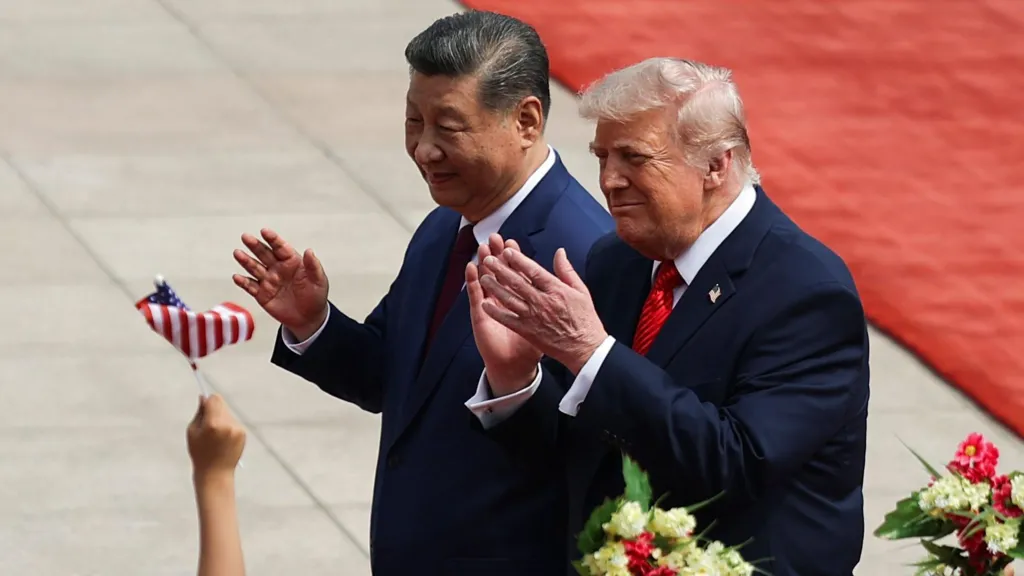
The New York Times highlights the symbolism and political theater surrounding the summit, emphasizing the stark contrast between the personal styles of the two leaders. According to the newspaper, Chinese President Xi Jinping adopted an almost philosophical tone in his remarks, speaking about the historical role of great powers in maintaining international stability. Trump, by contrast, relied on his familiar political style centered around praise, exaggeration, and personal rapport. The publication argues that this contrast became one of the defining visual and political elements of the meeting.
Bloomberg stresses that beneath the carefully managed diplomatic warmth lies deep strategic tension. According to the agency, both Washington and Beijing are currently attempting to stabilize relations at least temporarily and prevent an uncontrolled escalation amid disputes over trade, Taiwan, technology, and global influence. Bloomberg writes that the summit has so far been dominated by “smiles and diplomatic platitudes,” while warning that the coming months will reveal whether the relationship can avoid sliding into a deeper crisis.
One of the most discussed moments of the visit involved the Chinese government’s decision to release portions of Xi Jinping’s remarks before the nearly two-and-a-half-hour talks had even concluded. Bloomberg interpreted the move as a deliberate political signal demonstrating Beijing’s confidence and its intention to shape the narrative surrounding the summit on its own terms.
The Wall Street Journal focused heavily on the Taiwan issue. According to the newspaper, Xi Jinping warned Trump during the talks that mistakes by the United States regarding Taiwan could lead to an “extremely dangerous situation.” The paper notes that Beijing increasingly treats Taiwan not simply as a diplomatic dispute, but as a central pillar of Chinese national security policy, with Chinese officials prepared to react forcefully to any perceived support for Taiwanese independence.
Associated Press emphasized that despite the respectful public tone of the meetings, the positions of Washington and Beijing remain far apart on multiple critical issues. AP cited tensions over Iran, trade disputes, sanctions, technology restrictions, and Taiwan as the principal areas of disagreement between the two powers. At the same time, the agency noted that both governments appear determined to avoid a total strategic rupture due to the potentially catastrophic economic and geopolitical consequences.
CNN argued that Trump arrived in Beijing with significantly less leverage than during his previous presidency. According to the network, domestic political pressures in the United States, election-year dynamics, and broader international instability have weakened Washington’s negotiating position. CNN further suggested that today’s China feels considerably more confident than it did during Trump’s first term and is therefore approaching negotiations from a stronger position.
American media also devoted significant attention to the ceremonial aspects of the visit. CNN and several other outlets observed that Trump was welcomed in Beijing with exceptional pomp and carefully choreographed symbolism clearly tailored to the American president’s well-known appreciation for grand spectacles and visual displays of power. Commentators pointed to military honors, large-scale ceremonies, elaborate protocol arrangements, and highly controlled imagery intended to project respect and stability.
The New York Post noted that the atmosphere surrounding the current visit differs noticeably from Trump’s 2017 trip. According to the newspaper, relations between Trump and Xi now appear more personal and less formalized, although this surface-level warmth coexists with intense strategic rivalry. The publication also highlighted attempts by both governments to project an image of “managed stability” between the world’s two largest powers.
American analysts are also examining the broader international context shaping the negotiations. Commentators cited by The Washington Post, Politico, and several foreign policy think tanks argue that Beijing is seeking to capitalize on U.S. entanglement in Middle Eastern tensions and the confrontation surrounding Iran in order to strengthen China’s own negotiating leverage. Meanwhile, Washington is portrayed as increasingly interested in preventing simultaneous escalation across multiple geopolitical theaters.
A number of analysts describe the summit as an effort by both superpowers to temporarily freeze the most dangerous elements of their rivalry. Nevertheless, most American media outlets conclude that the fundamental contradictions between the United States and China remain unresolved across nearly every major strategic domain, including economics, technology, military security, and influence in the Indo-Pacific region.
Against this backdrop, Trump’s visit to Beijing is widely viewed in Western media not as the beginning of genuine rapprochement, but rather as a major diplomatic episode within an increasingly intense long-term competition between the two dominant power centers of the modern international system.
Related Articles
Artificial Intelligence Enters a New Era
27 July 2026
Read more
Agentic AI: Why It Is Poised to Become the Defining Technology of the Coming Years
22 July 2026
Read more
Саммит G7 во Франции: мировые лидеры перед лицом новой эпохи глобальных вызовов
17 June 2026
Read more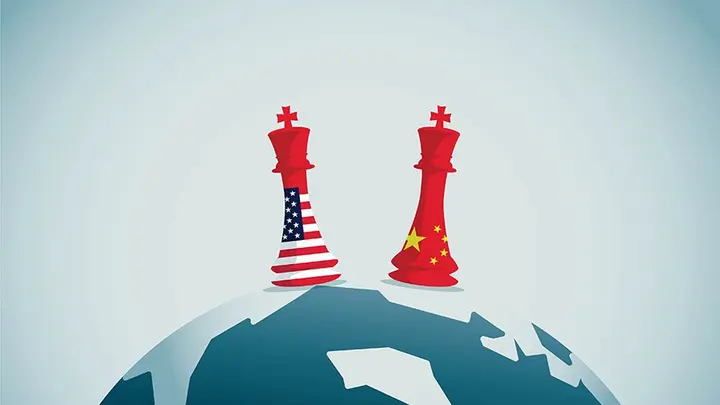
China Against the System: How Beijing Is Preparing for an Era of Great Global Confrontation
23 May 2026
Read more