Geneva 2026: $800 Billion Talks Under 420 Drones — Diplomacy Between Reconstruction and Territorial Deadlock

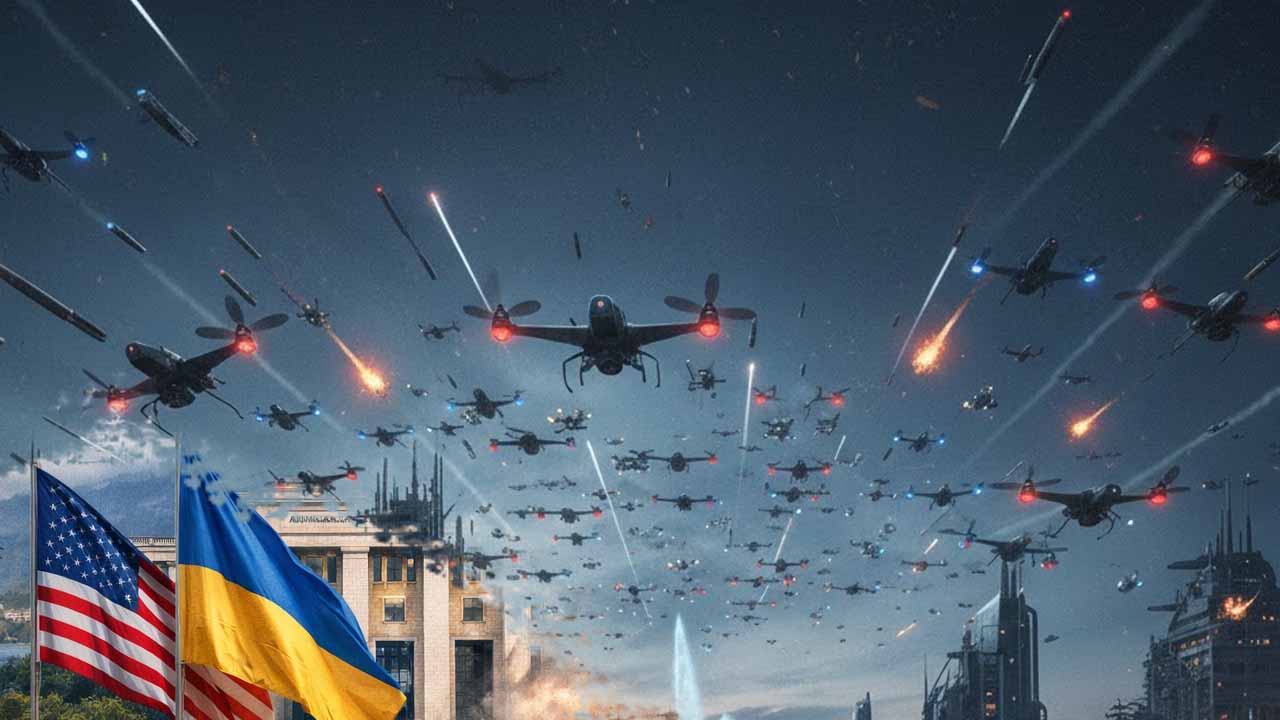
The U.S.–Ukraine negotiations in Geneva are unfolding amid visible military escalation. During the night of February 25–26, according to Ukrainian authorities, 420 drones and 39 missiles — including 11 ballistic — were launched against eight regions. In the Kharkiv area, two missile strikes and 17 drone attacks were reported. In Zaporizhzhia, 19 residential buildings were damaged and approximately 500 homes were temporarily left without heating. At least 20 people were injured, including a seven-year-old child.
These figures are not merely operational data; they shape the political context of the talks. Diplomacy conducted under active fire carries a distinct strategic weight, as each wave of strikes alters the negotiating environment.
The official agenda centers on post-war reconstruction and long-term economic architecture. Kyiv has outlined a target of roughly $800 billion in investments over ten years. The World Bank’s reconstruction assessment covering February 2022 through the end of 2025 stands at $588 billion. The discrepancy between these figures underscores both uncertainty and the potential expansion of damage if hostilities persist.
The U.S. delegation is reportedly focused on structuring a sustainable economic framework encompassing energy infrastructure, transport networks, housing reconstruction, digital modernization, and strategic industrial capacity. However, these projections remain conditional in the absence of political clarity regarding territorial status and security guarantees.
The previous round of Geneva discussions on February 17–18 ended without a breakthrough. The central obstacle remains territorial control. Moscow insists on formalizing its position in contested regions, while Kyiv publicly rejects territorial concessions. This structural divergence constrains the viability of economic planning scenarios.
Trilateral consultations involving the United States, Ukraine, and Russia are being considered for March, potentially elevating discussions to the level of heads of state. Yet without preliminary convergence on core issues, such a summit remains uncertain.
The scale of aerial operations — hundreds of drones combined with ballistic missile launches — reflects sustained military pressure. Strategically, it signals escalation capability; diplomatically, it reinforces leverage in parallel with negotiations.
Geneva 2026 thus operates across three dimensions: financial projections measured in hundreds of billions of dollars, unresolved territorial disputes, and ongoing high-intensity warfare. While diplomacy seeks to define the contours of a post-war order, battlefield developments continue to redefine the present.
Related Articles

Artificial Intelligence Enters a New Era
27 July 2026
Read more
Agentic AI: Why It Is Poised to Become the Defining Technology of the Coming Years
22 July 2026
Read more
Саммит G7 во Франции: мировые лидеры перед лицом новой эпохи глобальных вызовов
17 June 2026
Read more
China Against the System: How Beijing Is Preparing for an Era of Great Global Confrontation
23 May 2026
Read more