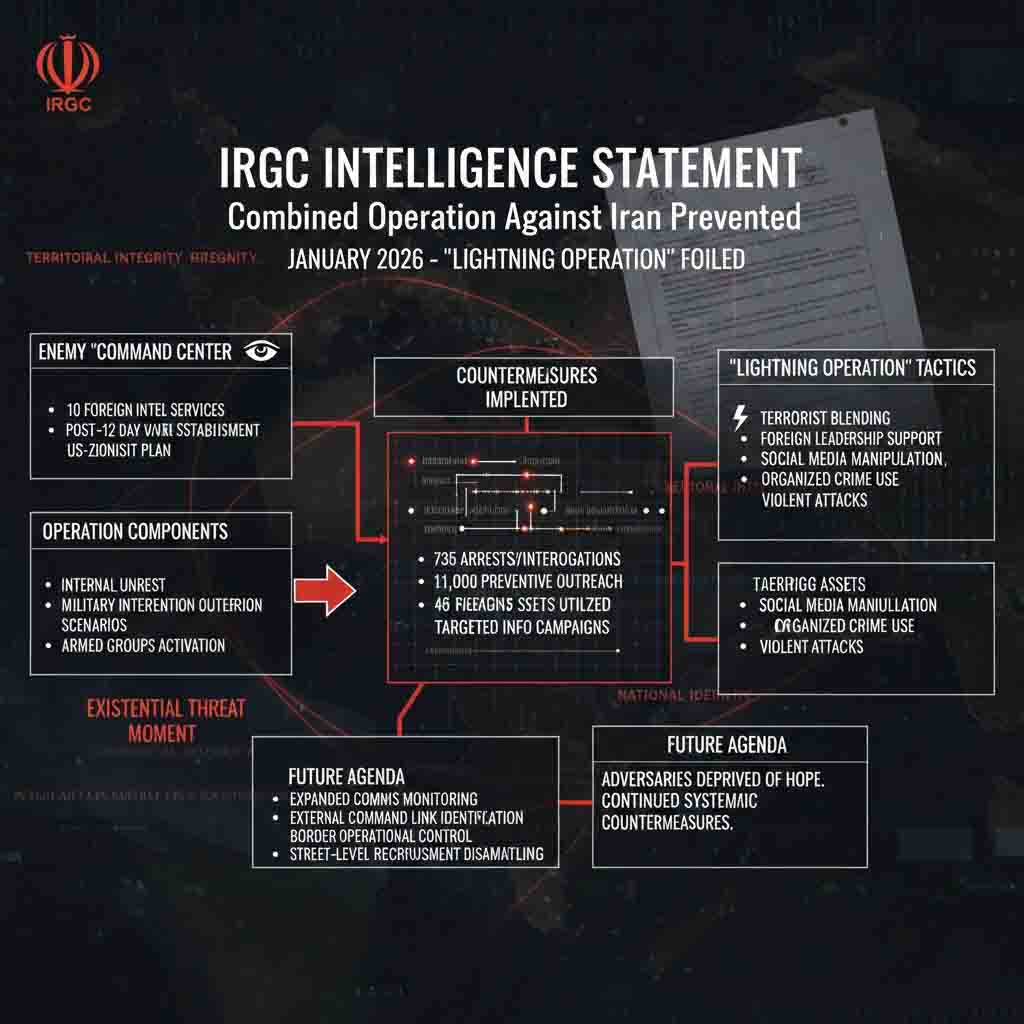
IRGC Intelligence Statement: Combined Operation Against Iran Prevented
The Intelligence Organization of the Islamic Revolutionary Guard Corps has released its third official statement addressing the events of January 2026, which Iranian authorities describe as an attempted large-scale destabilization of the country.
According to the statement, the terrorist incidents that occurred during the month of Dey were part of a broader American–Zionist plan aimed at undermining Iran’s territorial integrity and national identity. A central element of this plan, the IRGC claims, was the creation of an enemy “command center” established immediately after the 12-day war and composed of 10 hostile and mutually competing foreign intelligence services.
Analysis of documents and information obtained from this command center allegedly indicates that the operation was built around three interlinked components: the instigation of internal unrest, preparation for military intervention scenarios, and the activation of armed and semi-armed groups. Together, these elements were intended to generate what Iranian officials describe as an “existential threat moment” for the Iranian state.
The IRGC Intelligence Organization states that, due to the actions of security forces, law enforcement agencies, and the participation of the population, a key part of this plan failed. As part of counterintelligence and security operations, the following measures were reportedly implemented:
– 735 individuals linked to anti-security networks were arrested or summoned for interrogation
– preventive outreach and “guidance” was conducted with 11,000 individuals identified as vulnerable to recruitment
– 743 units of illegal military and hunting weapons were discovered and seized
– 46 members of networks cooperating with foreign intelligence services were identified and utilized operationally
– targeted information campaigns were carried out among social and professional groups assessed as being at risk
The statement emphasizes that the recent unrest represented a weakened and reconfigured version of earlier combined operations against the Islamic Republic, while maintaining the same strategic objectives.
According to the IRGC, the field phase of the disturbances, carried out under the codename “Lightning Operation,” involved several coordinated actions:
– blending organized terrorist elements into crowds of civilian protesters
– direct support and participation by foreign political and security leaderships in calls for street actions
– manipulation of social media algorithms and centralized content production for satellite television channels to incite violence, geographically localize calls to action, and promote chaotic behavior
– use of individuals convicted of organized crime, including armed robbers and smugglers
– execution of violent and lethal attacks against civilians, security personnel, law enforcement officers, and Basij members
Looking ahead, the IRGC Intelligence Organization states that its agenda includes expanded monitoring and penetration of the communication infrastructures used by unrest participants, identification of links to external command centers, intensified operational control in border regions, exploitation of misled participants within hostile networks, and continued dismantling of street-level recruitment structures with public cooperation.
The statement concludes by asserting that Iran has deprived its adversaries of hope for success not only in military confrontation but also in terrorist and separatist warfare, and reaffirms its determination to continue systematic countermeasures against such operations.
Related Articles

Artificial Intelligence Enters a New Era
27 July 2026
Read more
Agentic AI: Why It Is Poised to Become the Defining Technology of the Coming Years
22 July 2026
Read more
Саммит G7 во Франции: мировые лидеры перед лицом новой эпохи глобальных вызовов
17 June 2026
Read more
China Against the System: How Beijing Is Preparing for an Era of Great Global Confrontation
23 May 2026
Read more