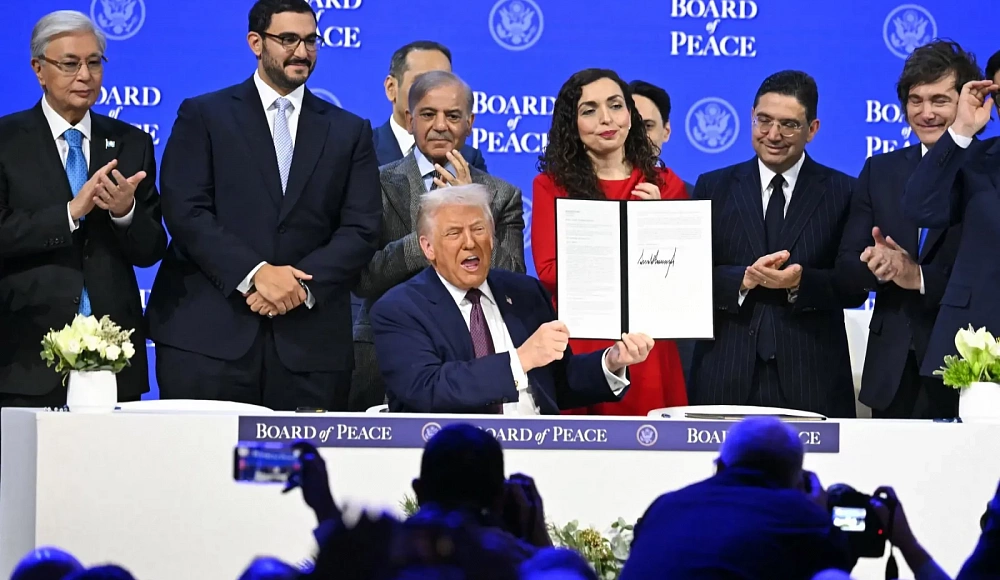
In Davos, the Charter of the Council of Peace Was Signed
At the World Economic Forum in Davos on January 22, 2026, the signing ceremony concluded for the charter of a new international structure called the Council of Peace. The initiative was framed as a separate international mechanism, and the US administration linked its launch to conflict settlement and the creation of an additional platform for coordinating political decisions.
The ceremony was led by US President Donald Trump. Following the meeting, the charter was signed by representatives of a group of states, and the composition of participants was notably uneven. Delegations and leaders from a number of countries in the Middle East, Central Asia, Eastern Europe, and Latin America took part in the signing. At the same time, a visible share of Washington’s traditional Western allies did not attend the ceremony or kept their distance, which immediately made the launch controversial in terms of international backing and future institutional consolidation.
The Council of Peace is presented as a structure initially tied to initiatives aimed at ending the conflict in Gaza and discussing postwar reconstruction. However, according to statements made in Davos, the concept is broader than a single conflict and could extend to other crisis areas. In other words, this is an attempt to create a more universal format for political mediation and coordination. It is precisely this expanded framing that has generated the core questions about how the new body will relate to the existing system of international institutions.
The main line of criticism is that the Council of Peace is perceived as the construction of a parallel architecture that could, over time, compete with the United Nations and traditional peacekeeping mechanisms. These concerns grew amid reports that not all key US allies are prepared to join the new framework, and that in some cases they expressed doubts about the mandate, transparency, and legal logic of the body.
Donald Trump, speaking during the ceremony, portrayed the Council of Peace as an instrument intended to deliver faster decisions and higher effectiveness than existing formats. In his public remarks, he also claimed the world is becoming safer and tied the launch to a broader concept of foreign policy reset. In practical terms, the White House chose a demonstrative political move at Davos to anchor the new format in the global agenda and turn it into a subject for negotiations with a wide circle of states.
The list of initial signatories also carries a political signal. The participants included countries that often act pragmatically and prefer direct arrangements over complex multilateral procedures. At the same time, the absence of several leading Western capitals showed that no consensus exists around the initiative, and that such a consensus will not form automatically in the near term. This suggests that the Council of Peace will develop either as a club of states willing to back a US-led initiative in specific cases, or as a project that will have to continuously prove its usefulness in practice.
For Europe, the episode matters as an indicator of a broader shift. The launch of the Council of Peace in Davos became another confirmation that global diplomacy is moving toward the creation of additional, competing formats in which decisions are made faster and sometimes outside traditional institutional frameworks. For some states, this looks like a way to increase governability and accelerate negotiations. For others, it carries the risk of fragmenting international law and weakening universal mechanisms originally designed to prevent conflict.
The outcome of the Davos ceremony can be summarized as follows. The charter of the Council of Peace has been signed, the new structure has been publicly launched, and it has secured an initial group of states willing to participate from the outset. Yet the project’s limits were visible at the moment of its founding. Key US allies did not take part, and the question of whether the Council will complement existing institutions or become an alternative to them remains open. This makes the launch not the end of the story, but the beginning of a political test whose results will determine whether the Council of Peace becomes a functional diplomatic tool or remains a symbolic initiative of Davos week.
Related Articles

Artificial Intelligence Enters a New Era
27 July 2026
Read more
Agentic AI: Why It Is Poised to Become the Defining Technology of the Coming Years
22 July 2026
Read more
Саммит G7 во Франции: мировые лидеры перед лицом новой эпохи глобальных вызовов
17 June 2026
Read more
China Against the System: How Beijing Is Preparing for an Era of Great Global Confrontation
23 May 2026
Read more