Shooting at the Washington Hilton: full reconstruction of the attack, threat dynamics, and the systemic limits of U.S. political security architecture

The incident that unfolded on the evening of April 25 at the Washington Hilton during the annual White House Correspondents’ Association dinner was initially framed as a contained security episode—swiftly neutralized, professionally handled, and ultimately unsuccessful in its apparent objective. However, as additional details emerged, that simplified narrative began to fracture. What took shape instead was a far more complex and revealing picture: not merely an isolated breach, but a structural signal exposing the widening gap between prevention and response within modern security systems.
Formally, the event occurred outside the White House. In reality, it was embedded within the operational core of American political life. The Correspondents’ Dinner is not a routine gathering; it is a dense convergence point of executive power, legislative leadership, media influence, and diplomatic presence. At any given moment during the event, the President, Vice President, senior cabinet officials, congressional leadership, and leading journalists occupy the same enclosed environment. This concentration transforms the venue into a high-value target by definition—a single-node aggregation of national decision-making authority.
At the time of the incident, the event was fully underway. The ballroom was active, speeches were in progress, and the flow of incoming guests had not yet fully ceased. This overlap—between an already engaged high-profile gathering and an ongoing intake of participants—created a critical vulnerability window. It was within this window that the attacker advanced.
According to the reconstructed timeline, at approximately 8:40 PM local time, an individual approached the magnetometer checkpoint positioned at the final access point before entry into the main ballroom. Up to that moment, he did not trigger immediate alarm. His appearance was consistent with that of an expected attendee, and his behavior remained within acceptable bounds until the moment of direct interaction with the screening system.
The metal detector’s alert marked the first rupture between perceived normalcy and latent threat. Standard secondary screening procedures were initiated. It was at this precise juncture that the situation escalated abruptly. The individual attempted to force his way through the checkpoint, transitioning instantly from a screened guest to an active attacker.
What followed was a rapid and violent escalation. The attacker produced multiple weapons and opened fire in the immediate vicinity of the magnetometers. The spatial configuration of the checkpoint amplified the impact: confined space, restricted movement, and a high density of personnel. Under such conditions, even a limited number of shots generates maximum disorientation and psychological shock.
Subsequent reporting indicates that the attack was not random. The assailant targeted the magnetometer closest to the primary entrance, effectively attempting a breach into the ballroom itself. This suggests intent and directional focus rather than chaotic aggression. The objective was not disruption—it was penetration.
Contact between the attacker and Secret Service personnel occurred within seconds. One agent was struck by gunfire, with the projectile stopped by body armor. This moment represents a critical inflection point. Without that layer of protection, the trajectory of the incident could have shifted immediately toward fatal outcomes.
Crucially, the attacker did not cease action upon initial engagement. Eyewitness accounts indicate that even after being brought to the ground, he continued firing at agents. This detail is operationally significant. It indicates persistence under suppression—a willingness to continue the attack despite imminent incapacitation. Such behavior aligns with high-intent lone-actor profiles rather than spontaneous or reactive violence.
Simultaneously, a parallel operational sequence unfolded: the extraction of protected individuals. The Secret Service activated its protective shift protocols, prioritizing the immediate evacuation of the President and other high-ranking officials. These movements were executed through pre-designated, segregated routes, ensuring zero overlap with the threat vector. The precision of this response reflects extensive scenario planning and disciplined execution under pressure.
However, the evacuation was not limited to a narrow protective circle. The Vice President, congressional leadership, and additional high-level attendees were also removed from the premises. This broader extraction underscores a critical early uncertainty: at the moment of response, there was no confirmation that the threat was singular. The system responded as if facing a potentially distributed attack.
Inside the ballroom, the psychological dimension of the incident began to unfold. The sound of gunfire—distorted but unmistakable—triggered immediate reactions among attendees. Pockets of panic emerged. Some individuals attempted to take cover, others sought exits. Yet, notably, the situation did not devolve into a full-scale stampede. This suggests effective crowd management protocols and controlled communication, even under rapidly deteriorating conditions.
Certain behavioral details, while seemingly peripheral, offer insight into the human response under acute uncertainty. Reports indicate that some attendees, while evacuating, grabbed bottles from their tables and carried them out. This is not trivial. It reflects a cognitive dissonance—an attempt to maintain normalcy or assert control in an environment that had abruptly lost coherence.
Beyond the interior, the external security perimeter transitioned into crisis mode. Metropolitan police units established distance buffers, pushing bystanders away from the hotel. Armed personnel conducted sweeps within the structure, verifying the absence of additional threats. The entire site shifted from controlled access to active containment within minutes.
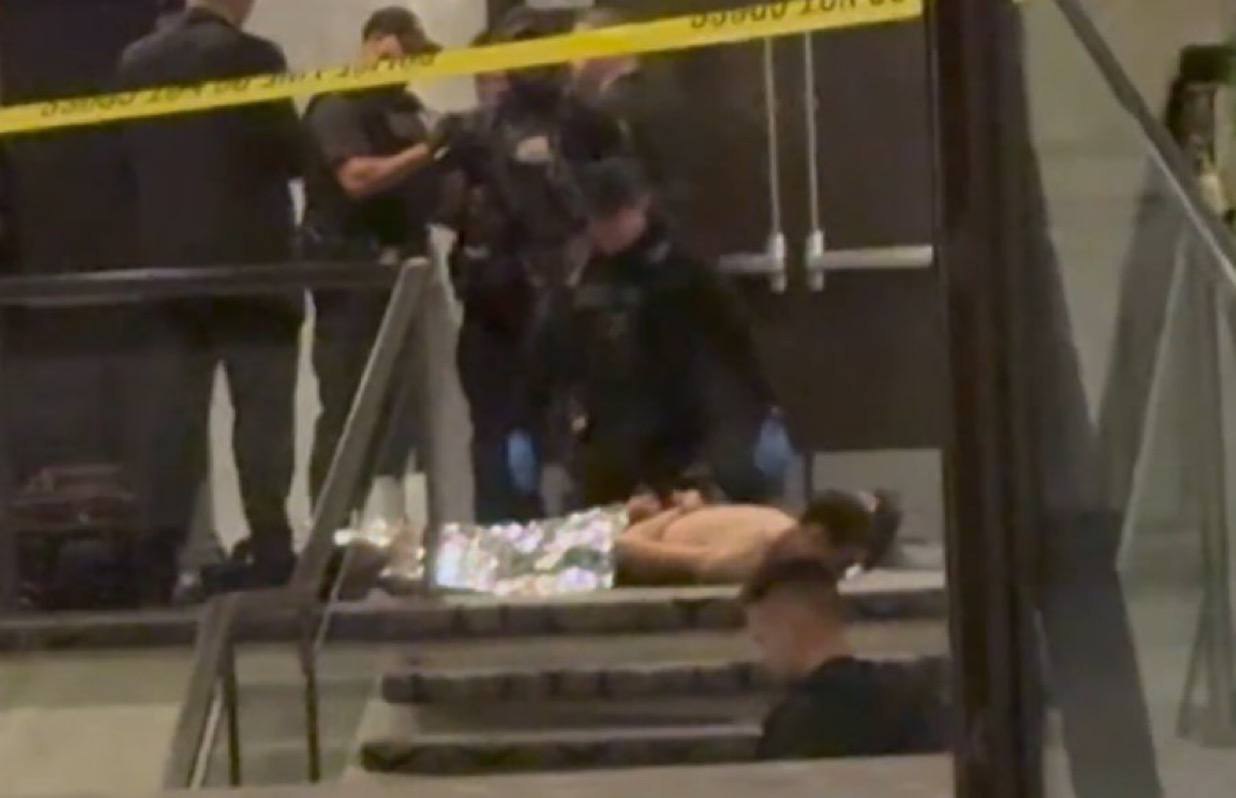
Information flow during this phase was fragmented and volatile. Initial reports alternated between claims that the attacker had been killed and confirmations that he was in custody. Ultimately, it was established that the suspect had been subdued, apprehended, and transported to a hospital. This inconsistency reflects not merely media noise, but the inherent difficulty of maintaining informational clarity in a rapidly evolving tactical environment.
The suspect was identified as a 31-year-old male from California, reportedly with a background in teaching. This profile is consistent with contemporary lone-actor typologies: socially integrated individuals without overt ties to organized networks, yet capable of rapid escalation into targeted violence.
In the immediate aftermath, the President addressed the incident, confirming that the attacker had charged a security checkpoint with multiple weapons and had been neutralized by Secret Service personnel. He emphasized both the professionalism of the response and the reality that such threats are increasingly embedded within the operational landscape of political leadership.
The incident quickly expanded beyond its tactical boundaries into strategic discourse. Calls for enhanced security infrastructure—including hardened, purpose-built venues with advanced protective features—emerged almost immediately. This illustrates how discrete events can catalyze broader shifts in security doctrine.
International reactions followed without delay. Leaders from multiple countries issued statements condemning the attack and expressing support. The speed and uniformity of these responses highlight the global interpretive frame applied to such incidents: they are seen not as domestic anomalies, but as indicators of systemic stress within democratic institutions.
Yet the core analytical conclusion lies elsewhere. When examined structurally, the incident reveals a fundamental asymmetry. The attacker succeeded in reaching the threshold of the inner security layer. He initiated contact, deployed weapons, and sustained engagement under suppression. In other words, the preventive barrier failed. What followed—the rapid neutralization, the successful evacuation—was a demonstration of response capacity, not preventive success.
This distinction is critical. Modern security systems, particularly in open democratic contexts, are increasingly optimized for reaction rather than exclusion. The shift is driven by the evolution of threats: from coordinated networks to autonomous individuals, from long-term planning to immediate action.
Under such conditions, absolute prevention becomes unattainable. The system can reduce probability, but not eliminate it. The decisive factor becomes the speed and effectiveness of response once the threshold has been breached.
The Washington Hilton incident illustrates this boundary with stark clarity. On one level, the system functioned: no high-value targets were harmed, the attacker was stopped, the situation contained. On another level, the breach itself remains the defining fact.
A heavily armed individual reached the final checkpoint of a venue hosting the highest concentration of U.S. political leadership outside the White House. That reality cannot be neutralized by successful response alone.
In this sense, the event transcends its immediate context. It is not merely an incident—it is a structural signal. A signal that the operating environment of political power is becoming less predictable, more compressed, and increasingly vulnerable to precise, high-impact disruptions executed by single actors.
And within that shift lies the true significance of what occurred that evening in Washington.
Related Articles

Artificial Intelligence Enters a New Era
27 July 2026
Read more
Agentic AI: Why It Is Poised to Become the Defining Technology of the Coming Years
22 July 2026
Read more
Саммит G7 во Франции: мировые лидеры перед лицом новой эпохи глобальных вызовов
17 June 2026
Read more
China Against the System: How Beijing Is Preparing for an Era of Great Global Confrontation
23 May 2026
Read more