Federal Agents’ Shooting in Minneapolis and the Mass Protests That Followed in Minnesota

The morning of 24 January 2026 marked a turning point in Minneapolis and across the state of Minnesota. At approximately 9:05 a.m. local time, in a residential area near the intersection of West 26th Street and Nicollet Avenue, federal immigration agents opened fire during an operation. A 37-year-old local resident, a healthcare worker employed at a medical facility, was critically wounded and later died in hospital from gunshot injuries.
Almost immediately after the shooting, videos recorded by witnesses began circulating publicly. These recordings became central to everything that followed. They showed the victim unarmed, holding a mobile phone in his hands and not displaying aggressive behavior. According to witnesses, he appeared to be documenting the operation rather than threatening the agents. The contrast between these images and the official federal statement — which described the shooting as an act of self-defense in response to a perceived threat — triggered widespread public outrage.
The reaction was intensified by context. This was not the first fatal incident involving federal immigration agents in Minnesota that month. On 7 January 2026, another resident had been killed during a similar operation. As a result, the 24 January shooting was widely perceived not as an isolated tragedy but as part of a repeating and dangerous pattern.
Immediate public response
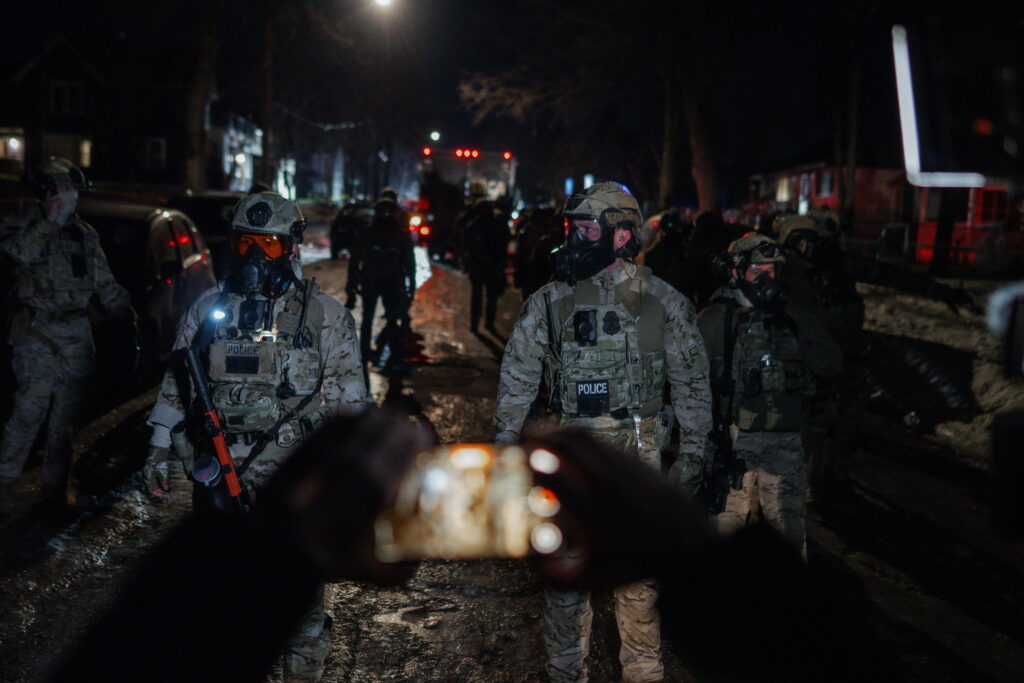
Public reaction began within hours. By midday, people started gathering at the site of the shooting. By evening, hundreds of demonstrators were present. They brought candles and flowers, held signs, and demanded explanations and accountability. The initial protests were focused and localized, directed specifically at the killing itself and the use of lethal force by federal agents in a residential neighborhood.
The situation escalated later that evening when federal forces attempted to restrict access to the area and disperse parts of the crowd. The use of crowd-control measures marked a decisive shift. What had begun as a localized protest turned into a mass, politically charged mobilization.
Expansion of protests
On 25–26 January, demonstrations spread across Minneapolis. Protests were held near municipal buildings, federal offices, and major streets. Participation grew into the thousands. The social composition of the protests broadened significantly, drawing in religious leaders, labor unions, students, educators, municipal officials, and civil society groups.
At this stage, the protests were no longer only about the death of one individual. They evolved into demands for a fundamental review of federal immigration enforcement practices, as well as for an independent investigation involving state authorities.
Political pressure and institutional response
As protests continued, political pressure intensified. City and state officials were compelled to respond publicly. Minneapolis city leadership and Minnesota state representatives called for transparency and accountability, emphasizing that the killing had deeply undermined public trust.
Federal authorities, however, maintained that the agents acted within their legal mandate and followed operational guidelines. This position crystallized a split in interpretation: a legalistic justification from the federal level versus a moral and societal rejection at the local level.
Why this killing became a breaking point
The killing on 24 January became a catalyst for wider unrest for several reasons:
- Visual evidence that contradicted official statements.
- Repetition of fatal incidents involving federal agents within a single month.
- Pre-existing social mobilization, including protests against immigration policy the day before the shooting.
Together, these factors transformed the event from an individual tragedy into a symbol of broader concerns about the use of lethal force by federal authorities in civilian environments.
Consequences
By the end of January, the situation in Minneapolis remained tense but contained. Large-scale riots did not occur, yet protests persisted, and demands for accountability did not fade. The killing on 24 January continued to shape public discourse and political pressure.
Analytically, this event marked the moment when latent distrust turned into open confrontation. Everything that followed — protests, political conflict, and nationwide attention — stemmed directly from the gunfire of that morning. The episode demonstrated how a single killing by state agents, under conditions of heightened social sensitivity, can trigger a chain reaction with consequences far beyond the immediate scene.
Related Articles

Artificial Intelligence Enters a New Era
27 July 2026
Read more
Agentic AI: Why It Is Poised to Become the Defining Technology of the Coming Years
22 July 2026
Read more
Саммит G7 во Франции: мировые лидеры перед лицом новой эпохи глобальных вызовов
17 June 2026
Read more
China Against the System: How Beijing Is Preparing for an Era of Great Global Confrontation
23 May 2026
Read more