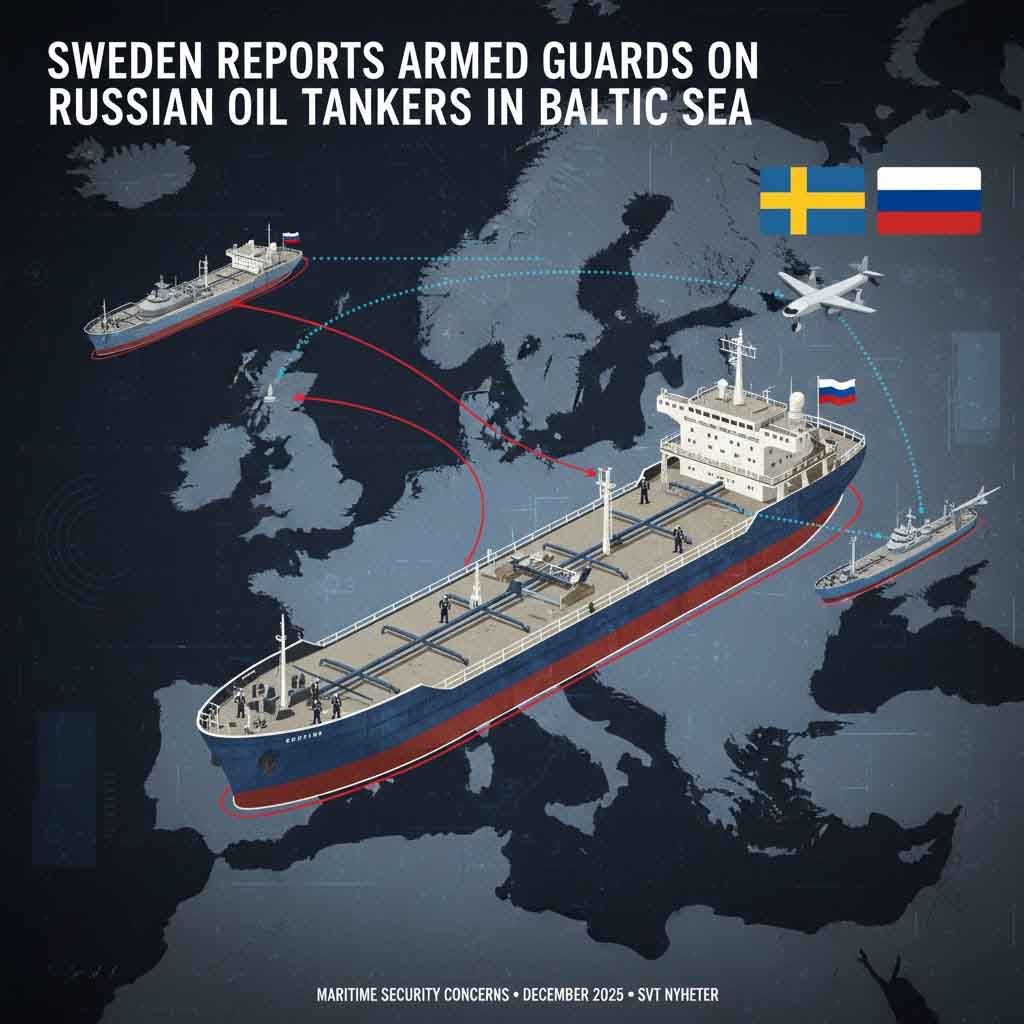
Sweden Reports Armed Guards on Russian Oil Tankers

Sweden Reports Armed Guards on Russian Oil Tankers in the Baltic Sea
Swedish military and border authorities say they have observed armed, uniformed personnel aboard a number of Russian oil tankers belonging to the so-called “shadow fleet” operating in the Baltic Sea. The information was confirmed by senior officials of the Swedish Navy and Coast Guard on December 15–16, 2025, and was first reported by SVT Nyheter.
The observations suggest an additional layer of security around vessels used to circumvent sanctions and raise questions related to maritime safety, escalation risks, and regional stability.
Official Position from Stockholm
Marko Petkovic, Chief of Operations of the Swedish Navy, said authorities have credible indications of armed personnel on board certain Russian-linked tankers.
According to him, the individuals were armed and wearing military-style uniforms. He stressed, however, that they are most likely members of private security companies and not necessarily active-duty personnel of the Russian armed forces.
Even so, this marks the first time that the navy of a NATO member state has officially confirmed such observations, shifting earlier reports from the realm of unverified claims into that of state-backed assessments.

Sweden Spots Armed Guards on Russian Tankers
Persistent Naval Presence
Swedish officials link the presence of guards to a broader Russian effort to protect its “shadow fleet” — hundreds of mostly aging tankers with opaque ownership structures used to export oil in circumvention of G7 price caps and European Union sanctions.
Petkovic said these measures are accompanied by a “fairly constant” presence of Russian Baltic Fleet warships in key areas of the Baltic Sea and the Gulf of Finland.
Daniel Stenling, Deputy Head of Operations at the Swedish Coast Guard, reported increased Russian naval activity near strategically important coastal zones. He noted that the Coast Guard itself has not directly observed armed personnel aboard tankers, but emphasized the fleet’s critical importance to Russia’s economy and wartime revenues.
Sanctions, Shipping, and Risk
Western maritime analysts estimate that up to 90% of Russia’s seaborne crude oil exports are handled by the shadow fleet. Many of these vessels are older, operate under non-Western flags, and carry limited insurance coverage.
This raises concerns over potential accidents, oil spills, collisions, and accountability in the congested waters of the Baltic Sea.
Enhanced monitoring by Sweden, Denmark, Finland, and other regional actors has coincided with what officials describe as more assertive Russian protective measures. Petkovic said there is currently no reason for alarm, but stressed the need for transparency and predictability at sea to prevent incidents.
Deterrence or Escalation
Reports of armed personnel first emerged in autumn 2025, after Danish military pilots described tense encounters near shadow fleet tankers. The Swedish statements provide the first official confirmation of those accounts, although no public imagery has been released; the observations are believed to rely on aerial and maritime surveillance.
Some Western and maritime-focused outlets interpret the development as a step toward the militarization of commercial shipping to shield sanctions-evading activity. Pro-Russian media, meanwhile, present the measures as defensive, citing alleged risks of interference by NATO forces.
Swedish authorities continue to frame their response as monitoring rather than escalation, while acknowledging rising tensions across the Baltic maritime domain.
Related Articles

Artificial Intelligence Enters a New Era
27 July 2026
Read more
Саммит G7 во Франции: мировые лидеры перед лицом новой эпохи глобальных вызовов
17 June 2026
Read more
Russian Africa Corps Sustains Losses in Mali: Kidal as the Breaking Point of the War’s Entire Configuration
26 April 2026
Read more
The AI Tsunami: What Dario Amodei Warned About — And Why the Numbers Matter
26 February 2026
Read more