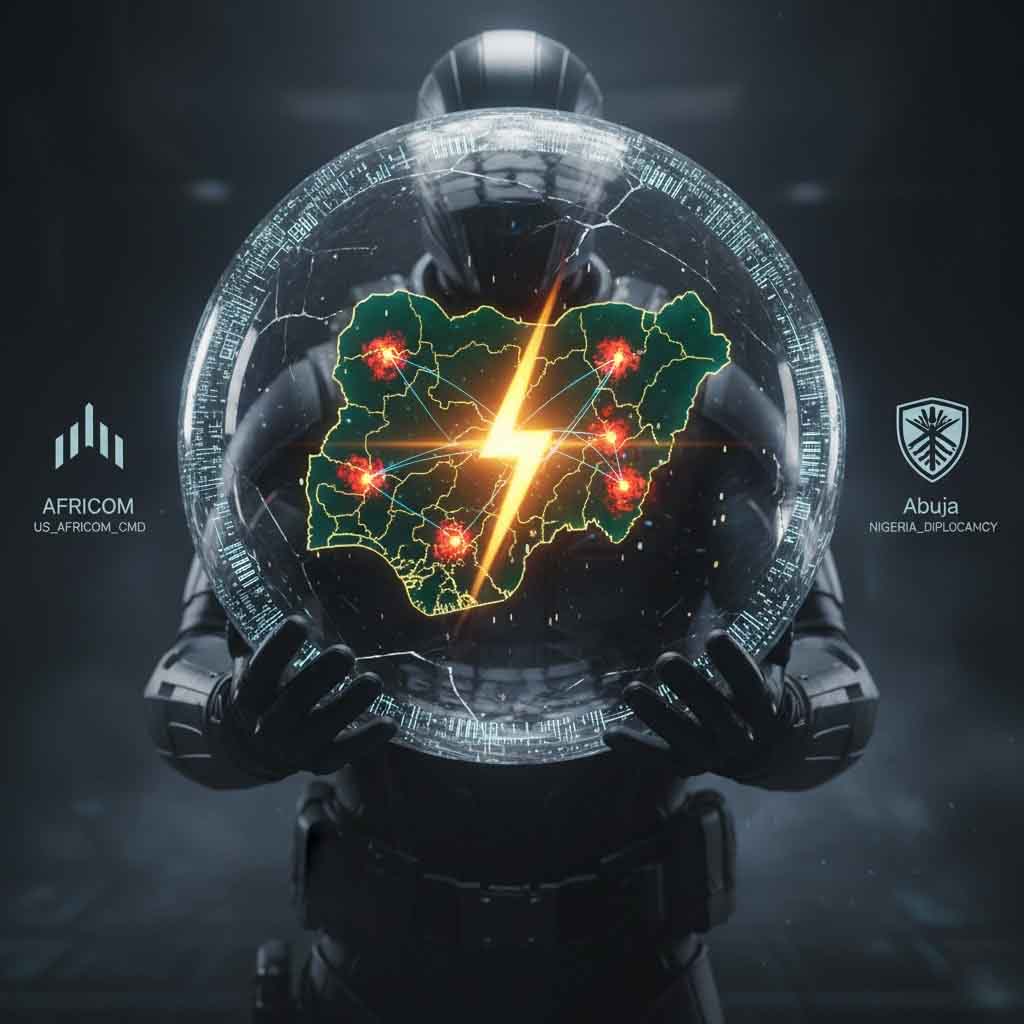
U.S. strikes ISIL targets in northwestern Nigeria
.png "Department of Strategic Monitoring")
U.S. strikes ISIL targets in northwestern Nigeria. What is officially confirmed and what remains unknown
The United States carried out strikes against ISIL targets in Nigeria on December 25, 2025. The episode drew particular attention in West Africa because Washington publicly confirmed the use of force on Nigerian territory, while Abuja acknowledged the cooperative framework and, at the same time, insisted that violence in Nigeria cannot be described by a single simple explanation. The story now rests on three layers. The military layer is set by an official statement from U.S. Africa Command. The political layer is set by President Donald Trump’s public announcement. The diplomatic layer is set by Nigeria’s public messaging and by a text carried by Nigerian outlets as foreign ministry communication.
The core feature of this sequence is that all sides refer to the same event but emphasize different meanings. The U.S. military presents the operation in a strictly factual format. Trump presents it through a moral and political lens. Nigeria confirms cooperation but rejects a simplified reading that reduces the country’s security crisis to one religion centered narrative, arguing instead for a broader, multi factor understanding of both drivers and victims.
What the United States has officially confirmed
U.S. Africa Command stated that strikes were conducted on December 25, 2025, in Sokoto State in northwestern Nigeria. The release says the action was carried out at the direction of the President of the United States and the senior official responsible for the military portfolio, in coordination with Nigerian authorities. The official U.S. account therefore centers on two points. The target set is described as ISIL terrorists. The operation is described as coordinated with Abuja rather than unilateral.
AFRICOM also provided an initial assessment of impact, stating that multiple ISIL militants were killed in ISIL camps. At the same time, it said assessment is ongoing and additional information will be provided as appropriate, while operational details will be withheld to protect security. This creates a clear boundary for what can be asserted publicly at this stage. The date, the location, the identity of the target set, and a general statement on militant casualties are confirmed. Further detail is not released.
The release frames the strike within a broader counterterrorism posture, highlighting work with regional partners and the objective of disrupting violent extremist organizations wherever they operate. For readers, that means the strike is presented not as a one off act but as part of a wider security approach that relies on intelligence, coordination, and targeted action.
What Donald Trump said
Alongside the military statement, Donald Trump publicly announced the operation and described it as a powerful and deadly strike. In his message, he linked the decision to civilian attacks and placed particular emphasis on violence he described as primarily targeting Christians. Major English language reporting noted that he did not provide technical details in the post, while U.S. officials confirmed coordination with Nigeria.
For high precision reporting, separating verified operational facts from political framing is essential. AFRICOM provides the factual structure. Trump supplies the moral narrative, emotional tone, and political justification. His framing shapes perception, but it does not expand the set of verified military specifics. In a newsroom standard text, the religious emphasis should therefore be attributed to Trump’s position rather than treated as a conclusion derived from the operational release.
What Nigeria said and how Abuja frames the situation
Nigeria’s line combines confirmation of cooperation with rejection of a single axis explanation. Reuters reported that Foreign Minister Yusuf Maitama Tuggar said the strike was part of a long planned joint operation based on Nigerian intelligence and stressed that the effort was aimed at terrorists and not tied to any particular religion. The same reporting also highlighted Nigeria’s point that extremist attacks in the country have affected both Christians and Muslims.
Separately, Nigerian media carried a text presented as a foreign ministry confirmation describing precision strikes against terrorist targets in the northwest. That framing emphasizes intelligence sharing and strategic coordination, conducted in line with international law and with respect for Nigeria’s sovereignty. In substance, it extends a consistent Nigerian posture. Abuja welcomes counterterrorism partnership but seeks to retain control of the national narrative and insists the security crisis is multi causal.
What is known about the location and why Sokoto matters
Official U.S. messaging places the operation in Sokoto State in northwestern Nigeria. This stands out against the more familiar international framing of Nigeria’s militant threat that often highlights other regions. The explicit mention of Sokoto suggests that the publicly discussed map of threat and response is widening and that Nigeria’s partners are looking beyond the zones most frequently cited in earlier global headlines.
The geographic element helps explain the scale of attention. Even without precise coordinates, the choice of location functions as a signal about how actors perceive changes in violent networks and areas of presence.
What is known about the mechanics and what remains closed
At this early stage, a large share of technical detail remains unavailable. AFRICOM does not publish platforms, munitions, or a map of strike points, citing operational security. Reuters reports that the action was carried out at Nigeria’s request and provides additional context, but such reporting does not substitute for an official technical account.
The most rigorous newsroom formulation therefore is as follows. The strikes are confirmed, the location is confirmed, coordination is confirmed, and an initial impact statement is provided in general terms. The technical layer remains limited in the public domain, and that limitation is explicitly stated by the U.S. military.
What is known about casualties and what should not be asserted without confirmation
AFRICOM’s initial assessment says multiple ISIL militants were killed, without a public figure, names, or a target list. There are no confirmed public civilian casualty figures in the initial official messaging. This does not prove there were no civilian losses, it indicates that verified public data have not been released and independent verification is constrained at the outset.
That is why the boundary between confirmed information and what remains to be established matters. If later assessments are released, this section can be updated. For now, only what is contained in official statements and major agency reporting can be treated as firm.
Why Washington and Abuja emphasize different points
The U.S. political framing highlights a moral rationale and a show of resolve, with a religious emphasis advanced by Trump. Nigeria’s diplomatic framing emphasizes sovereignty, legal basis for cooperation, and the multi layered nature of violence. The divergence is not about whether the strike occurred, but about how to explain what Nigeria is facing and how to characterize victims and drivers.
For Washington, a simple narrative is effective political communication. For Abuja, an overly simple narrative is risky because it compresses a complex internal security crisis into a single conflict frame and can weaken internal balance and external perception. That is why Nigeria confirms cooperation while widening the frame, stressing that multiple communities are affected and that the response relies not only on strikes but also on intelligence, civilian protection, and institutional resilience.
Four points are established at this stage. The United States conducted strikes against ISIL targets on December 25, 2025. The location identified is Sokoto State in northwestern Nigeria. Coordination with Nigerian authorities is stated in U.S. messaging. The initial assessment reports multiple ISIL militants killed. Trump’s announcement provides political justification and rhetoric, while Nigeria confirms cooperation and underscores that the violence cannot be described through a single religion centered lens.
Sources
- U.S. Africa Command, “U.S. Africa Command Conducts Strike against ISIS in Nigeria”, Dec. 25, 2025. (Африком)
- Reuters, “US says it struck Islamic State militants in northwest Nigeria”, Dec. 25, 2025. (Reuters)
- Associated Press, “Trump says US struck Islamic State targets in Nigeria after group targeted Christians”, Dec. 25, 2025. (apnews.com)
- ICIR Nigeria, “Nigeria confirms U.S. air strikes on terrorist targets in North West”, Dec. 26, 2025. (icirnigeria.org)
Related Articles

Artificial Intelligence Enters a New Era
27 July 2026
Read more
Agentic AI: Why It Is Poised to Become the Defining Technology of the Coming Years
22 July 2026
Read more
Саммит G7 во Франции: мировые лидеры перед лицом новой эпохи глобальных вызовов
17 June 2026
Read more
China Against the System: How Beijing Is Preparing for an Era of Great Global Confrontation
23 May 2026
Read more