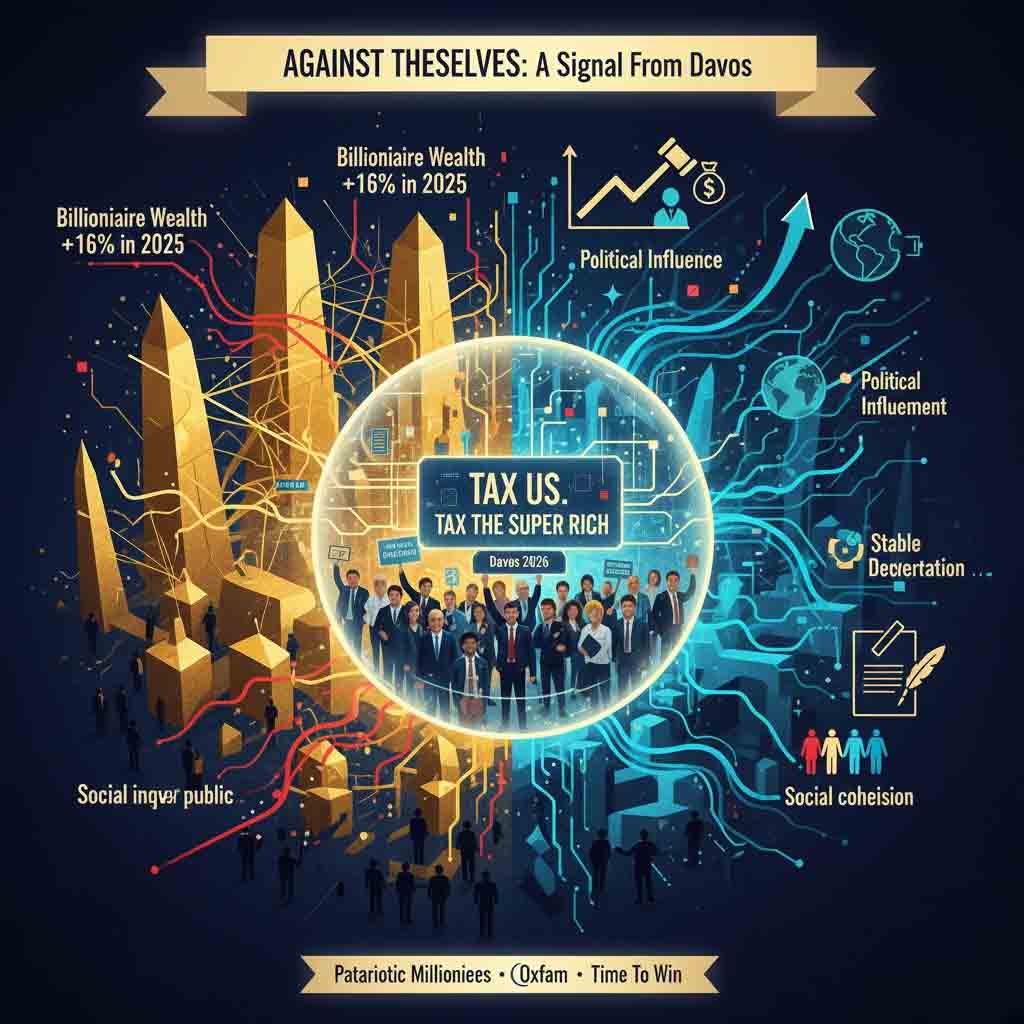
Against Themselves. Why the Letter by Nearly 400 Millionaires and Billionaires on Taxes Became a Key Signal from Davos

On the sidelines of the World Economic Forum in Davos, a storyline emerged that runs counter to the usual logic of capital defending itself. Nearly 400 millionaires and billionaires from 24 countries published an open letter to world leaders calling explicitly for higher taxes on the super-rich. The timing was deliberate. The letter was released during Davos week as an attempt to push the issue of taxing extreme wealth into the very center of a forum traditionally dominated by investment, trade, and geopolitical bargaining.
The letter rests on three core claims, each supported by data and recent research circulated during the Davos period. First, the authors argue that extreme concentration of wealth has ceased to be merely an economic phenomenon and has become a political problem. According to them, vast fortunes translate into disproportionate influence over politics, media, and rule-making, undermining democratic institutions and eroding public trust. Second, they link extreme wealth to rising inequality and social fragmentation. Third, they claim that the current system obstructs innovation and climate action because governments are deprived of the resources needed for large-scale public investment and the energy transition. These arguments are framed deliberately in political rather than technical terms, avoiding debates over specific tax rates and instead challenging the legitimacy of the existing model itself.
The composition of the signatories was designed to make the letter difficult to dismiss. Publicly cited names include Mark Ruffalo, Brian Eno, Abigail Disney, and Brian Cox. The emphasis is not only on their visibility but on the fact that they are wealthy individuals calling for higher taxes on their own economic class. This is a critical psychological element. It removes the most convenient counterargument, namely that calls to tax the rich come only from those who do not pay such taxes themselves.
The letter is often summarized through its central slogan, which quickly became its defining phrase: “Tax us. Tax the super rich.” In several publications, the headline of the appeal is presented as a direct address to Davos leaders, urging them to tax extreme wealth for the sake of the future. This is not a legislative proposal and not a policy blueprint. It is a political signal, crafted for maximum visibility during the forum and designed to force political leaders to respond publicly.
Organizationally, the initiative is linked to the Time To Win campaign. The letter is promoted by groups advocating tax reform and redistribution, primarily Patriotic Millionaires and Millionaires for Humanity, with Oxfam playing a central role as the main source of Davos-timed inequality data. This explains why the letter was synchronized with the release of reports and opinion surveys, forming a coordinated package aimed at applying pressure on global elites.
The strength of this episode lies in the fact that it did not stand alone. Almost simultaneously, survey data among millionaires in G20 countries was published, producing results that are deeply uncomfortable for Davos audiences. According to the survey, 77% of millionaires believe that the super-rich are able to buy political influence. 65% support higher taxes on the wealthiest individuals in order to fund public services and address the cost-of-living crisis. Only 17% oppose higher taxes on the super-rich. In several summaries of the same dataset, it is additionally noted that a large share of respondents explicitly view wealth concentration as a threat to democracy. These figures matter because they reveal a split within the wealthy class itself, not merely a conflict between rich and poor.
At the same time, Oxfam released a report timed to the opening of the forum, highlighting key indicators of wealth accumulation at the top. According to Oxfam, total billionaire wealth increased by 16% in 2025, reaching a record 18.3 trillion dollars. The report also emphasizes that billionaire wealth has grown by 81% since 2020. Another striking figure in the same dataset states that billionaires are around 4,000 times more likely to hold public office than ordinary citizens. One further data point frequently cited is that the richest 1% increased their wealth by 2.5 trillion dollars in a single year, a sum comparable to the combined wealth of the poorest 4.1 billion people. For Davos, this is not neutral statistics but a direct indictment of the current configuration of wealth and power.
Against this backdrop, the letter signed by nearly 400 wealthy individuals takes on a different meaning. It is neither a romantic gesture nor an act of pure altruism. It is an attempt to propose a managed form of redistribution in order to prevent a far more disruptive political backlash. The underlying logic is straightforward. If inequality and the political influence of money continue to grow unchecked, social pressure will intensify, increasing the likelihood of radical responses that elites will no longer be able to control. Read this way, the call to tax the super-rich functions as a safety valve, an effort to release pressure while preserving the system itself.
This also explains why the authors avoided proposing concrete tax rates, timelines, or implementation mechanisms. The answer lies in politics rather than economics. Specific numbers immediately fracture coalitions. Different countries have different tax bases, residency rules, asset transparency standards, and enforcement capacities. A proposal of 1%, 2%, or 5% would instantly shift the discussion into technical disputes among economists and lawyers, allowing political leaders to evade the core issue. The letter is structured precisely to prevent that. It speaks in terms of principle: extreme wealth must contribute more, and this is framed as a matter of public stability rather than ideological preference.
A serious analysis must also acknowledge the weaknesses of the initiative. Critics routinely point to the risk of capital flight, intensified tax competition between jurisdictions, and the difficulty of valuing illiquid assets such as private company shares, trusts, or intellectual property. These arguments are real. What has changed is that they now face public pressure not only from activists on the left, but from a segment of wealthy individuals who argue that the risks posed by inequality to democracy and climate stability already outweigh the risks of higher taxation.
For Davos, this episode marked a shift in tone. Previously, taxation of wealth existed largely on the margins of the forum’s debates. This time, it was brought directly into the main conversation by people who themselves belong to the economic elite being targeted. That makes the letter a marker. A marker of growing anxiety within global elites about the political consequences of inequality, and a growing willingness to pay higher taxes as the price for preserving systemic stability.
The practical conclusion is clear. The appeal by nearly 400 millionaires and billionaires does not create new laws or immediately alter budgets. What it does change is the boundary of what is considered legitimate in public debate. It normalizes discussion of taxing extreme wealth at the world’s most elite forum and explicitly ties the issue to three defining themes of the current era: democracy, climate, and the governability of the global economy. That is why this letter became one of the most consequential signals to emerge from Davos 2026.
Related Articles

Artificial Intelligence Enters a New Era
27 July 2026
Read more
Agentic AI: Why It Is Poised to Become the Defining Technology of the Coming Years
22 July 2026
Read more
Саммит G7 во Франции: мировые лидеры перед лицом новой эпохи глобальных вызовов
17 June 2026
Read more
China Against the System: How Beijing Is Preparing for an Era of Great Global Confrontation
23 May 2026
Read more