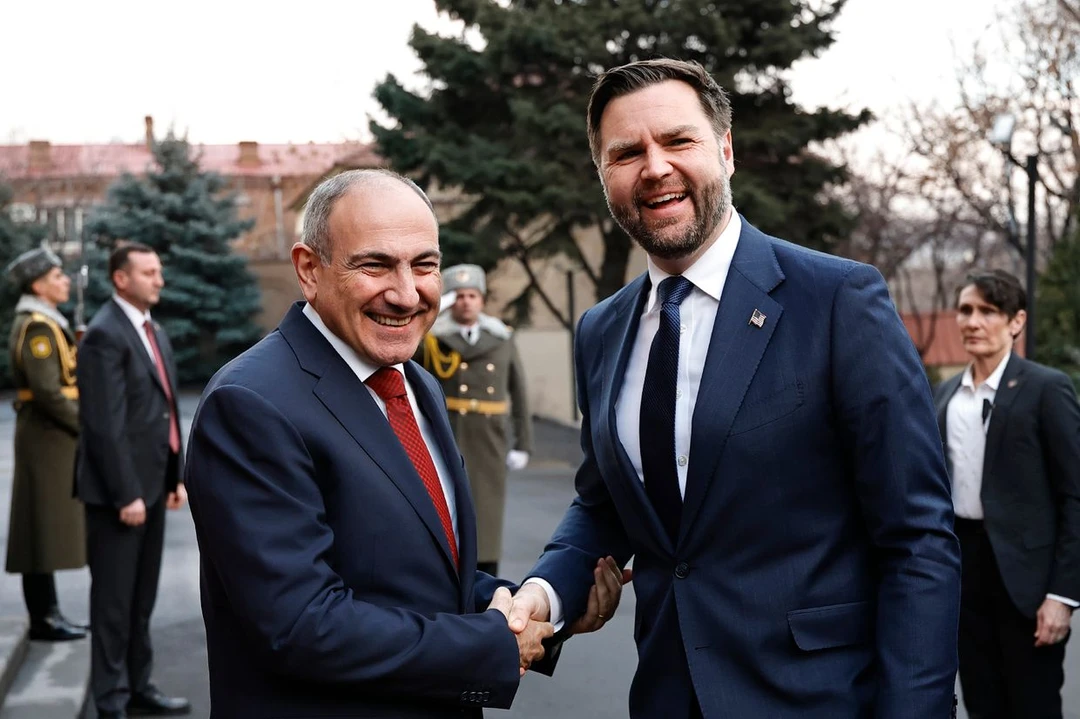
The Historic Visit of U.S. Vice President J.D. Vance to Yerevan

On February 9, 2026, U.S. Vice President J.D. Vance arrived in Yerevan on an official visit that became the first case in the history of independent Armenia in which a sitting President or Vice President of the United States visited the country. This was treated as a precedent both because of the rank of the visitor and because the trip was presented as a working visit with concrete political and economic deliverables rather than a purely ceremonial stop.
The decision to travel had been framed in advance as part of a regional tour tied to the dates February 9–11, 2026, covering Italy, Armenia, and Azerbaijan. In the public description used by the U.S. side, the trip had two major objectives: advancing the administration’s peace agenda in the South Caucasus and promoting a transit initiative referred to as TRIPP, short for the Trump Route for International Peace and Prosperity.
The immediate background to the visit was shaped by several linked developments from 2025 and early 2026. In 2025, after U.S.-mediated talks, Armenia and Azerbaijan took steps toward a peace framework that U.S. messaging portrayed as a foundation for a broader settlement and a reduction of long-standing regional tensions. By January 2026, public reporting and political messaging around the U.S. track increasingly emphasized an economic and infrastructure layer meant to reinforce the political process. In that framing, TRIPP was presented not as a slogan but as an integrated set of transport, energy, and connectivity ideas to create predictable cross-border incentives for stability.
The Yerevan leg of the trip followed several days in Italy. Before arriving in Armenia, Vance spent time in Milan around the Winter Olympic Games, after which the itinerary moved to Yerevan and then to Baku. The sequence was meant to underline that Washington intended to engage both regional capitals in close succession, projecting an active, mediating role.
Vance arrived in Yerevan on February 9. The aircraft landed at Zvartnots International Airport, where the Armenian side described the reception as fully protocol-based. Armenian official communications stated that the Vice President was greeted by senior officials at the airport and then proceeded to the government venue for high-level meetings.
The first day in Yerevan centered on talks with Prime Minister Nikol Pashinyan and on formalizing a package presented as economic, energy-related, and closely tied to the peace and connectivity agenda. The most prominent result announced in Yerevan was the signing of a joint statement on cooperation in the field of civilian nuclear energy, described as the completion of negotiations on a framework for peaceful nuclear cooperation.
The practical meaning of this track, as it was publicly described, related to a legal and regulatory framework that enables licensed U.S. exports of civilian nuclear technology, equipment, and services under nonproliferation requirements. In the public figures associated with the announcement, the prospective economic scale was described in terms of up to five billion dollars of U.S. exports on an initial track and up to four billion dollars in longer-term fuel and servicing contracts. The nuclear issue drew heightened attention because it intersects directly with Armenia’s long-term energy planning and with discussions about modernization and replacement options connected to the Metsamor nuclear plant, whose operating unit dates back to the Soviet era.
Alongside the nuclear agenda, the U.S. side publicly linked the visit to a broader economic push. Public accounts associated with the trip framed U.S. interest as supporting investment and technology cooperation in Armenia and promoting areas of advanced technology. In Armenian and regional descriptions of the public exchanges, small modular reactors were mentioned as a possible technological option, but no definitive decision on a specific reactor type was presented as having been finalized in the public record used around the visit.
A second line of the Yerevan visit touched on security and defense technology, but it was presented in the language of deterrence and stabilization rather than escalation. Reporting around the trip described an announcement of a first major sale of U.S. military technology to Armenia valued at eleven million dollars, related to reconnaissance drones, and positioned as a new form of practical cooperation at that scale.
A third line that consistently surfaced in public messaging was the Armenia–Azerbaijan peace process and the idea of a new transit route. The visit to Yerevan was framed as part of a regional effort because it was paired with plans to travel onward to Baku. In this framing, the U.S. role was not limited to political mediation but was tied to an infrastructure and economic concept meant to give the peace process tangible, material supports.
In public descriptions of TRIPP circulating before and during the visit, the project was portrayed as a transit and connectivity package intended to link Azerbaijan to Nakhchivan through Armenia and onward to wider regional and global routes. The concept was described as involving transport infrastructure and, in some accounts, energy and digital connectivity components. The implication of this approach is that the next stage of negotiations would necessarily shift from broad political declarations to technical and administrative details: transit rules, border logistics, security arrangements, financing models, legal responsibilities, and the operational standards required for roads, railways, and supporting systems.
The timing of the nuclear announcement also triggered visible diplomatic competition around the energy agenda. As the U.S. track gained prominence, there were reports that Russia, too, signaled readiness to offer Armenia expanded cooperation in the nuclear sphere. This context underscored that the nuclear framework announced in Yerevan was interpreted as more than a symbolic gesture; it was treated as a move with real strategic weight because it creates a channel for U.S. involvement in a sector historically sensitive for Armenia’s external alignments.
Public statements during the Yerevan events tried to hold together two themes at once: a practical economic and energy program and a political narrative focused on stabilizing the region through negotiated arrangements. In the public portrayal of the talks, Vance emphasized the future-oriented nature of the agenda, while Pashinyan publicly presented Armenia and Azerbaijan as being close to a durable peace after decades of conflict and placed weight on steps that build mutual stakes in stability.
If the chronology is assembled in its most compact, fact-based form as it was publicly described, it runs as follows. In late January 2026, reporting and political messaging signaled that Vance would travel to Armenia and Azerbaijan in February in connection with the U.S.-promoted TRIPP idea and the peace and trade agenda. In January, public accounts described TRIPP as an emerging framework with transport and connectivity elements, discussed in the context of Armenia’s approach to regional economic architecture. On February 9, Vance arrived in Yerevan, was received under official protocol, held talks with Prime Minister Pashinyan, and the parties announced and signed the joint statement on civilian nuclear cooperation as the headline deliverable. The second day of the visit was set for February 10, after which the Vice President was expected to continue to Azerbaijan as part of the same regional tour.
From these publicly stated elements, several consequences can be described strictly within the boundaries of what was presented as factual and what follows directly from those facts. First, there is an institutional consequence: the visit set a new benchmark for the level of official U.S. political presence in Armenia since independence. This is a matter of rank and precedent, not an interpretation of sentiment.
Second, there is a legal and technological consequence: completing the negotiations and formalizing a civilian nuclear cooperation framework creates a channel through which U.S. civilian nuclear exports and services can proceed under an established regulatory structure. Even if specific commercial contracts follow later, the creation of such a framework is often treated as a major step because it requires prolonged coordination and review.
Third, there is an energy and geopolitical consequence grounded in publicly described context: the nuclear framework was widely interpreted as intersecting with Armenia’s aim to diversify energy partnerships and as a move that affects the balance of external influence in a strategic sector. The emergence of parallel signals from other actors about nuclear cooperation reinforced the perception that the U.S. step carried strategic importance.
Fourth, there is a consequence tied to regional connectivity and the peace process: TRIPP and the associated transit idea imply a long, technical phase of negotiations and implementation. The concept’s credibility depends on detailed arrangements governing transit, security, customs administration, financing, and operational control. That work cannot be completed by a single high-level visit, but the visit functions as a political push that attempts to move the process from abstract agreements toward implementable parameters.
Fifth, there is a defense-technology consequence: the publicized reconnaissance drone sale, though limited in monetary scale compared to major arms packages elsewhere, signals a shift toward practical, technology-based cooperation in security matters. In political terms, it adds a modest deterrence component to the broader peace-and-development framing advanced around the trip.
It is also important to separate what was presented as confirmed from what often appears in viral summaries without adequate grounding. The arrival with family, the protocol reception, the meeting with the prime minister, the announcement of a civilian nuclear cooperation framework, the publicly circulated figures about potential export and service volumes, the linkage to TRIPP, and the plan to proceed to Azerbaijan were presented as factual elements. By contrast, claims that a specific reactor type had already been definitively selected, that every technical detail of the transit route had been finalized, or that there exists a single fully completed and universally agreed document described as a finalized “Trump Peace Plan” were not presented in the same way in the public, fact-based narrative associated with the trip. In the more sober public framing, these items were described as initiatives and frameworks that still require detailed negotiation and sustained political and administrative follow-through.
Taken together, the February 9–10, 2026 visit simultaneously fixed a symbolic milestone and opened several practical tracks with measurable content, legal structure, and potential economic scale. The civilian nuclear framework set a new trajectory for long-term energy modernization discussions. TRIPP and the wider connectivity agenda attempted to build a matrix of mutual interests centered on transit, energy planning, and digital connectivity. The defense-technology component added a limited but noteworthy practical element to the security narrative that accompanied the diplomacy.
The durability of these outcomes depends on what followed in Baku, on whether the TRIPP concept could be translated into detailed, enforceable technical protocols, and on how quickly the civilian nuclear framework might turn into concrete contracts, financing decisions, and engineering plans. At the level of the publicly stated facts, the visit represented the highest point of official U.S. political presence in Armenia since independence and defined a set of themes whose nature requires sustained continuation well beyond a single protocol event.
Related Articles

Artificial Intelligence Enters a New Era
27 July 2026
Read more
Agentic AI: Why It Is Poised to Become the Defining Technology of the Coming Years
22 July 2026
Read more
Саммит G7 во Франции: мировые лидеры перед лицом новой эпохи глобальных вызовов
17 June 2026
Read more
2026 elections to the National Assembly of Armenia
16 June 2026
Read more