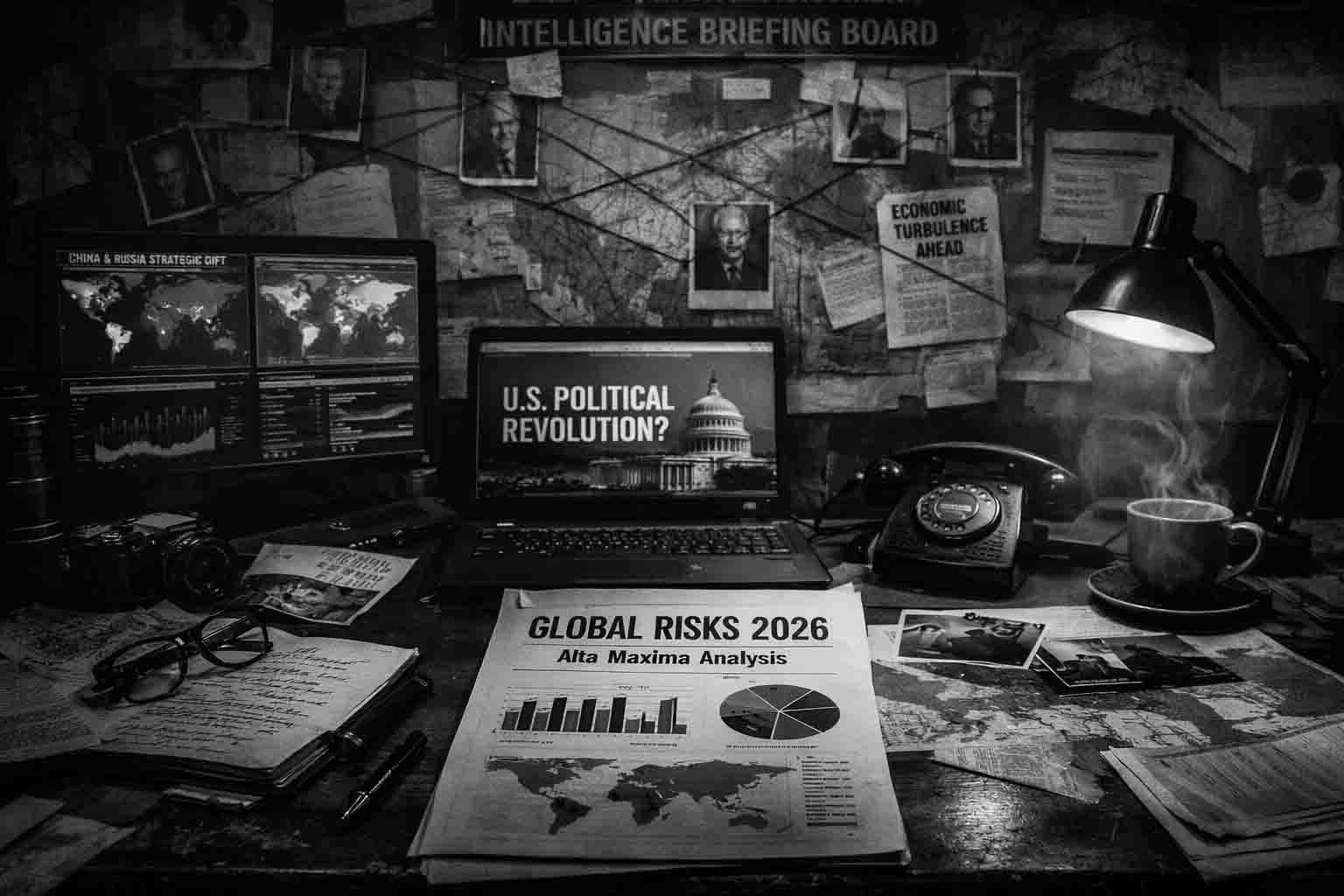
Global Risks 2026: A Quantitative Map of the World Order Breakpoint and the Alta Maxima Method for Monitoring and Forecasting
The January 2026 reviews from Eurasia Group, World Economic Forum, Lazard, Deutsche Bank Research, Geopolitical Futures, and EY converge on one core conclusion: 2026 is no longer merely a year of isolated “crises” but the period when a new infrastructure of global pressure solidifies. The decisive factors are no longer limited to military episodes; they increasingly include institutional mechanics, trade-technological restrictions, capital controls, regulatory barriers, and algorithmic environments. This infrastructure operates as an impulse transmission system: a local decision in one node triggers cascading effects across others, with the impact amplified precisely because the global economy and politics are bound by dense chains of interdependence. In such a world, analytical error is measured not by failing to predict a specific event, but by misjudging the transmission channel of risk — the pathway through which an incident translates into broad economic and political consequences.
The sharpest and most uncompromising formulation of 2026 comes from Eurasia Group’s “The Top Risks of 2026” (released January 5, 2026). Ranked as Risk #1 is “US political revolution” — Donald Trump’s attempt to dismantle checks on executive power, capture the machinery of government, and weaponize it against domestic opponents, making the United States the primary source of global risk in 2026. Crucially, this is not framed as an isolated domestic issue but as the projection of internal institutional restructuring onto the global stage through the instruments available to the American state (sanctions, export controls, tariffs, regulatory pressure, alliance reconfiguration). For analysis, this signals a fundamental shift: from the model of “foreign policy as an extension of national strategy” to “foreign policy as an extension of domestic political dynamics,” where decisions accelerate, become more discrete and abrupt. In mathematical terms — increased variance in political decisions: greater amplitude of swings, higher frequency of impulses, lower predictability.
The World Economic Forum in its “Global Risks Report 2026” (published mid-January 2026, based on the Global Risks Perception Survey of over 1,300 experts worldwide) confirms this picture quantitatively rather than rhetorically. The top “trigger” threat over the two-year horizon is geoeconomic confrontation, selected by 18% of respondents as the risk most likely to cause a material global crisis in 2026. By comparison, interstate armed conflict was chosen by 14%. These figures define the framework: in 2026, the world fears less a single explosive “big bang” war and more a systemic conflict channeled through economy, technology, and trade — capable of unleashing global disruption without formal declarations of war. At the same time, WEF captures the consensus of expectations: 50% of surveyed leaders and experts anticipate a “turbulent or stormy” trajectory over the next two years, rising to 57% on the ten-year horizon. This is not poetic imagery but a measured indicator of collective perception: the median future outlook has become “stormy,” influencing state and corporate behavior in a manner analogous to how interest-rate expectations shape investment decisions.
This yields a central methodological conclusion for the Alta Maxima approach: when geoeconomics emerges as the leading crisis trigger, purely event-based monitoring (tracking isolated incidents) is insufficient. What is required is monitoring of the politico-economic mechanisms that provide leverage and multiplicative amplification. Lazard in its “Top Geopolitical Trends in 2026” (January 12) articulates the same idea in applied terms: economic competition is increasingly morphing into policies of hard restriction. The report specifically highlights escalating EU–China tensions — extending beyond electric vehicles to wind and solar energy components and mature semiconductor nodes. This is a textbook description of transmission channels: market competition → regulatory decisions → supply-chain reconfiguration → price increases → employment and domestic political pressures. The logic is straightforward: when one pole generates excess supply and the other imposes political import barriers, equilibrium is restored not via market pricing but via politics. The market ceases to be the sole clearing mechanism.
Geopolitical Futures in its “2026 Forecast: Re-anchoring the World” (January 16) elevates the analysis further by introducing the concept of “re-anchoring.” According to their assessment, China has effectively supplanted Russia as the global counter-pole to the West, with U.S.–China relations becoming the defining axis of the emerging world order. In the medium term, the forecast allows for a possible “grand bargain” — not an alliance, but a pragmatic delineation of spheres of influence and stabilization through managed competition. For Alta Maxima, the value lies not in debating “replacement” but in registering the structural shift: if the 20th-century anchor was U.S.–USSR bipolarity, in 2026 it is U.S.–China bipolarity, with Russia reduced to a factor that amplifies instability without singly defining the global architecture. Practically, this means most major decisions in trade, technology, and standards will be evaluated through the lens of whether a given step enhances one pole’s autonomy and reduces dependence on the other.
Deutsche Bank Research in its “2026 Geopolitical Outlook” (early January) characterizes the environment as a regime of sustained volatility: 2026 will be as geopolitically unpredictable as 2025, and investors should brace for a continued fragmented setting. The strength of this perspective is its translation of geopolitics into capital-market language: entrenched uncertainty raises the cost of hedging, increases the premium on liquidity, and shortens average planning horizons. Political risk directly converts into monetary risk.
The macroeconomic baseline remains supportive. According to the IMF’s January 2026 update (reported by Reuters on January 19), global GDP growth is projected at 3.3% for 2026, with the U.S. at 2.4%, China at 4.5%, and global inflation on a downward path (from 4.1% in 2025 toward 3.4% by 2027). These figures serve as the “zero line”: amid moderate baseline growth and disinflation, risks nonetheless dominate elite perceptions. The source of fear is therefore not inevitable recession but political and geoeconomic discreteness — the capacity for abrupt negative deviations. Outcome distributions become “fat-tailed”: the probability of rare but severe downside scenarios rises.
The Alta Maxima Method: From Event Model to Mechanism Model
We propose interpreting 2026 as the transition from an “event model” (risk = probability of a discrete episode) to a “mechanism model” (risk = capacity of an episode to ignite a cascade via pre-existing channels). The object of analysis is precisely the transmission channels of risk: institutional, trade-technological, financial, infrastructural, informational. When a channel is active and loaded, even a medium-intensity episode can produce outsized effects.
- Institutional channel — pivotal in 2026 because it alters decision speed and quality. Eurasia Group’s designation of the U.S. as the chief risk source warns that American tools (sanctions, export controls, tariffs, etc.) will be deployed more frequently, more sharply, and with less regard for long-term blowback, amplifying secondary effects: capital flight, risk repricing, contract ruptures, route shifts.
- Trade-technological channel — central, as it directly links politics to industry. Lazard points to the broadening EU–China conflict in wind, solar, and semiconductor sectors. Simple pressure mathematics: high import dependency in a critical chain + regulatory tightening → end-price inflation → political problem at scale. This is why geoeconomic confrontation leads WEF’s 2026 trigger list at 18%.
- Financial channel operates via risk premia and liquidity. Even with 3.3% baseline growth (IMF), the price of insurance against geopolitical tail risks continues to climb.
- Infrastructural channel (logistics, energy, digital backbone, rare earths, Arctic) turns geopolitics into tangible physical constraint.
- Informational channel in 2026 rivals trade and capital in importance, as it accelerates polarization and shapes institutional decision velocity.
Alta Maxima Early-Warning Indicator System
A practical tool — daily/weekly dashboards with verifiable indicators:
- Frequency, legal specificity, and parameters of U.S. tariff-regulatory signals (draft acts, timelines, exemptions).
- Dynamics of export controls and tech restrictions vis-à-vis China + Beijing’s countermeasures.
- Subsidy and industrial-policy decisions in the U.S. and EU that alter sectoral competition.
- Status of key logistical nodes and shifts in shipping insurance premia.
- Critical infrastructure incidents and official attributions.
- Signs of financial stress: rate of change in risk premia and expectations.
- Institutional changes in major states that rewrite rules (not just personnel).
- Synchronous informational surges across countries with aligned narratives.
Model Validation
The Alta Maxima framework is testable via observable traces:
- If Eurasia Group is correct → surge in frequency and scope of U.S. external-economic decisions altering market/technology access rules, plus reciprocal responses.
- If WEF is correct → broadening range of sectors subject to trade measures + rising “security” language in economic policy documents.
- If Geopolitical Futures is correct → growing share of decisions evaluated through the U.S.–China duality lens.
- If Deutsche Bank is correct → persistent uncertainty premium in investment strategies despite moderate macro baselines.
In 2026, victory belongs not to the loudest forecast but to the one that distinguishes signal from noise, measures risk via transmission channels, and updates assessments on data rather than sentiment. Alta Maxima achieves precisely this: it integrates quantitative consensus (WEF’s 18% and 14%, 50–57% stormy expectations, IMF’s 3.3% growth), links it to institutional momentum (Eurasia Group), specifies conflict domains (Lazard), and operationalizes everything into trackable indicators. This is applied mathematics of uncertainty management in geopolitics: capturing not only “what happened” but “which mechanism activated,” “which channel engaged,” “which variables shifted,” “what next step follows logically,” and “which threshold signals a scenario switch.”
Related Articles

Artificial Intelligence Enters a New Era
27 July 2026
Read more
Agentic AI: Why It Is Poised to Become the Defining Technology of the Coming Years
22 July 2026
Read more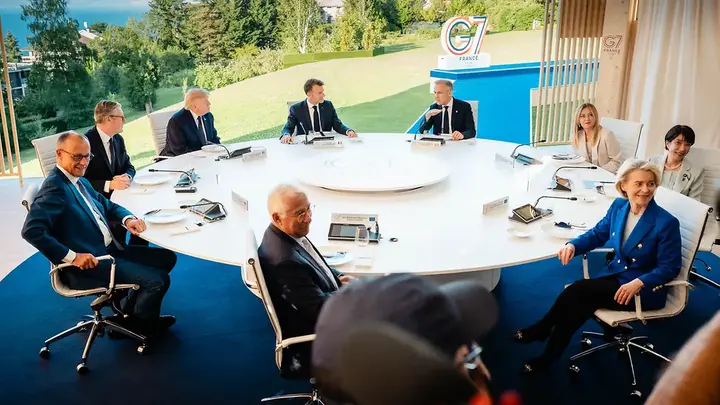
Саммит G7 во Франции: мировые лидеры перед лицом новой эпохи глобальных вызовов
17 June 2026
Read more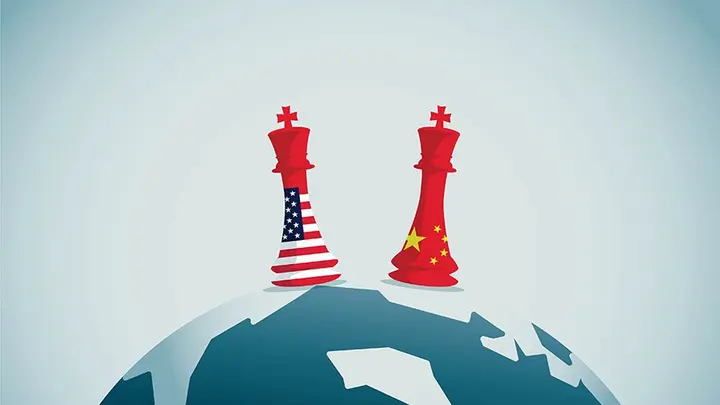
China Against the System: How Beijing Is Preparing for an Era of Great Global Confrontation
23 May 2026
Read more