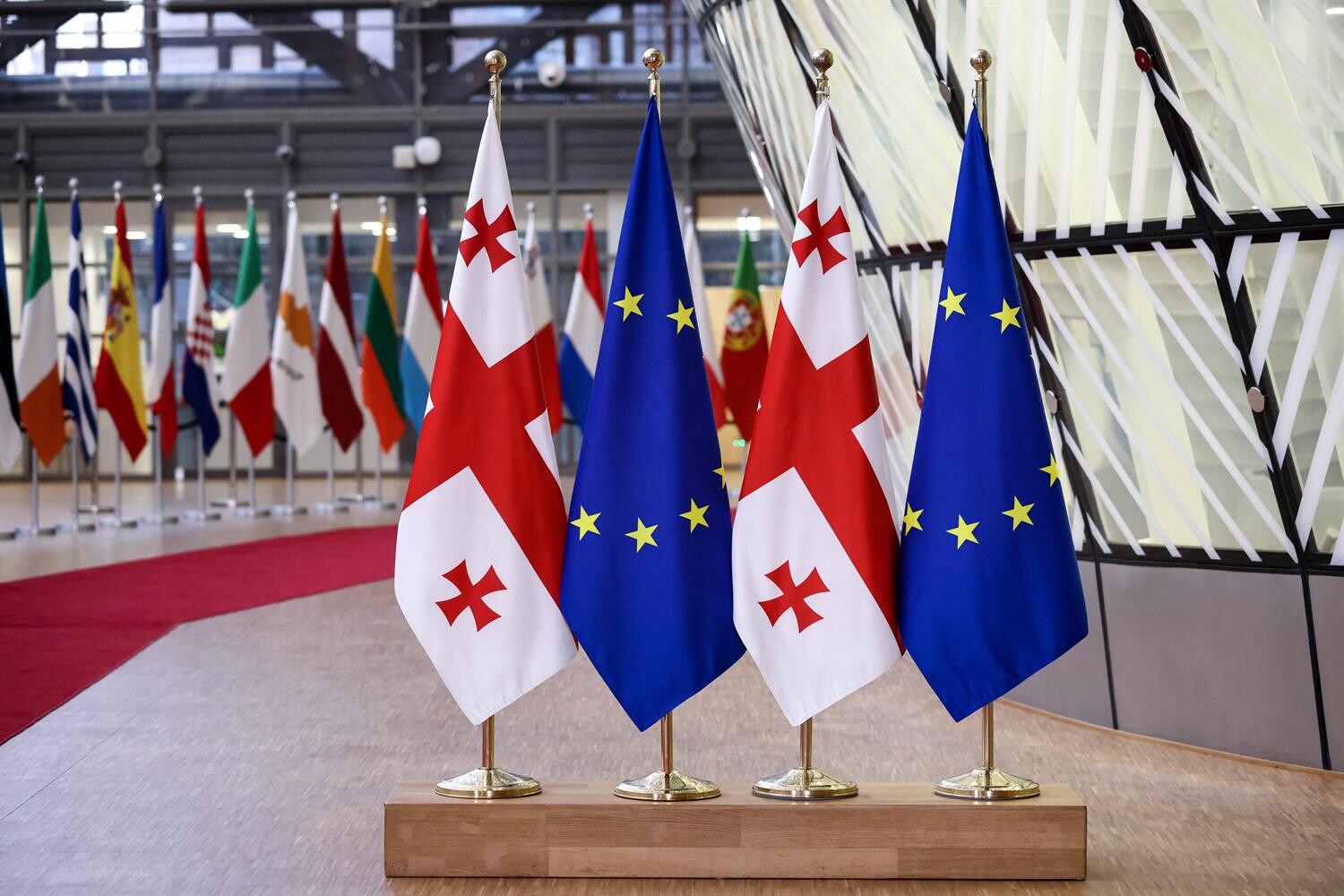
EU Triggers Visa Suspension Mechanism for Holders of Georgian Diplomatic Passports

In January 2026, the European Commission initiated a procedure that may lead to the suspension of visa free travel for holders of Georgia’s diplomatic, service, and official passports when travelling to the Schengen area. This is not a one off political statement and not a loose recommendation to individual capitals. It is a step taken under a revised EU wide suspension mechanism that is intended to be applied uniformly across the Union. That is why Brussels stresses the legal nature of the process, the sequence of steps, and the possibility of broader measures if the situation deteriorates further or if the Georgian authorities fail to address EU demands.
The formal starting point of this phase was a public confirmation by Commission spokesperson Markus Lammert at a briefing on January 21, 2026. He said the Commission is launching the process under the revised mechanism and that the first level concerns diplomatic, service, and official passports. The central message is that the measure is aimed not at ordinary citizens with regular biometric passports, but at a privileged category linked to state travel. Brussels is choosing a targeted pressure tool that is easier to justify politically and easier to administer, while keeping the option of further steps on the table.
To understand the scale, it is essential to separate two parallel layers. One layer is the general visa free regime for Georgian citizens holding ordinary biometric passports, which is not being cancelled at this stage. The other layer is the specific category of diplomatic and service documents, where the Commission has initiated a suspension track. Public explanations explicitly state that the current procedure is limited to that category. In practical terms, if the process is completed, holders of those passports would lose visa free entry on the previous terms and would have to go through visa formalities.
Brussels’ insistence on EU wide uniformity is directly linked to the reform of the suspension mechanism itself. In 2025, the EU updated the rules to react faster and more forcefully when visa free travel is seen as abused or as working against EU interests. The Council of the EU announced the final approval of the updated rules in November 2025, emphasizing quicker and stronger tools. Institutionally, this means the Commission has a clearer and more practical route to trigger such procedures.
A separate key point is the entry into force date of the revised mechanism. An EU Delegation in Georgia page summarizing the annual monitoring framework states that the revised suspension mechanism enters into force on December 30, 2025. That date helps explain why the Commission moved from warnings to formal action already in January 2026.
The design of the mechanism supports step by step pressure. In materials describing the revised framework and its potential application, a staged model is discussed, where the first step can be targeted at narrow categories of passports and travel, and broader measures remain possible if concerns persist. This staged architecture underpins the current EU approach toward Tbilisi, first diplomatic and service passports, then, if the situation remains unresolved, a broader debate on the overall regime. At the same time, explanatory analyses stress that any move to a wider level is not automatic and would require additional procedural steps, consultations, and political decisions.
On the justification, Brussels ties visa liberalization to a set of principles and criteria. In public comments attributed to the Commission, the linkage is framed around human rights, democracy, and the rule of law. The Commission position is described as the view that actions by Georgia’s authorities undermine the principles on which visa liberalization is based and do not align with EU norms and values. This matters because it shifts the issue from migration statistics to political compliance.
Alongside political language, there is a long running technical track in EU monitoring of visa free partners. Particular attention is paid to visa policy alignment with the EU, migration management, document security, and transit related risks. In that framework, Georgia is discussed in connection with continued divergence in visa policy alignment and concerns linked to migration risks. Brussels uses this to argue that visa free travel is not symbolic, but a conditional instrument tied to security and rules.
The Commission’s January 2026 move also fits into a longer chain of EU steps where Georgia’s diplomatic passports had been debated for some time. International reporting in late 2024 described EU foreign ministers agreeing on a direction toward suspending visa free travel for Georgian diplomatic passport holders amid political turmoil and a crackdown on protests, and in January 2025 the approval of such a suspension was reported. The January 2026 Commission action looks like a continuation of that line, now placed into a more forceful legal framework after the revised mechanism entered into force at the end of 2025.
For Tbilisi, the meaning is twofold. On one hand, targeting diplomatic and service passports is a status blow, because it sends a public signal directly to the state apparatus. On the other hand, Brussels is also making clear that this can be only the opening move if relations worsen and if EU recommendations are not met. In this construction, the diplomatic passport step functions as a high intensity warning, but not yet as a full rollback of travel freedoms for the broader population.
The next trajectory depends on legal procedure and political dynamics. Legally, the process must move through the established steps, consultations with EU member states, and subsequent decisions that make the measure effective within the common regime. Politically, it depends on how the Georgian authorities respond and whether the EU records progress or further regression in areas it considers foundational for visa liberalization. That is why Brussels uses wording that keeps the door open, while maintaining the threat of escalation as a real scenario.
The core conclusion at this stage is straightforward. The European Commission has moved from warning signals to a formal process, using the revised mechanism that entered into force on December 30, 2025. The first level concerns Georgia’s diplomatic, service, and official passports. For ordinary citizens with regular biometric passports, the regime remains in place at this stage. Yet the very launch of the procedure under the new EU legal framework turns the issue into concrete leverage, with the next step depending on political developments and on whether Brussels judges that the situation has improved.
Related Articles

Artificial Intelligence Enters a New Era
27 July 2026
Read more
Саммит G7 во Франции: мировые лидеры перед лицом новой эпохи глобальных вызовов
17 June 2026
Read more
The AI Tsunami: What Dario Amodei Warned About — And Why the Numbers Matter
26 February 2026
Read more
Iceland Reopens the EU Question: National Referendum on Restarting Accession Talks Scheduled for 2026
26 February 2026
Read more