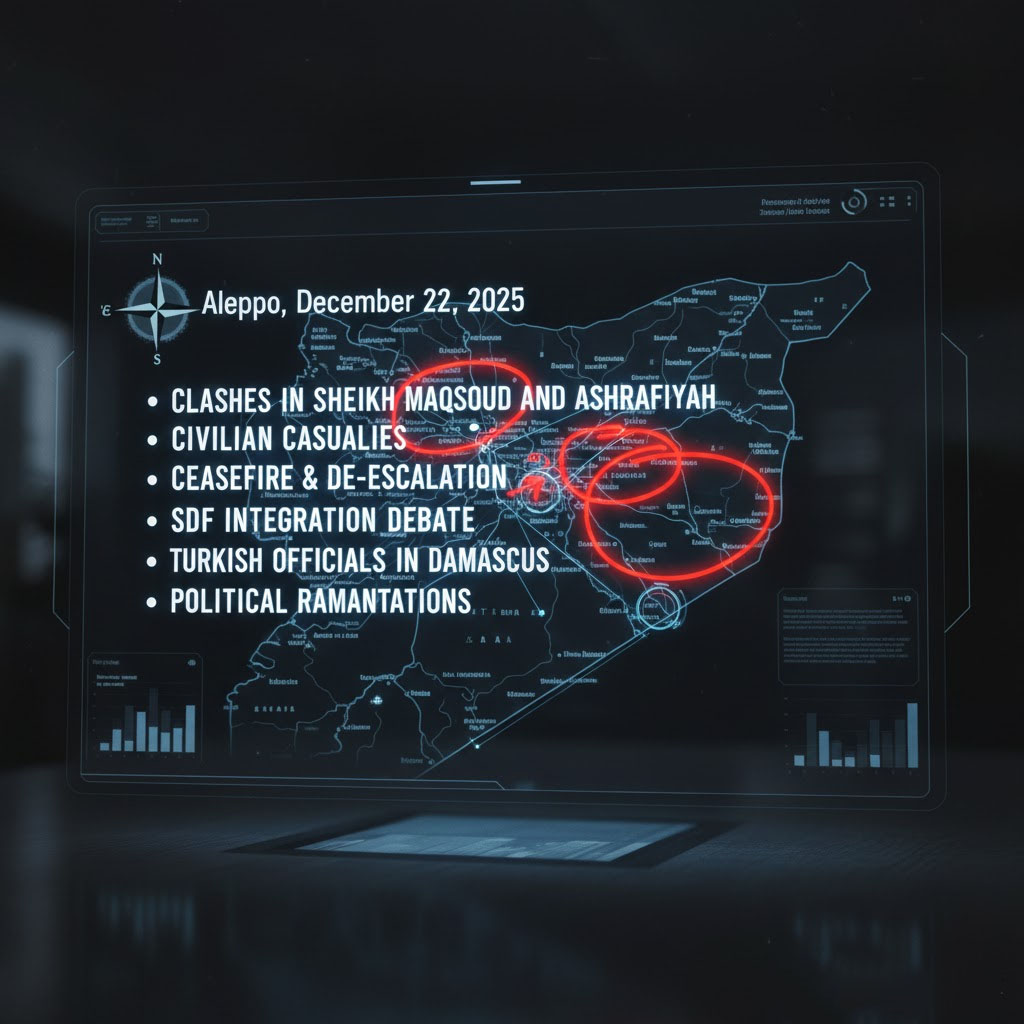
Aleppo: Clashes in Sheikh Maqsoud and Ashrafiyah
.png "Department of Strategic Monitoring")
Aleppo, December 22
Clashes in Sheikh Maqsoud and Ashrafiyah, civilian casualties, a ceasefire, and the wider debate over the future of the SDF
On Monday, December 22, 2025, security conditions in Aleppo sharply deteriorated. Fighting broke out in the northern neighborhoods of Sheikh Maqsoud and Ashrafiyah, areas that for years have remained sensitive because of local control arrangements and the presence of forces linked to the Syrian Democratic Forces (SDF) and their internal security component, Asayish. Reports during the day described mortar and artillery fire, the use of heavier weapons, wounded and killed civilians, and later a ceasefire and de-escalation efforts.
The flare-up in Aleppo unfolded against a broader political backdrop: ongoing talks about how (and whether) the SDF should be integrated into Syrian state structures, and a high-level visit to Damascus by senior Turkish officials. This timing gave the clashes not only a local dimension but also an explicitly political one, as different actors framed the events as evidence supporting their positions on northern Syria’s future and the mechanics of integrating Kurdish-led forces into a new security architecture.
What follows is a reconstruction based on international news agency reporting, monitoring resources, and two Telegram streams reflecting opposing narratives. Where accounts diverge or cannot be independently confirmed in open sources, that uncertainty is stated explicitly.
Geography of the clashes and key junctions
Reports repeatedly referenced the Al-Sheihan roundabout and the Al-Layramoun roundabout. These junctions matter for movement between industrial and residential zones; during spikes in violence, they often become choke points where road closures or sniper activity immediately affect civilian safety.
As fighting spread, warnings circulated urging civilians to avoid travel near these roundabouts, and there were claims of closures on routes linking Aleppo to Layramoun and other nearby areas. Monitoring sources also mentioned road disruptions and the closing of certain corridors that normally connect neighborhoods and suburbs. Some messages specifically advised residents to avoid routes toward the Handarat area because of danger and blocked access.
How the fighting began
Two opposing accounts of the initial trigger
Account promoted by SDF-linked sources and SDF press statements.
In this narrative, the trigger was an attack on an Asayish checkpoint near the Al-Sheihan roundabout. SDF-aligned outlets reported that two Asayish members were wounded, and they blamed “factions linked to the Damascus government’s Ministry of Defense.” They further claimed that, following this incident, the neighborhoods of Sheikh Maqsoud and Ashrafiyah came under heavy and medium-weapon fire, and that residents and internal security forces took measures to protect civilians.
Account promoted by an Arabic-language Telegram stream hostile to the SDF.
In that narrative, clashes broke out after “SDF militias” targeted a military checkpoint linked to the Ministry of Defense at the Al-Sheihan roundabout, after which fighting expanded around Sheikh Maqsoud and Ashrafiyah. The same stream posted warnings urging civilians not to pass through Al-Layramoun and Al-Sheihan and claimed that fire was directed toward civilian vehicles.
Both accounts overlap on the core point: the escalation began around the Al-Sheihan area and rapidly expanded into nearby neighborhoods.
Escalation and reports of heavier weapons
As the day progressed, reporting described mortar and artillery exchanges, as well as the use of heavy machine guns. International outlets stated that mortars and artillery were used in Sheikh Maqsoud and Ashrafiyah, and that each side blamed the other for starting the violence.
In the SDF-aligned Telegram stream, claims appeared that the opposing side was not limited to Damascus-linked formations; it also explicitly named HTS and, at times, Turkey-backed SNA units. The same stream described intensifying mortar and artillery fire and alleged that additional fighters were being moved toward the front lines.
It also carried claims that BMP-1 infantry fighting vehicles were brought into Aleppo, and later that tanks and Grad-type rockets were used against residential districts. These details reflect the version of SDF-oriented sources. Open-source independent confirmation of each such claim is uneven, so they should be treated as assertions recorded in those channels rather than as fully verified facts.
The Arabic-language stream emphasized the opposite allegation: it claimed that SDF forces were shelling residential areas and using heavy machine guns, and it highlighted the arrival of wounded persons to hospitals.
Snipers, blocked roads, and the pressure on civilian life
A notable feature of the day was sniper activity. The SDF-aligned stream claimed Asayish snipers were targeting HTS militants near Al-Sheihan. The Arabic-language stream reported injuries near Al-Sheihan and attributed sniper fire to SDF elements.
Regardless of attribution, sniper activity magnified the impact of closures and warnings to civilians. Even without a large-scale bombardment, the risk of movement through contested roundabouts can rise sharply, and the repeated warnings not to use those routes reflect the degree of danger perceived by sources on the ground.
Civilian casualties
What is known and why the numbers differ
Casualty reporting became one of the most contested elements. This is typical in urban fighting, where information evolves quickly and different sources track different categories of victims.
International outlets reported at least two civilians killed and several wounded, while other early reports spoke of at least one civilian killed, illustrating how initial figures can vary and be revised.
Monitoring sources reported wounded individuals arriving at Al-Razi Hospital, and in some accounts, members of civil defense services were among those injured.
The SDF-aligned Telegram stream described a rising number of wounded civilians through the evening, at one point claiming the total reached 12, including healthcare workers, and reporting damage to civilian homes.
The Arabic-language Telegram stream stated that five wounded arrived at Al-Razi Hospital, including two civil defense members, and it published names and injury descriptions for several individuals. Even where full verification is not possible, the presence of such medical-route details suggests that at least part of the information flow moved through identifiable clinical channels.
Taken together, the safest conclusion is that civilian casualties and injuries occurred and were widely reported. Discrepancies in totals likely reflect timing, methodology (severe injuries vs. all treated cases), and the competing narratives of the parties involved.
Impact on the city
Calls to suspend gatherings and disruptions to daily life
The violence affected daily life in Aleppo. Reuters reported that authorities suspended school and government office work in parts of the city center as a precaution during the escalation.
The Arabic-language stream also circulated a statement attributed to Aleppo’s governor urging civilians, particularly members of the Christian community near the clash areas, to temporarily stop gatherings and celebrations for safety reasons. Even if every wording detail is not independently confirmed, the appearance of such messages aligns with the pattern of risk mitigation during periods of indiscriminate fire or uncertain front lines.
Claims of captives and arrests
Items that became part of the narrative but require verification
The SDF-aligned stream claimed that Asayish forces captured eight HTS militants and two vehicles, and that additional arrests involved individuals described as SNA members, with a running total mentioned later. These claims are significant as part of the information environment, but open-source independent confirmation was limited in the materials available at the time the messages circulated.
Drones and strikes on residential homes
One of the most inflammatory claims in the SDF-aligned stream was that SNA units used kamikaze drones allegedly provided by Turkey and that civilian homes were damaged. Alongside this were repeated messages about property damage and civilians fleeing their houses.
Because independent confirmation of drone use in this specific episode is not consistently available in open reporting, the neutral way to present this is to note that such claims were made and that they intensified public concern, without presenting them as established facts absent corroboration.
Ceasefire and de-escalation
By late evening, reports indicated a ceasefire or at least a significant reduction in fighting. Reuters reported that Syrian authorities and the SDF agreed on de-escalation, after which Syria’s defense ministry ordered a halt to strikes on SDF positions, and the SDF stated it would stop responding.
The Arabic-language stream also posted that a truce had been agreed in Sheikh Maqsoud and Ashrafiyah. SDF-aligned messages, for their part, described calmer conditions and suggested that opposing forces had pulled back from immediate contact lines.
Overall, both streams converged on the practical outcome: fighting decreased, and “truce/ceasefire” language entered the public narrative during the night leading into December 23.
Political backdrop
SDF integration debates and the Turkish delegation’s Damascus visit
The Aleppo clashes occurred amid broader negotiations and pressure regarding the future of the SDF. Associated Press reported that the violence erupted as a deadline approached linked to the integration of SDF forces into a restructured Syrian army under earlier arrangements. Reuters reported that Turkey criticized the pace of integration and warned about the consequences of insufficient progress.
On the same day, a high-level Turkish delegation arrived in Damascus led by Foreign Minister Hakan Fidan, accompanied by the defense minister and the intelligence chief. Talks reportedly focused on security issues and the SDF file. Turkey has long viewed the SDF as connected to the PKK and opposes any arrangement that preserves the SDF as an autonomous, unified force inside Syria.
SDF-aligned Telegram commentary asserted that the escalation was “not a coincidence” and linked it politically to the Turkish visit. That is an interpretation rather than a verified causal claim, but its prominence illustrates how quickly localized clashes become intertwined with regional diplomacy and mutual suspicion.
What can be stated with high confidence
Across the source set, several points can be stated with relatively high confidence:
- Clashes took place in Aleppo on December 22, concentrated around Sheikh Maqsoud and Ashrafiyah, with fighting referenced around the Al-Sheihan and Al-Layramoun junctions.
- Mortar and artillery fire was reported, and the escalation lasted at least into the evening hours.
- Civilian casualties and injuries were reported by multiple categories of sources, though totals vary.
- A ceasefire or de-escalation arrangement was reported late in the day, and fighting decreased.
- The episode occurred amid a sensitive political process regarding SDF integration and amid Turkish diplomatic engagement in Damascus.
Conclusion
The December 22 escalation in Aleppo shows how a localized incident at a checkpoint can rapidly turn into heavier urban fighting in densely populated neighborhoods. Competing narratives, reports of civilian harm, and the later ceasefire underscore both the fragility of security arrangements in the city and the continued existence of channels that can halt fighting when escalation costs rise.
At the same time, the timing of the violence—amid the debate over the SDF’s future and the mechanics of integration into Syrian state structures—means the Aleppo incident quickly acquired broader political significance. That combination increases the risk of renewed flare-ups if negotiations stall or if the parties seek leverage on the ground.
Links (all URLs listed below, none in the article body)
Reuters (22 Dec 2025) Syrian government and SDF agree to de-escalate after Aleppo violence
https://www.reuters.com/world/middle-east/least-two-civilians-killed-aleppo-violence-syrian-government-sdf-trade-blame-2025-12-22/

Reuters (22 Dec 2025) High-level Turkish team to visit Damascus on Monday for talks on SDF integration
https://www.reuters.com/world/middle-east/high-level-turkish-team-visit-damascus-monday-talks-sdf-integration-2025-12-22/

Reuters (18 Dec 2025) Exclusive: Syria, Kurdish forces race to save integration deal ahead of deadline
https://www.reuters.com/world/middle-east/syria-kurdish-forces-race-save-integration-deal-ahead-deadline-2025-12-18/

AP (22 Dec 2025) Clashes flare as top Turkish officials visit Syria ahead of a deadline for Kurdish integration
https://apnews.com/article/9e87114f4c829064396e180f17c64af4

SOHR (22 Dec 2025) Military escalation: Mortar and heavy shelling hit Sheikh Maqsoud and Al-Ashrafieh in Aleppo
https://www.syriahr.com/en/375272/

SOHR (22 Dec 2025) Total reaches 16: Nine civilians including a child injured...
https://www.syriahr.com/en/375274/

SOHR (22 Dec 2025) Casualty rises to 23: ... ongoing shelling in Al-Sheikh Maqsoud and Al-Ashrafiyah
https://www.syriahr.com/en/375281/

Al Jazeera (22 Dec 2025) Clashes between Syrian army, Kurdish-led SDF break out in Aleppo
https://www.aljazeera.com/news/2025/12/22/clashes-between-syrian-army-kurdish-led-sdf-break-out-in-aleppo

The National (22 Dec 2025) Syrian government warns SDF against delaying Kurdish integration deal
https://www.thenationalnews.com/news/mena/2025/12/22/syrian-government-warns-sdf-against-delaying-kurdish-integration-deal/
Related Articles
Cyprus Defence Ministry Responds to Reports of Turkish Air-Defence Expansion in the North
31 January 2026
Read more
Istanbul Sets the Line: Türkiye and Iran Define the Limits of Escalation Amid Rising Regional Tensions
30 January 2026
Read more
The Aegean Sea as a Zone of Managed Pressure. Turkey’s Rising Activity and Greece’s Strategic Response
24 January 2026
Read more
Northern Cyprus as a Zone of De Facto Integration
24 January 2026
Read more